Biography
Ezequiel Moreno y Díaz
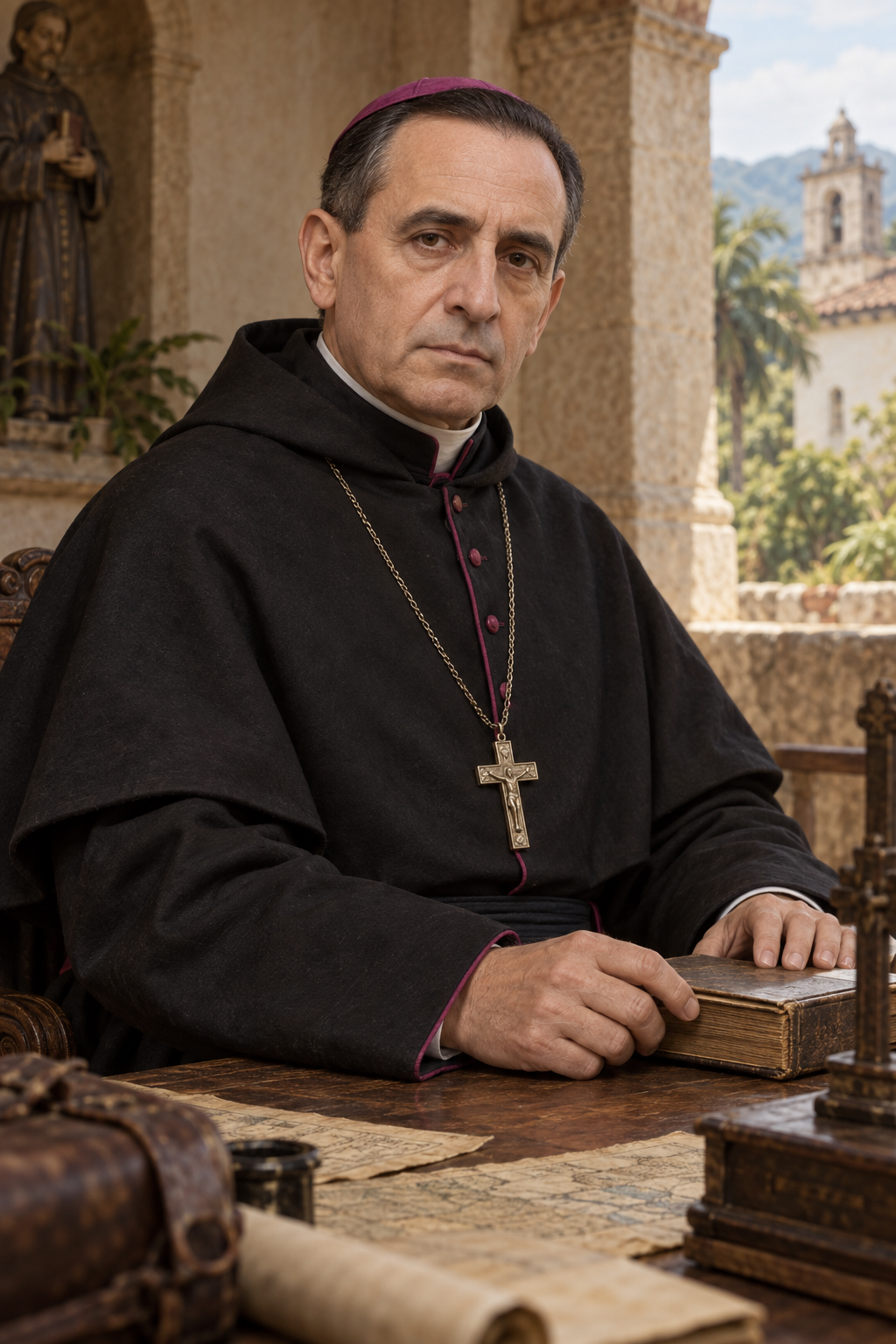
About Ezequiel Moreno y Díaz
Ezequiel Moreno y Díaz was born at Alfaro, La Rioja, Spain, on April 9, 1848. The catalog stores that birthplace and full date, and this draft preserves both.
His vocation led him into the Augustinian Recollect family. The catalog classifies him as `Bishop` and `Monk / Nun`, a shorthand that preserves both his episcopal office and religious identity.
The biography should explain that religious identity in plain language. He was not merely a bishop in formal dress; he was a Recollect religious formed by a particular Augustinian tradition.
His early ministry took him beyond Spain. The Vatican biography connects him with missionary service in the Philippines and Colombia, a wide field of work that should be summarized carefully.
The page should avoid making travel itself the point. Movement across continents matters because it placed Ezequiel in different pastoral and cultural settings, not because distance alone makes sanctity.
He eventually became Bishop of Pasto. That episcopal service brought him into a complex public world where religious leadership, social conflict, and political questions overlapped.
This is a place for restraint. Sources remember his strong Catholic convictions, but the page should not become polemic or propaganda.
The article can state that he was a missionary bishop known for firm defense of the faith as he understood it. It should avoid turning opponents into villains or importing modern partisan categories.
The Agustinos source helps identify the order-family memory of him as San Ezequiel Moreno.
That source should be used for religious identity and public memory, while the official Vatican and Dicastery sources anchor the structured facts.
Ezequiel's ministry included hardship, illness, travel, governance, preaching, and pastoral responsibility. These are enough to carry the narrative without inventing dramatic scenes.
The generated portrait reflects this restraint: a Recollect bishop in sober black religious dress with pectoral cross, book, and mission papers, not a political banner or militant tableau.
The page should also mention illness and final return to Spain without overplaying suffering. His death was not simply an ending but part of the public memory preserved by his order and by the Church.
The catalog stores his death place as the Augustinian Recollect convent, Monteagudo, Navarra. This draft preserves that precise field.
He died on August 19, 1906, and the Roman Catholic feast day is stored as August 19. The Dicastery profile supports the date and public recognition.
Ezequiel was beatified by Paul VI in 1975 and canonized by John Paul II on October 11, 1992, in Santo Domingo.
The canonization setting should be named briefly. It gives official Catholic context, but it should not crowd out the lived story of Recollect formation, missionary service, and episcopal care.
Because Ezequiel's memory can be politically charged, the page should keep its tone calm. It can name conviction without adopting slogans.
It can also acknowledge that the historical setting was contentious. A careful biography does not need to smooth conflict away, but it should not intensify it for effect.
His enduring significance is best presented as steadfast religious and pastoral service across changing places: Spain, the Philippines, Colombia, Pasto, and Monteagudo.
The final page should leave readers with a serious Augustinian Recollect bishop and missionary, rooted in prayer and office, carrying responsibility under pressure.
That pressure included illness, distance from home, and the strain of leading a diocese in a divided public environment. The page should name those pressures without turning them into melodrama. They help explain why his memory is tied to endurance as much as to office.
The biography should also keep his missionary geography organized. Spain marks his birth and death context, the Philippines and Colombia mark major fields of service, Pasto marks episcopal responsibility, and Monteagudo marks his final illness and death. Listing those places carelessly would feel like a travelogue; connecting them to vocation makes the narrative coherent.
Because his reputation can be used polemically, the final packet should be especially careful with adjectives. "Firm," "controversial," and "pastoral" may all be true in context, but none should become a substitute for evidence. The slow-vetted page should prefer documented actions and roles over labels.
The profile can still be humane. Ezequiel was not only an officeholder or a symbol in later arguments; he was a religious formed in community, a missionary sent to difficult places, a bishop burdened with governance, and a sick man who returned to a Recollect convent before death.
That complete frame lets readers understand why the Church remembers him without requiring the article to decide every historical controversy. It keeps the saint page focused on vocation, service, and recognized sanctity.
Artwork should avoid flags, party imagery, battlefield cues, readable text, halo, and exact-likeness claims. It should show bishop and religious without turning his memory into political theater.
The badge crop should keep his face, pectoral cross, black Recollect/episcopal dress, book, and mission setting readable at target size.
Wondering how to weigh the stories and sources? Learn how to read a saint biography.