Biography
Martin of Tours
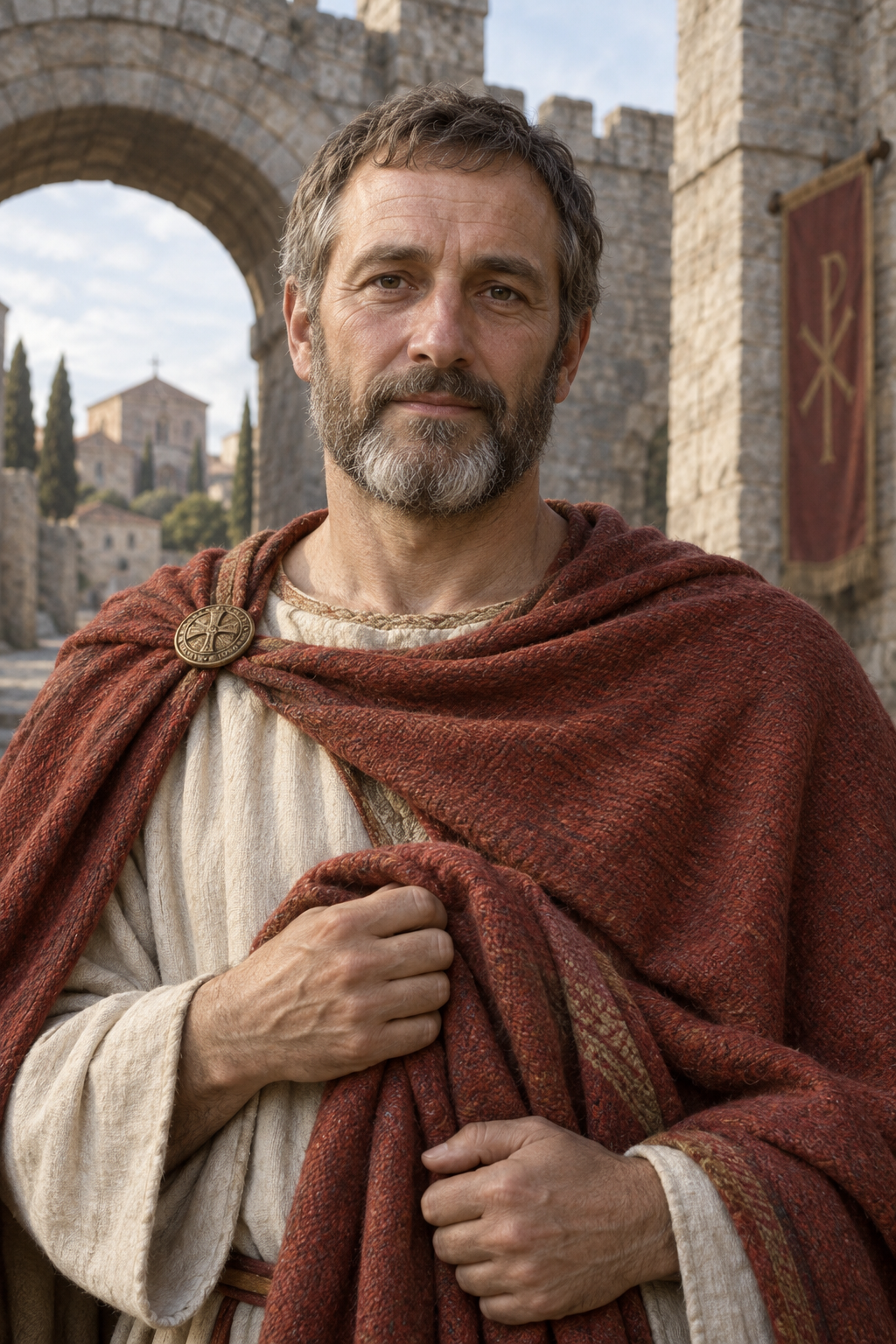
About Martin of Tours
Martin of Tours moved from the Roman army into a life of monastic prayer and responsibility for a Christian community. His early religious formation did not begin with ordination: he sought baptism while still connected with military service. After leaving the army, he went to Poitiers, where the bishop Hilary became an important guide. The life he chose joined withdrawal for prayer to service among other people. As bishop, he would devote attention both to teaching the clergy and to bringing Christianity into the countryside, rather than confining his work to the city where he held office.
His birthplace was Sabaria in Roman Pannonia, in present-day Hungary. The chronology of his youth remains disputed: the basilica at Tours gives 316 and also acknowledges 336 as a possible birth year. His later association with France should not turn his childhood into the story of a modern French national. The empire through which he traveled crossed boundaries that belong to today's different countries.
His best-known act appears in the Life written by Sulpicius Severus. At Amiens, Martin encountered a poorly clothed man in winter, cut his own cloak in two, and gave him half. Sulpicius then tells of a dream in which Christ wore the donated cloth. The dream expresses the story's Christian interpretation of serving Christ in a person in need; it is a reported vision, not an independently verified event.
The abbey at Ligugé dates Martin's settlement there to 361. Hilary provided the place, a partly ruined Gallo-Roman religious site near Poitiers. Martin's monastic beginning therefore reused an existing landscape rather than starting with the buildings visitors see today. He remained associated with Ligugé before becoming bishop of Tours about ten years later. The abbey's own history distinguishes that early foundation from subsequent periods of rebuilding and interruption; the later Benedictine community should not be projected unchanged into Martin's fourth-century household.
At Tours he continued to live with monks. Sulpicius describes wooden cells and caves, common ownership, shared meals, and younger members copying books. Some members had left privileged backgrounds for this discipline. The same author also describes Martin destroying pagan temples and challenging villagers' sacred practices. His mission could involve direct conflict with other communities' worship, not only persuasion or assistance to the poor. Sulpicius celebrates these confrontations as religious victories, a viewpoint that should not erase what the shrines meant to their worshippers.
Marmoutier, his settlement outside Tours, lay between the limestone hillside and the Loire. Archaeologist Elisabeth Lorans cautions against taking the biographer's description of a wilderness literally. Excavation has found earlier Roman occupation, including well-built masonry, painted walls, and concrete floors, although the buildings' purpose remains uncertain. A wooden bridge probably linked the two riverbanks during late antiquity. Martin and his companions occupied a place with a past and connections to the surrounding landscape. The narrow space between hillside and river may explain the difficult approach more directly than an image of complete separation from human settlement.
Excavation also indicates continuing occupation from antiquity into the early Middle Ages, although how the property entered church ownership remains unknown.
His episcopal responsibilities also brought him into conflict with fellow bishops over punishment. In the Sacred History, Sulpicius recounts proceedings against Priscillian and his associates before the emperor Maximus. Martin pressed the accuser Ithacius to stop the prosecution and urged the emperor not to execute them. He accepted exclusion from the church as a response to condemned teaching, but opposed handing an ecclesiastical dispute to a secular ruler for a death sentence. His intervention was therefore not an endorsement of Priscillian's beliefs or a declaration of modern religious freedom. It was a concrete effort to prevent bloodshed. The effort ultimately failed: Priscillian and several others were executed, and the controversy continued to divide Christians.
Near the end of his life, Martin traveled to Candes because the local clergy were quarreling. Sulpicius's letter to Bassula reports that he restored peace, then became too ill to return to his monastery. His companions were distressed about losing him. The letter presents Martin as willing to continue serving if he was still needed, while entrusting the outcome to God. Sulpicius was not himself an eyewitness at the deathbed, and the words he records come through that account. The episode nevertheless places an ordinary pastoral duty, reconciling a divided community, at the center of Martin's final journey.
Martin died at Candes on November 8, 397, and was buried at Tours three days later. His grave became the focus of a developing shrine: a small chapel was followed by a larger basilica. The surviving church at Tours is a later rebuilding, not the building in which Martin served. Its crypt preserves the place associated with his burial, while the November feast remembers a bishop whose reputation outlasted both the Roman political world and successive changes to the shrine.
Wondering how to weigh the stories and sources? Learn how to read a saint biography.
Explore similar vocations
Prayers for Martin of Tours
Martin: Common Worship collect excerpt
give us grace to follow him in his love and compassion for the needy