Biography
Meinhard
About Meinhard
Meinhard was a canon of the Augustinian house at Segeberg in northern Germany before he became a missionary in Livonia. His year of birth is uncertain. One church account places it in the middle 1130s, while the *Neue Deutsche Biographie* allows a wider estimate around 1130 or 1140. Neither account securely identifies his birthplace. The historical setting of his later work is clearer: German merchants traveled the Baltic waterways, and Livonian communities lived along the lower Daugava River in a region connected politically with Polotsk. Meinhard entered that world as a cleric attached to movement across the sea and river, not as the founder of an empty frontier.
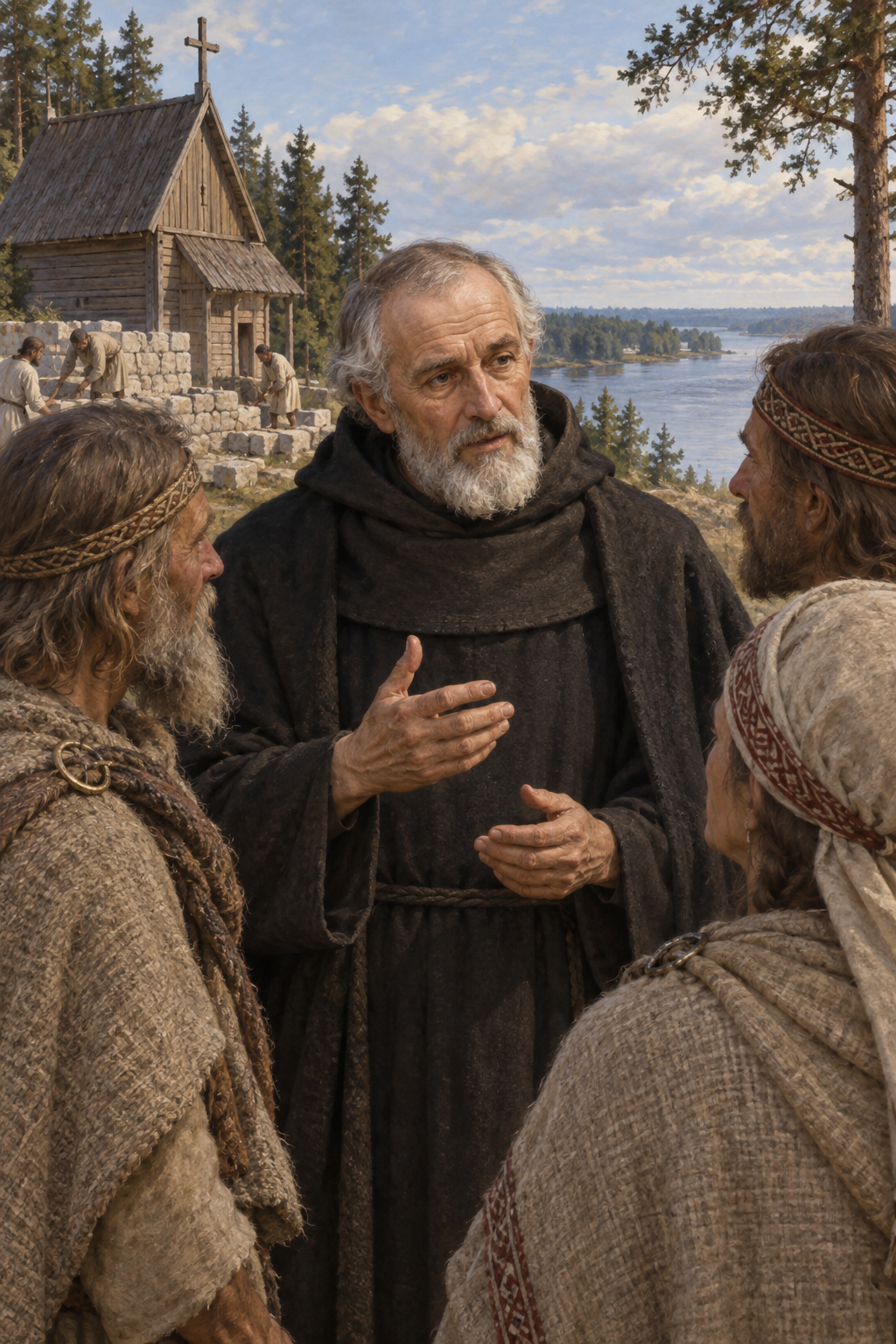
Around 1184 he left Segeberg and settled at Üxküll, today's Ikšķile. Manfred Hellmann's historical account says he obtained the consent of Vladimir of Polotsk, the overlord to whom the Livonians paid tribute. Meinhard preached among local people and built a wooden church. The location became a base for meetings, worship and a developing mission. The surviving record chiefly comes through Latin Christian writers, so their description of acceptance or resistance does not give direct access to Livonian voices. It does show that particular elders were baptized early and that Meinhard's work depended on relationships with local leaders as well as with political authorities.
The church building was followed by stone construction. Ikšķile's parish history describes a first wooden church around 1184 and a stone church and castle in the following years. These structures had several purposes: they marked a place of worship, made a lasting institutional claim and offered refuge amid regional conflict. Meinhard's work cannot be understood solely as preaching detached from buildings and security. The wooden and stone phases are reported with slightly different dates in the surviving accounts, so no precise day or single construction campaign can be assigned to them. What is secure is the shift from a small mission station to a fortified and visible Christian presence by the middle 1180s.
The fortifications also complicate a simple story of voluntary conversion. A scholarly study of Livonian castles reports the chronicler's account of a bargain: Meinhard would arrange defensive construction and local people would accept baptism. The same study notes that the dating and workmanship of the earliest stone buildings have been debated by archaeologists. An offer made amid threats of violence and linked to a new religious commitment involved real local choices, but also unequal bargaining and outside power. The stonework associated with the mission should therefore be read alongside the vulnerability of the communities it was meant to shelter, rather than as uncomplicated proof of religious agreement.
In 1186 Archbishop Hartwig of Bremen consecrated Meinhard as bishop. The Latvian Catholic Church's historical overview identifies Ikšķile as the center of the new bishopric. Two years later Pope Clement III confirmed the episcopal arrangement. This placed Meinhard's mission within an ecclesiastical structure that reached far beyond the Daugava, while its day-to-day work still depended on a small local network. Clergy and helpers joined him, and the bishop had to seek material support as well as pastoral collaborators. The titles bishop and first apostle of Latvia are later ways of locating him in church history; the people among whom he worked were Livonians, not citizens of a modern Latvian state.
Meinhard's mission did not develop without opposition or setbacks. The *Neue Deutsche Biographie* describes mixed responses to baptism, insecurity around the fortifications, and requests for further assistance. Its account includes a famine in which Meinhard provided aid. The evidence for these episodes is filtered through medieval Christian narrative, especially Henry's Chronicle of Livonia. Historian Linda Kaljundi notes that Henry wrote a mission-centered story shaped by biblical language and the later crusading project. Such a source remains indispensable, yet its spiritual interpretation should not be mistaken for a full account of Livonian motives. Meinhard's life is therefore visible in actions and institutions more clearly than in the feelings ascribed to him or his neighbors.
He died at Üxküll in 1196 and was buried there. Sources disagree about the day: the Dicastery's account calls 11 October most likely while acknowledging alternatives, and Hellmann favors 14 August. The 11 October memorial cannot settle the historical question. Later, his remains were moved to Riga Cathedral, where the remembered first bishop of Livonia became part of the city's sacred landscape. A Latvian government historical overview also distinguishes Meinhard's mission from the military conquests that followed under later bishops. Those later campaigns belong to the history of the region, but they should not simply be projected backward onto every action of the earlier missionary.
Medieval veneration of Meinhard preceded modern papal recognition. On 8 September 1993, during a visit to Riga soon after Latvia regained independence, John Paul II confirmed what he called Meinhard's centuries-old cult. The Dicastery records the same date as a canonization and lists his memorial on 11 October. The pope's own remarks describe the event as the recognition of an existing tradition, not the first appearance of devotion to him. These distinctions matter because a dated modern act should not erase the long, uneven history between Meinhard's death and the twentieth century.
At the Riga Mass that day, John Paul II recalled Meinhard as the first bishop of Livonia and connected his memory with the Latvian church's renewal after Soviet persecution. This was a theological interpretation spoken to a contemporary congregation. Historically, Meinhard's work began through travel, consent from an overlord, dealings with Livonian elders, construction, baptisms and a small episcopal institution. Its surviving accounts preserve both aspiration and tension. Remembering him carefully means recognizing the church community that grew from his mission while leaving room for the Livonians whose own testimony the written record rarely preserves.
Wondering how to weigh the stories and sources? Learn how to read a saint biography.