Biography
Giustino de Jacobis
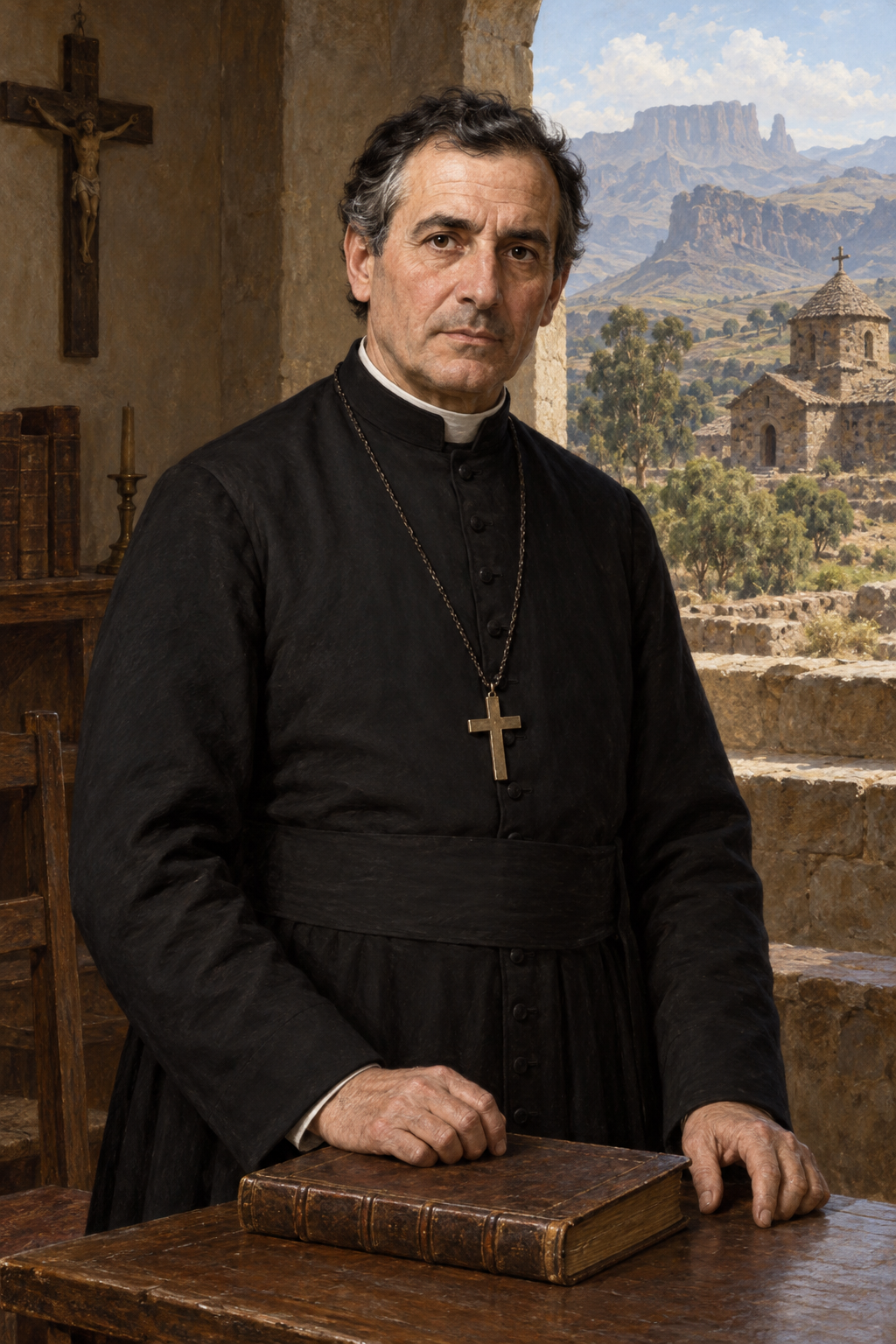
About Giustino de Jacobis
Giustino de Jacobis was born at San Fele in southern Italy on 9 October 1800. His family later moved to Naples, where he encountered the Congregation of the Mission, whose members are often called Vincentians. He entered their community as a young man and prepared for priestly service. The dated birth in the 1939 beatification act is stronger evidence than a later church account's conflicting day.
After further study in southern Italy, de Jacobis was ordained in Brindisi on 18 June 1824. His early ministry took place in Italian communities, including Naples. When cholera struck that city in the 1830s, he joined work among people affected by the epidemic. That experience preceded his appointment to the mission in the Horn of Africa.
In 1839 the Catholic mission authority appointed him apostolic prefect for Abyssinia, a historical term covering lands now divided between Ethiopia and Eritrea. He reached Adwa that October. He entered a region with an ancient Christian tradition and established clergy, not an unchurched landscape. The Catholic mission would have to relate to local worship, language and political authority.
The Eastern Churches account describes de Jacobis's attention to Ethiopian Christian practice. He accepted the Ethiopian rite rather than insisting that Catholic communities copy Latin worship. This was a concrete choice about language and ritual, though it did not erase confessional differences or the unequal power that accompanied European missions.
The 2010 Congregation for the Eastern Churches account notes his attention to Geʽez, the liturgical language, and to local usages. It also records a Christian teaching text in Amharic. These decisions made religious instruction and worship more closely connected with the linguistic world of the people he served. They should be credited alongside the work of Ethiopian clergy and teachers who knew those traditions firsthand.
The mission involved relationships with Ethiopian Christians whose views differed from those of Rome. The 1939 beatification record names Gebre Michael, an Ethiopian monk, among people associated with de Jacobis's mission. His story later became part of the mission's memory, but he was a person with his own learning and decisions, not simply an extension of the European bishop's work.
De Jacobis helped form local clergy and established a seminary. The surviving accounts differ on exactly when the seminary began, so the date is left open here. Its purpose is clearer: leadership of the Catholic communities should not remain entirely with foreign missionaries. Paul VI emphasized this commitment at the 1975 canonization, viewing it as a lasting part of de Jacobis's work.
His role changed as the mission developed. In January 1849 he was consecrated bishop while persecution had driven him toward the coast. The new office brought ecclesiastical authority but also made him more visible in disputes over the mission's place in the region. Treccani's older account gives a different exact day for the consecration, so the month is the sounder level of precision here.
The communities he served lay across a region of changing rulers and contested religious loyalties. Hastings says relations with some Ethiopian authorities worsened after a new patriarch arrived in 1855. De Jacobis was arrested, and his later activity was restricted. It would be misleading to reduce these tensions to a simple tale of one-sided persecution: church allegiance and regional politics were entangled.
An older Treccani account traces his detention at Gondar and later movement back toward the coast. It places his death at Eidale in the Alighede Valley on 31 July 1860. The location belonged to the world then called Abyssinia; Vatican News places Eidale in present-day Eritrea. Keeping those labels separate avoids treating a nineteenth- century church jurisdiction as a modern state boundary.
The Eastern Churches account says that he was buried at Hebo. A 2010 visit by Cardinal Leonardo Sandri to the shrine there shows the continuing place of his memory in Eritrean Catholic life. The same account describes a local Geʽez observance on 25 June.
Hastings argues that local clergy helped the Catholic communities survive after de Jacobis's final years of confinement. Some of those priests were married, in keeping with Eastern Christian practice. Their continued work is part of the historical result of his mission; the story cannot end with the Italian bishop alone. This perspective also keeps Ethiopian agency visible in accounts of the church's growth.
The Catholic Church beatified de Jacobis in 1939. The official apostolic letter is dated 25 June; later summary pages sometimes give 25 July, which the primary act does not support. Pius XII's letter reflects the Church's formal judgment of his life, while its devotional episodes require historical care.
Paul VI canonized him on 26 October 1975. In his homily he highlighted the formation of local priests and respect for existing Ethiopian Christian practices. Those are retrospective church assessments, but they draw attention to concrete choices in de Jacobis's ministry. The ecclesiastical record also preserves the tension and suffering that accompanied his later years.
Today his memory is kept on different dates in different Catholic settings. The Dicastery lists 31 July, the day of his death; the Archdiocese of Naples lists 30 July; and the Eritrean Geʽez account gives 25 June. These are calendar distinctions, not alternate dates of the same event. His enduring significance lies especially in the formation of local clergy and in his effort to work within the Ethiopian Christian liturgical inheritance.
Wondering how to weigh the stories and sources? Learn how to read a saint biography.