Saint profile
Fulton J. Sheen
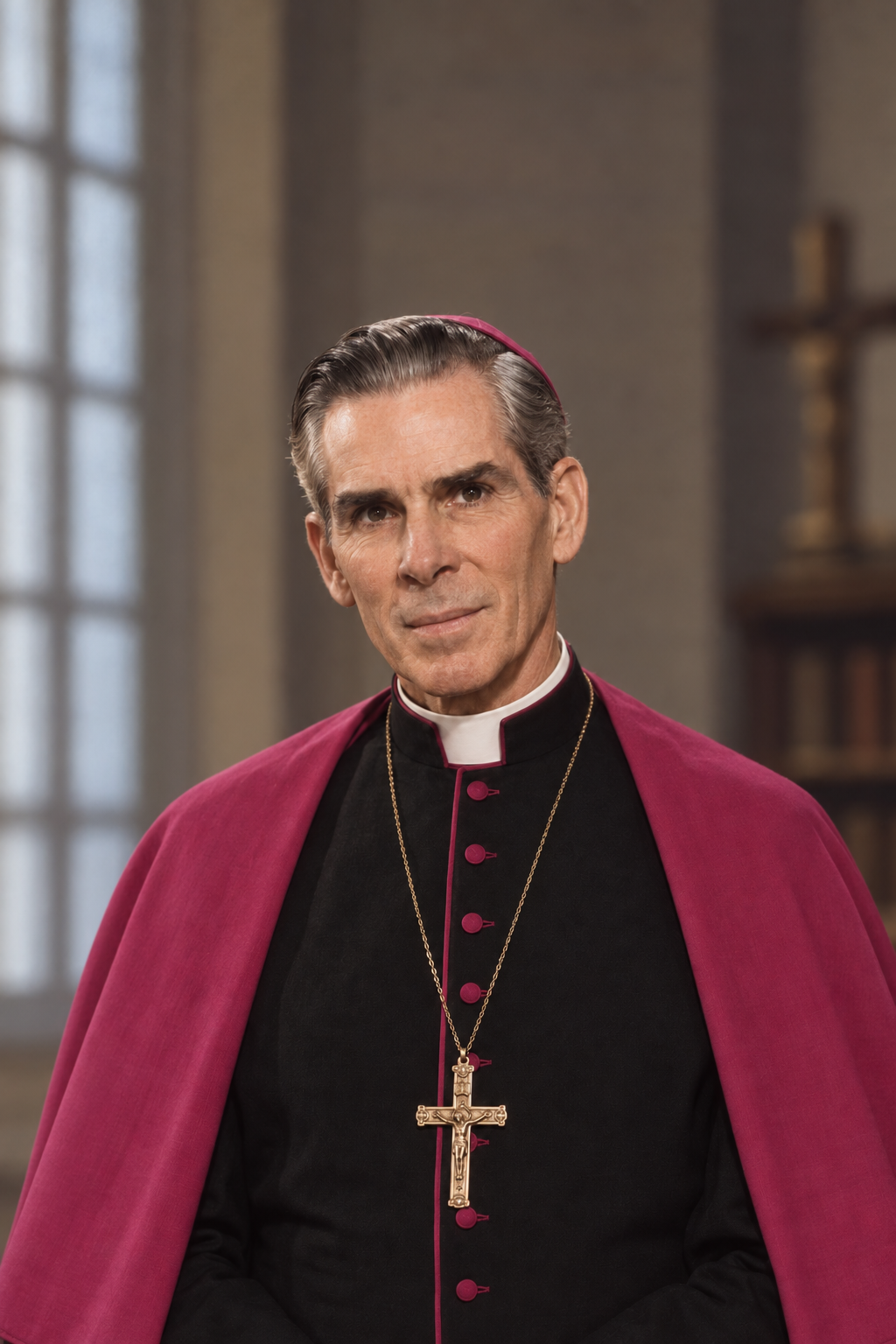
About Fulton J. Sheen
Fulton J. Sheen was born Peter John Sheen in El Paso, Illinois, on 8 May 1895. He was the eldest of four sons of Newton and Delia Fulton Sheen. His mother's family name became the name by which people knew him. The family later moved to Peoria, where he attended school and served at the Cathedral of St. Mary. The Peoria years gave his later ministry a lasting home: he would be ordained there, and the diocese would eventually present his cause for beatification.
Sheen studied at St. Viator College in Illinois and then entered seminary in Minnesota. He was ordained a priest for the Diocese of Peoria on 20 September 1919. Further study took him to The Catholic University of America and the Catholic University of Louvain in Belgium, where he earned advanced philosophical qualifications. He also taught for a time at St. Edmund's College in England. These years gave him a scholarly foundation for a vocation that would reach well beyond the classroom.
In 1926 Sheen returned to Catholic University in Washington, DC, as a teacher of theology and philosophy. His courses included philosophy of religion and questions about God and modern society. The university remembers a professor whose speaking invitations multiplied even while he maintained a teaching schedule. He published books, newspaper columns and shorter versions of his talks, moving ideas from the seminar room into forms people could encounter at home or in a parish.
The university's archives preserve a glimpse of the demands this work placed on him. In a 1937 letter to the rector, Sheen reported receiving dozens of letters each day that needed personal attention and described the preparation required for each lecture. A 1938 proposal for an Institute of Catholic Culture shows him trying to address changes in politics, economics and religion. These documents show both the practical labor behind his public voice and his concern with the questions shaping his own era.
Radio carried that voice across the United States. After early local broadcasts, Sheen appeared on The Catholic Hour in 1930 and became one of its regular speakers. He used radio to explain Catholic teaching and discuss religious and political questions for a broad audience. The broadcasts made a professor known to listeners who might never have entered a university lecture hall. Catholic University's archivist later described his popularity as helping Catholics participate in the country's national dialogue.
Sheen took part in an early televised Catholic broadcast on Easter Sunday in 1940. Television later made his teaching visible as well as audible. Life Is Worth Living began in 1952 and placed him before a blackboard to speak about religious, philosophical and political subjects. Its plain lecture format connected a familiar teaching method to a new medium. The series moved from the DuMont network to ABC and won him an Emmy for outstanding television personality in the 1952 season.
In 1946 Sheen also joined the board of the Catholic Medical Mission Board. The organization credits him with encouraging pharmaceutical companies to donate medicines for clinics and hospitals in places served by missionaries. He remained on its board until 1976. This work was less visible than his broadcasting, but it joined his public appeals to a practical effort to supply care. The board's own history records both his long service and his role in expanding its medical donations.
From 1950 to 1966, Sheen directed the United States branch of the Society for the Propagation of the Faith. The Pontifical Mission Societies say he reshaped their magazine, brought photographs and more accessible writing into it, and promoted the World Mission Rosary. He asked American Catholics to see the needs of churches beyond their own country and raised support for that work. His missionary role connected his skill as a communicator with financial and spiritual support for communities overseas.
He was consecrated a bishop in 1951 and served as an auxiliary bishop of New York while his television work continued. In 1966 he became bishop of Rochester. The diocese describes an appointment that brought high expectations because of his national reputation. His leadership there took place amid the social divisions of the late 1960s and the Catholic reforms associated with the Second Vatican Council. Some initiatives were welcomed; others drew resistance. Rochester's own history calls his period as bishop complex and records that he resigned after two years and ten months.
During the Rochester years, Sheen spoke against the Vietnam War and tried to put concern for the poor into diocesan decisions. He proposed making an inner-city parish property available for housing, but the plan faltered amid objections and a lack of consultation with parishioners. The Pontifical Mission Societies' account does not hide that failure. It places his attempt to address housing alongside the difficulty of governing a diocese through rapid change. This complicated episode belongs to the story of his pastoral work as much as his better-known broadcasts.
After leaving Rochester in 1969, Sheen held the title of archbishop and continued to write and preach. Ill health increasingly limited him. He died in New York City on 9 December 1979. In 2012 Pope Benedict XVI recognized his heroic virtues and gave him the title Venerable. The Catholic Church later recognized as a miracle the recovery of a newborn for whom family and friends had sought Sheen's intercession. That decision advanced his cause toward beatification.
A planned 2019 beatification was postponed after the Diocese of Rochester asked the Holy See to examine Sheen's role in priests' assignments during his episcopate. The diocese explicitly said that no complaint alleged personal inappropriate conduct by Sheen. In February 2026, the bishop of Peoria announced that the Holy See had allowed the cause to proceed to beatification.
On 24 September 2026 the Catholic Church beatified Sheen at a Mass in St. Louis. Cardinal Luis Antonio Tagle presided as the pope's delegate, and Pope Leo XIV's apostolic letter gave Sheen the title Blessed. December 9 is the approved optional memorial in the Diocese of Peoria. Sheen remains significant for combining modern broadcasting with support for missions overseas.