Biography
Hildegard of Bingen
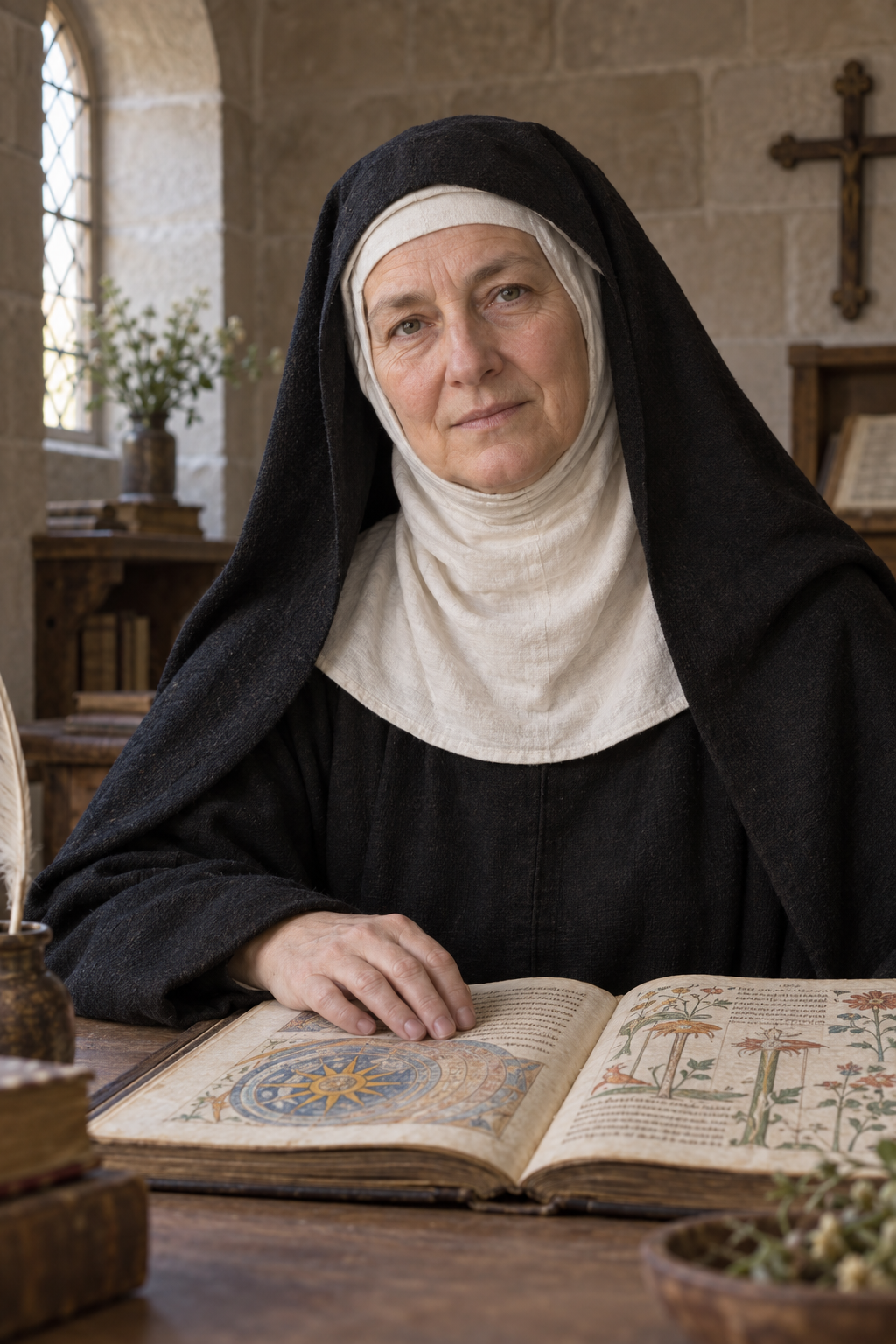
About Hildegard of Bingen
Hildegard of Bingen grew into a life in twelfth-century Germany that joined the care of a religious community with writing, music, and public counsel. Born in 1098, probably at Bermersheim in the Rhineland, she came from a noble family. As a child she was entrusted to religious teachers, among them Jutta of Sponheim. She entered the Benedictine life and eventually became the leader of the women at Disibodenberg after Jutta's death in 1136. Her work as their superior required attention to the organization of the household as well as its prayer.
At Disibodenberg, Hildegard began putting into words the visions through which she understood her religious calling. The monk Volmar and the nun Richardis helped her prepare her writings. She sought advice about these experiences rather than presenting them without consultation. Her first major book, Scivias, brought her visions and their interpretations together.
The opening of Scivias gives a sense of how she taught. She describes a shining figure enthroned upon an iron-colored mountain, accompanied by other figures and living sparks. She then explains the images: the mountain represents God's enduring kingdom, while the sparks stand for virtues that strengthen people. The movement from an arresting scene to an explanation allows her to speak about conduct as well as belief. She presents the call to speak as a divine command, addressed to someone fragile and easily dismissed. These are Hildegard's accounts of revelation, expressed through the imagery and scriptural language of her faith.
Writing did not remove the practical demands of building a community. Hildegard acquired land at Rupertsberg, near Bingen, and moved her sisters into a monastery there around 1150. The move led to disputes with the abbot of Disibodenberg over property and independence. She used her connections to obtain documents protecting the new foundation. As the community grew, she acquired a deserted monastery at Eibingen on the other bank of the Rhine. Benedictine women settled there in 1165, and Hildegard led both houses. Her foundations gave the sisters places to sustain their shared worship and work, while requiring continued negotiation with authorities outside the community.
Music belonged to this life of worship. Her collection known as the Symphonia preserves chants, while Ordo virtutum is a religious drama set to music. Surviving medieval manuscripts allow scholars and performers to study the music together with its words. Its precise uses are not always recoverable: scholars still discuss whether particular chants belonged to the daily office, Mass, or other settings. Hildegard's music also grew within the musical practices around her. Its distinctive character does not mean that she worked without influences; decades of Benedictine worship formed part of the world in which she composed.
Her later books expanded the range of her teaching. The Book of Life's Merits explores the struggle between virtues and vices, while the Book of Divine Works considers creation and humanity's place within it. Letters carried her advice to communities and church leaders. She also confronted powerful people: she rebuked Emperor Frederick Barbarossa over his support for rival popes. In her later years she traveled to address clergy and religious communities, urging them to live according to their commitments. Her criticism was a call for reform within the Church she served.
Her curiosity reached into the natural world as well. Works associated with medicine and natural knowledge stand beside her theological books, songs, sermons, and an invented vocabulary. These interests were linked by her understanding of creation as God's work and of human beings as creatures with both bodies and souls. The spiritual life, in this account, did not leave the body or the rest of creation behind.
Near the end of her life, a dispute brought enforced silence to her community's worship. Her letter to the prelates of Mainz says that the sisters had obeyed a restriction by reading the divine office instead of singing it. She answered with a defense of music that connected human voices, bodies, and the praise of God. She asked church authorities to examine their reasons carefully before silencing a community, and to distinguish justice from anger or revenge. For a woman who had composed for worship, the freedom to sing was a serious matter of religious life.
Hildegard died at Rupertsberg on 17 September 1179. Centuries later, Benedict XVI declared her a Doctor of the Church, recognizing her theological teaching.
Her work survived through the labor of others as well as through devotion to her memory. Nuns of the modern Abbey of Saint Hildegard prepared translations, studied manuscripts, and helped produce critical editions of her writings. Their work opened texts once accessible to relatively few readers to a wider public. The legacy of her communities thus includes a continuing practice of study: women preserving and interpreting the writings of a woman whose voice had reached well beyond her own monastery.
Wondering how to weigh the stories and sources? Learn how to read a saint biography.
Explore similar vocations
Prayers for Hildegard of Bingen
Hildegard of Bingen: sourced prayer excerpt
grant us, we pray, by her example and intercession, to know your ways