Biography
Jadwiga of Poland
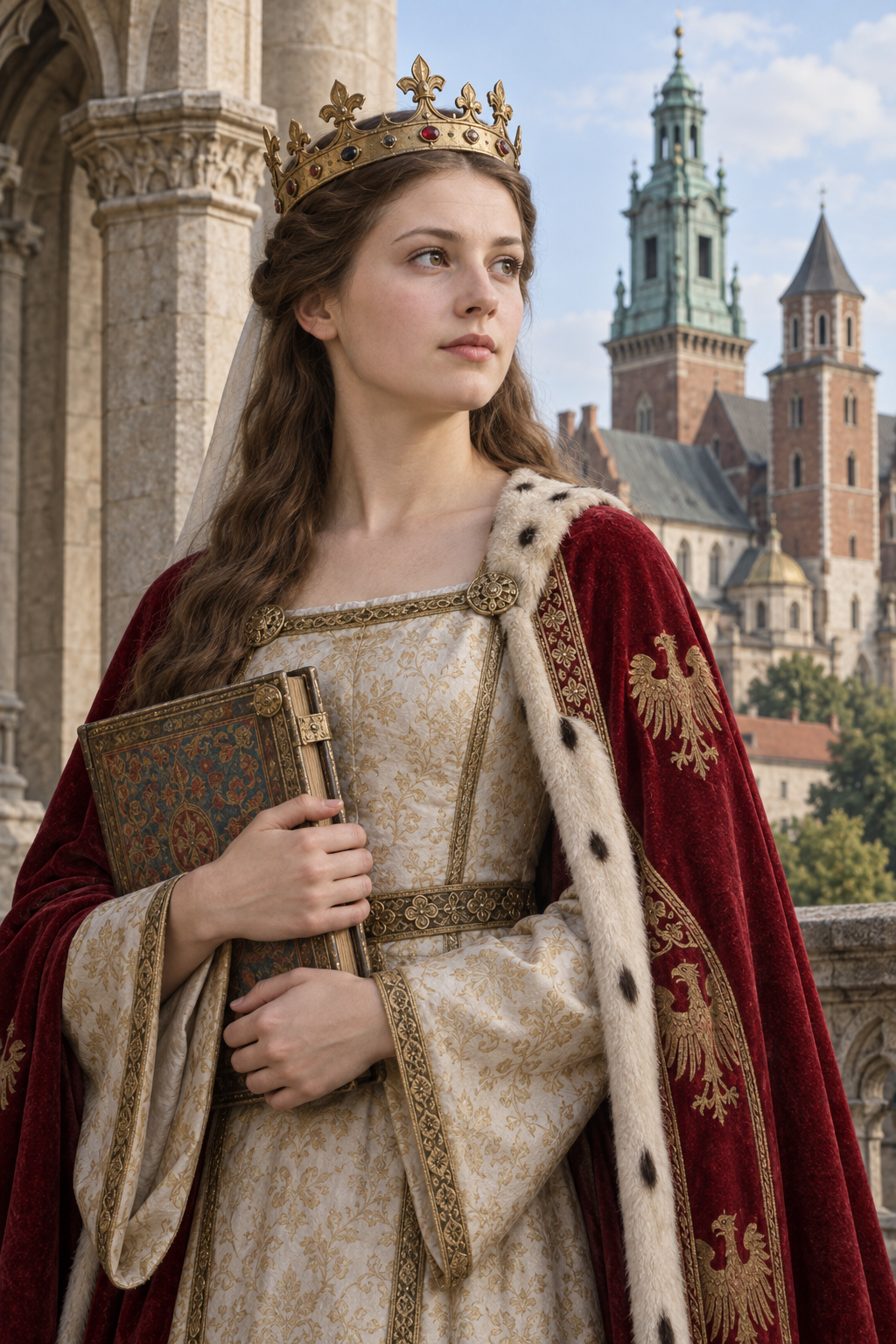
About Jadwiga of Poland
Jadwiga of Poland was born around 1374 into the Angevin ruling family. Her father, Louis, was king of Hungary and Poland, and her mother was Elizabeth of Bosnia. Her childhood was shaped by dynastic plans that treated marriage and succession as matters of state. When Louis died in 1382, Polish leaders sought a ruler who would reside in Poland rather than continue a close personal union with Hungary. Jadwiga came to Kraków and was crowned in 1384 while still a child. The circumstances made her an unusually young sovereign, but they did not give her unlimited freedom to choose the political direction of the kingdom. Later accounts sometimes insist that she was crowned “king”; historians dispute how the contemporary wording should be read.
The marriage negotiations surrounding her rule changed the map of eastern Europe. Jadwiga had earlier been betrothed to William of Austria, but Polish political leaders negotiated instead with Jogaila, grand duke of Lithuania. The agreement joined dynastic interest to the prospect of Christianization in Lithuania. Jogaila was baptized and took the name Władysław. Jadwiga and Władysław married in Kraków Cathedral on February 18, 1386; Władysław was crowned king two weeks later. Their partnership began the Jagiellonian dynasty in Poland. This sequence is more precise than the shorthand that a young queen simply chose between two suitors. It involved royal councils, religious commitments, and neighboring states, with consequences extending far beyond either individual.
Jadwiga remained a political actor after her marriage. The Wawel Cathedral biography records her involvement in affairs of the kingdom and in relations with Lithuania and neighboring lands. It also describes efforts to support religious life and care for the vulnerable. A medieval queen's authority operated through a court and its institutions, so her work should not be imagined as isolated from advisors, clergy, or her husband. The record nonetheless allows more than a portrait of a passive figure. Her patronage helped connect royal resources to churches, learning, and works of mercy. Religious commemoration later emphasized her generosity; a historical account can name the activities without assuming that every story attached to her was recorded during her lifetime.
Education became one of the most durable parts of Jadwiga's legacy. Kraków already had a university founded by Casimir the Great in 1364, but its activity had weakened after his death. In the 1390s Jadwiga and Władysław supported efforts to restore it and to add a theology faculty. Pope Boniface IX issued the bull for that faculty in 1397. Jadwiga's contribution was therefore part of a renewal, not the first creation of higher learning in the city. After her death, Władysław issued a new university foundation charter in 1400. The institution's own history distinguishes these stages, even while it honors Jadwiga as a central patron. Her support gave the court's political and material backing to an undertaking that later shaped Polish scholarship.
Jadwiga also directed resources toward people in need. At her 1997 canonization, John Paul II recalled hospitals and charitable works associated with her in several Polish towns. These later statements are part of the Church's account of her care for the poor and sick. The same homily connected her educational work with a conviction that learning served both Church and state. That interpretation should not erase the political dimensions of her reign or turn medieval hospitals into modern institutions. It does show what the Church chose to highlight when reflecting on her life: royal authority used for education and practical help. Her influence took institutional forms that could remain after her own brief lifetime.
The final year of her life was marked by childbirth and loss. Jadwiga gave birth to a daughter, Elizabeth Bonifacia, in June 1399; the child died soon afterward. Jadwiga herself died in Kraków on July 17, 1399, still in her mid-twenties. The university archive records the date and the importance of her bequest to the school's later renewal. Her burial at Wawel made the cathedral a place of memory for the queen. Accounts of her death invite restraint: the surviving record supports the sequence of births and deaths, but it does not justify inventing private conversations or emotions. The brevity of her reign did not prevent substantial consequences for the kingdom and the university.
Devotion to Jadwiga developed over centuries. John Paul II canonized her at Kraków on June 8, 1997, before a gathering that linked her memory to the city, Wawel Cathedral, and the university. The pope spoke of her as a patron of Poland and recalled the union with Lithuania, the theology faculty, and works of mercy. Those are later religious judgments on a medieval ruler, not direct evidence for every motive she held as a child or queen. Her importance can be described concretely: she helped shape the political union that linked Poland and Lithuania, supported ecclesial and educational institutions, and left resources that aided the university after her death. Her life is remembered where statecraft, learning, and charity met.
Wondering how to weigh the stories and sources? Learn how to read a saint biography.