Biography
John Houghton
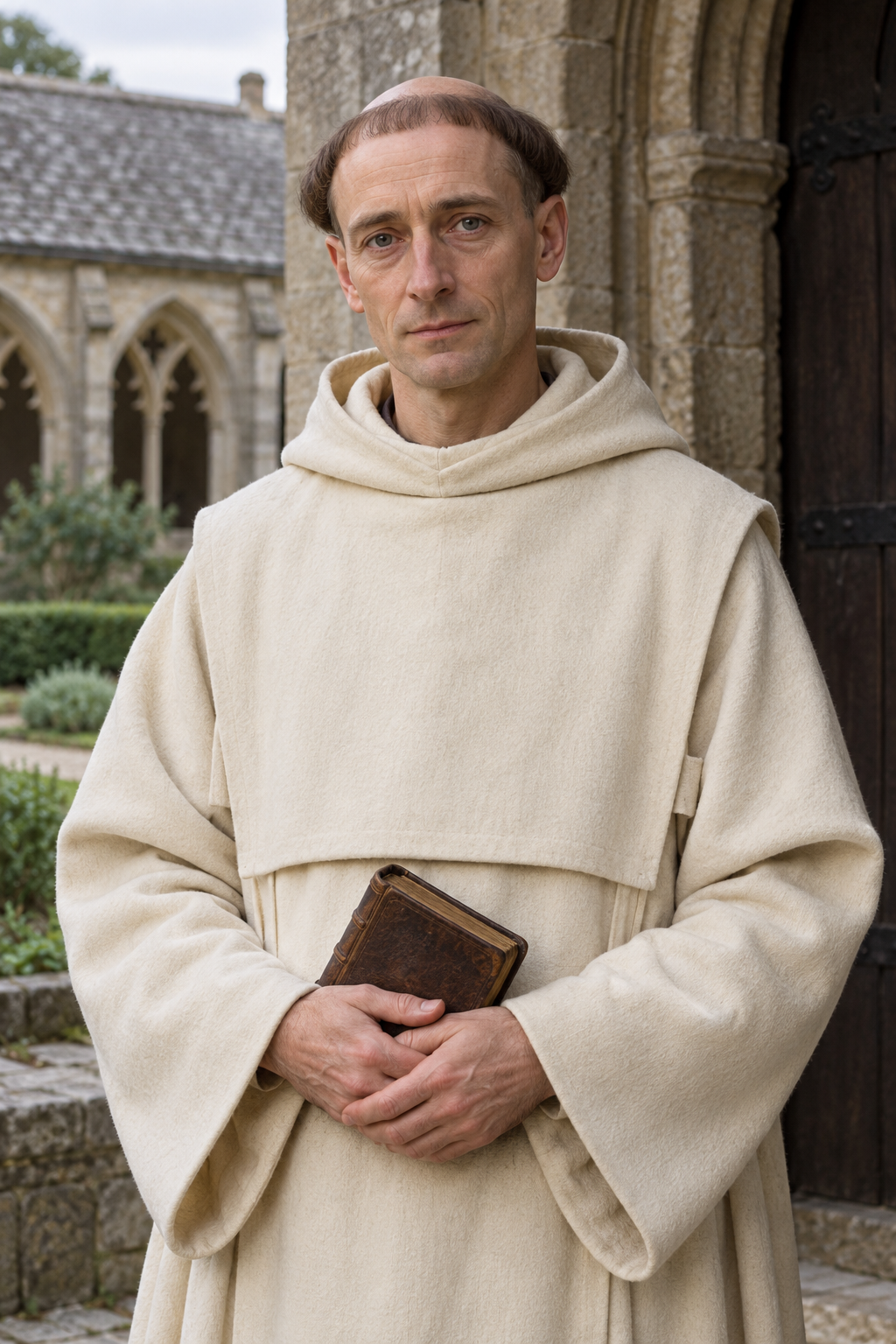
About John Houghton
John Houghton was prior of the London Charterhouse when Henry VIII’s break with Rome placed the community under pressure to accept royal authority over the Church. A priest before becoming a Carthusian, he had served as sacristan and procurator, then briefly as prior at Beauvale before returning to lead the London house in 1531. His death in 1535 made him one of the best remembered of the English Carthusian martyrs.
He came from Essex and studied at Cambridge. Older accounts describe his determination to become a priest despite his parents’ plans for his marriage, followed by several years of priestly service before he entered the monastery. Details of his early chronology differ between biographies, so exact birth and ordination dates are not given here. His later leadership and imprisonment are more securely documented than these beginnings.
Life within the charterhouse mattered deeply to him. Lawrence Hendriks’s history, drawing on the recollections of the monk Maurice Chauncy, portrays a prior who visited the brothers in their cells with the familiarity of a fellow monk. He disliked grand titles, yet could be exacting about the community’s prayer. He urged slow, attentive chanting and corrected carelessness in the Divine Office. Hendriks also cautions that the speeches remembered by Chauncy should not be treated as verbatim records.
That remembered gentleness did not mean indifference to discipline. In Hendriks’s account, Houghton sought to teach by example and restrained additional austerities when a monk’s strength did not permit them. The portrait is a devotional one, written long after his death, but it preserves the community’s memory of a superior concerned with both worship and the people entrusted to him.
A surviving letter offers a more direct glimpse of his interests. In 1532 he wrote to the Carthusian Theodoric Loer at Cologne about editions of Denis the Carthusian. Books by Denis were difficult to obtain in England, he explained, because other eager readers quickly acquired the copies that arrived. Houghton asked for multiple copies of the printed works and larger quantities of two shorter texts. He enclosed a part payment, requested individual prices and promised to settle the balance.
Among his requests were twenty copies each of De contemptu mundi and Scala religiosorum, showing that he sought several copies of the same shorter works.
His request joined spiritual enthusiasm to practical arrangements. He encouraged Loer to continue printing Denis’s writings and asked for copies of future publications as well. The letter shows a prior working across the Channel to obtain books he believed would strengthen religious life. It also reveals the ordinary problems of buying and transporting them: payment, availability and the risks of sending money.
David Rogers’s study traces this exchange to a book printed in Cologne in 1532, which preserved both Houghton’s letter and Loer’s answer. Rogers distinguishes this evidence from later bibliographical claims that turned a single letter into an entire volume of correspondence.
In 1534 royal commissioners demanded the succession oath. Houghton and the procurator Humphrey Middlemore were imprisoned in the Tower after resisting it. They eventually accepted the oath with a reservation that their submission extended only as far as conscience allowed.
The Dictionary of National Biography describes how the first confrontation unfolded. After about a month in prison, Houghton heard advice from learned churchmen, including Bishop Stokesley of London, that the succession issue did not justify accepting death. His conditional agreement did not immediately settle matters at the monastery. Commissioners returned with the lord mayor, and the community initially refused again. Only a further threat of imprisoning all the monks brought their qualified submission. The sequence shows the pressure surrounding their decision.
The following dispute concerned the king’s supremacy over the Church. Historian Caroline Barron distinguishes the two stages: the monks’ acceptance of the succession legislation in May 1534 did not end the pressure to conform. In April 1535 Houghton, Robert Lawrence of Beauvale and Augustine Webster of Axholme were taken to the Tower, together with the Bridgettine Richard Reynolds. At their trial, they maintained that obedience to the pope was necessary for the Church’s spiritual unity.
On May 4, 1535, Houghton, Lawrence and Webster were executed at Tyburn by hanging, drawing and quartering. The Charterhouse’s account recalls the tradition that Houghton affirmed his fidelity to the Catholic Church and forgave his executioners.
Paul VI canonized Houghton and his companions in 1970.
At the ceremony on October 25, the pope welcomed Anglican representatives and expressed hope that the martyrs’ witness could help heal Christian division.
His memory is also kept in schools. Saint John Houghton Catholic Voluntary Academy explicitly honors him as its patron.
The Priory Catholic Voluntary Academy honors both Houghton and Robert Lawrence, marking their May 4 feast through pilgrimage to Beauvale. These are documented local patronages, rather than a general claim that he is patron of students or teachers.
Wondering how to weigh the stories and sources? Learn how to read a saint biography.