Biography
John of Damascus
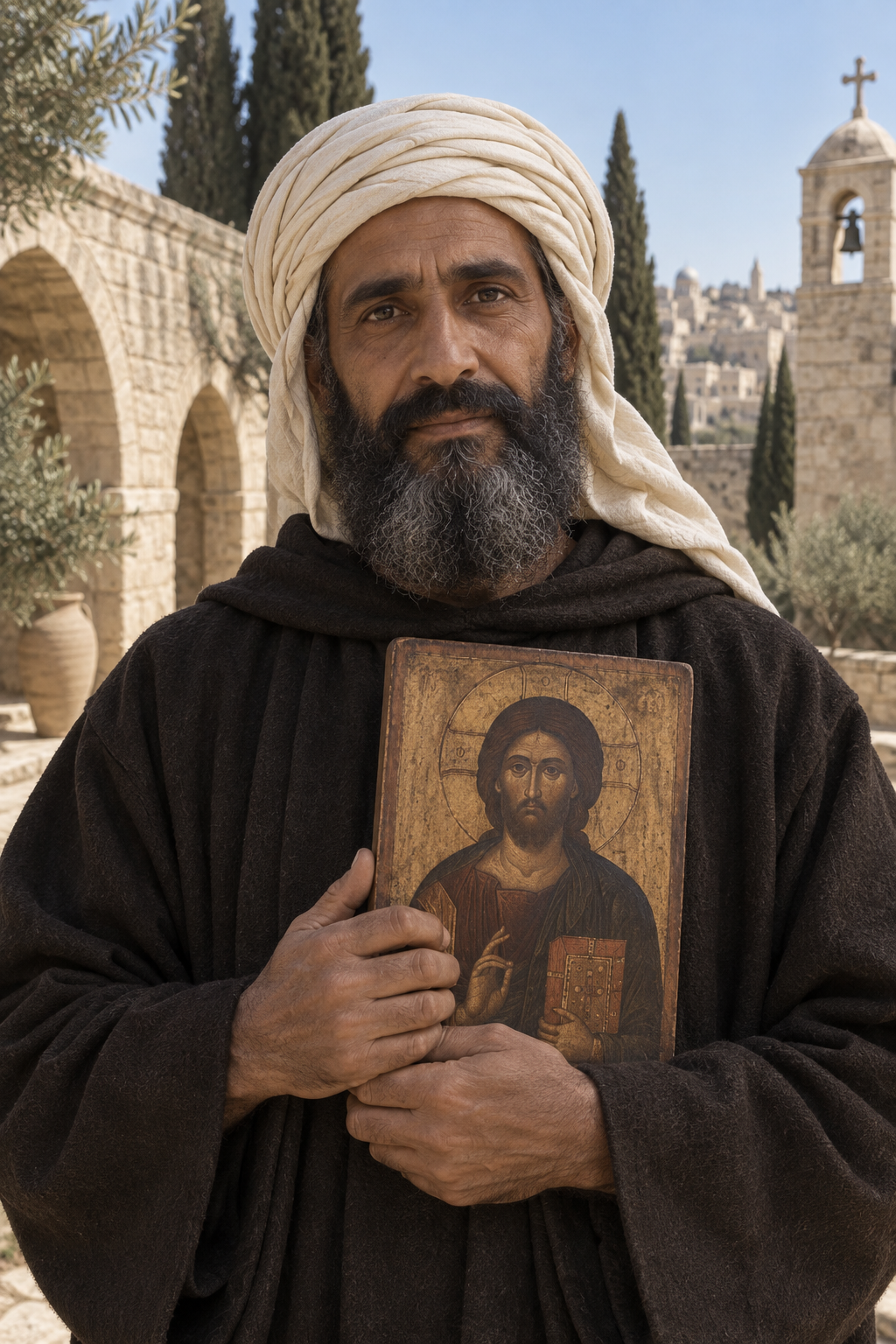
About John of Damascus
John grew up in Damascus in a Christian family connected with the city's administration. Born probably around 675, he received an education in Greek learning. His father and grandfather had held fiscal responsibilities, and John probably also worked in the caliph's service. He eventually left that career for religious life in Palestine. The change is usually placed in the early eighth century, although a precise year cannot be established.
Later tradition placed him at the monastery of Mar Saba. Andrew Louth instead considers a community serving the Church of the Resurrection in Jerusalem more likely. John was associated with Patriarch John V, who ordained him priest. The uncertainty concerns his precise monastic home, not his decision to become a monk and devote himself to teaching and worship.
His ministry included preaching for the feast of Mary's Dormition. Tony Burke dates these homilies between 730 and 750 and places their delivery at the church near Gethsemane associated with her tomb. The setting connects his surviving words with a particular community's worship in Jerusalem. Three surviving homilies preserve his treatment of that feast, each shaped as an address to worshippers.
He brought considerable learning to that vocation. His work ranged across systematic theology, the defence of sacred images, preaching, and liturgical poetry. Rather than leaving only one celebrated argument, he produced writings that served different parts of Christian life: study, public explanation of belief, and the prayer of the worshipping community. His intellectual inheritance was Greek, while his life unfolded in the changing world of the early Islamic caliphate. That combination gave his work a setting distinct from the imperial Christian society whose traditions he continued to study and transmit.
John defended sacred images when their place in Christian worship was being challenged. He distinguished honouring an image from treating material objects as gods. Christ's human appearance, he argued, could be represented without depicting the invisible divine nature.
When readers found his first defence unclear, John wrote another explanation. He asked them to examine the arguments carefully. He also challenged imperial interference: rulers could require taxes, but teaching the faith belonged to the Church's pastors. He gathered earlier Christian testimony in defence of images.
John also organized Christian teaching in the Fount of Knowledge. Its three divisions supplied philosophical vocabulary, examined disputed teachings, and presented an exposition of faith. He drew extensively on earlier Christian authors.
In the opening of the Exact Exposition, John began by asking what human beings can know about God. He distinguished God's existence from a complete understanding of the divine nature. Yet he did not abandon reasoning. He argued that changing things could not finally explain their own existence, pointing beyond them to an uncreated cause. His exposition then moved toward the Christian confession of the Father, the Word, and the Spirit. He also distinguished knowing something from finding words adequate to express it. Language about God, he explained, works within human limitations. References to divine hands or feet should not reduce God to a bodily creature. This caution helped his readers approach familiar religious language without assuming that every expression was meant literally.
Preaching allowed him to explore Scripture through vivid contrasts. In his Transfiguration sermon, he set the darkness associated with Sinai beside the radiance of the mountain where Christ was revealed to his disciples. He interpreted the change as a disclosure of glory already present, rather than Christ acquiring a new identity. He also attended to details that could puzzle a listener. He explained the different counts of days in the Gospel narratives by asking whether the first and last days were included. Then he turned to the spiritual meaning of the ascent, connecting prayer with quietness and love. Near the close, he refused to let Peter's wish to remain on the mountain become the end of the story. The disciples still had work before them. His explanation made room for wonder without forgetting the responsibilities that would follow.
His voice could also become the voice of a preacher at prayer. In a sermon for Mary's Dormition, he admitted that praise might exceed the speaker's ability and offered what he could. He asked for help in making his hesitant speech fruitful. The sermon moved through Christian belief about Christ and Mary before closing in prayer. These passages show a teacher addressing worshippers, joining theological explanation to praise and petitions for guidance.
John died probably around 750, before the council at Hieria condemned him in 754. His arguments continued to matter after his death. The Second Council of Nicaea in 787 received his defence of images favourably, and the Catholic Church declared him a Doctor of the Church in 1890. His lasting importance lies in the range of that work: he explained inherited belief, defended visible expressions of devotion, and gave worshippers language for prayer.
Wondering how to weigh the stories and sources? Learn how to read a saint biography.
Explore similar vocations
Prayers for John of Damascus
John of Damascus: sourced prayer excerpt
Watch over us, O Queen