Saint profile
Josemaría Escrivá
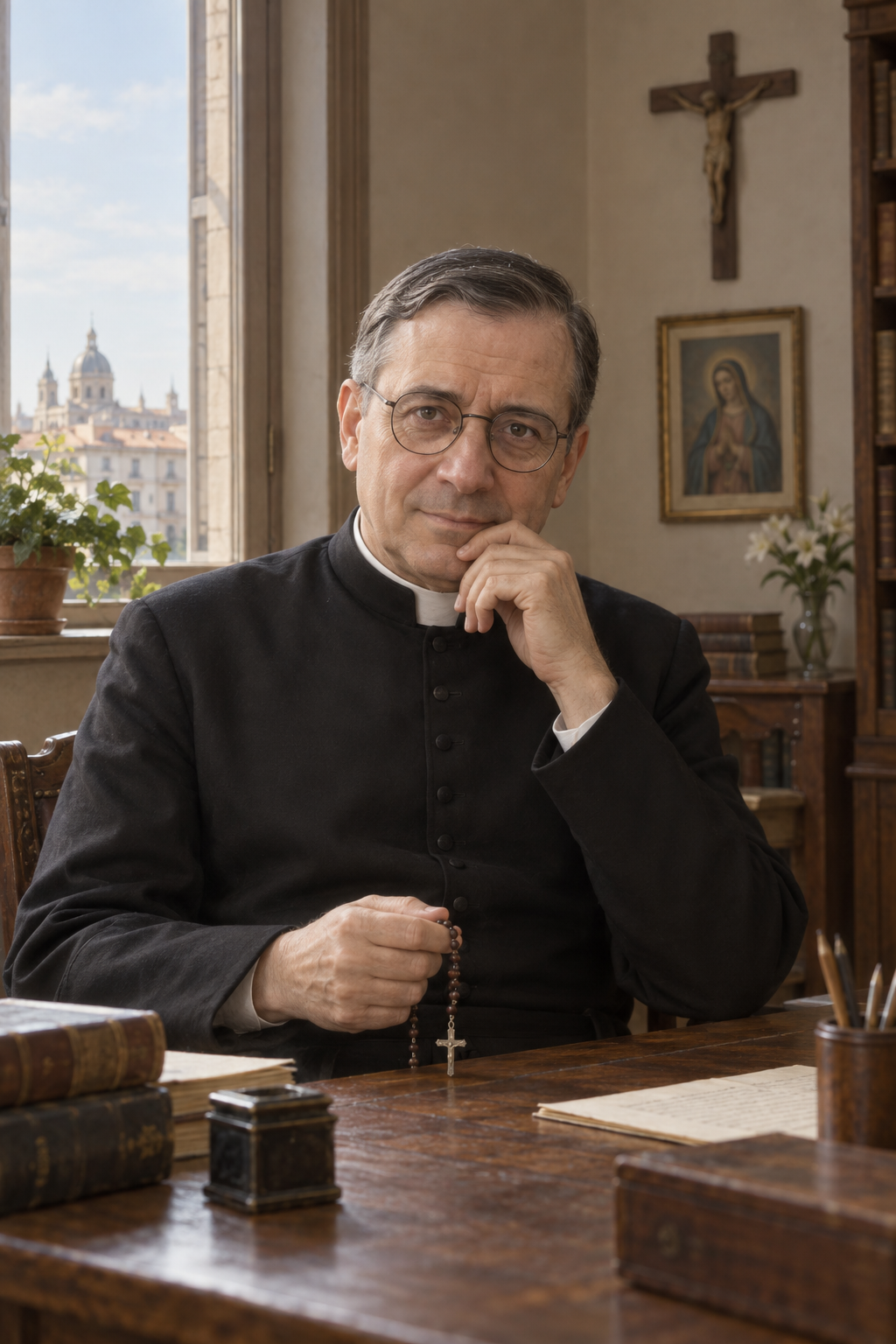
About Josemaría Escrivá
Josemaría Escrivá was born in Barbastro, Spain, on 9 January 1902. He was the second of six children of José Escrivá and María Dolores Albás. The family later moved to Logroño, where Josemaría attended secondary school. He began to consider the priesthood as a young man, and entered the diocesan seminary there before continuing his studies in Zaragoza. His vocation developed alongside ordinary family responsibilities and study, rather than through membership in a religious order. The Vatican’s canonization biography records his family background, seminary education, and decision to become a priest; the account is an official church biography, not a contemporary diary.
Escrivá was ordained a priest in Zaragoza on 28 March 1925. His first assignment was in the rural parish of Perdiguera, after which he served in Zaragoza. In 1927, with his bishop’s permission, he moved to Madrid to pursue doctoral studies in civil law. There he also served as chaplain to a foundation caring for the sick and poor. The Vatican biography describes him visiting people in hospitals and the city’s poorer outskirts, while teaching law to help support his widowed mother and younger siblings. These responsibilities placed pastoral service, study, and family support in the same demanding years. The exact daily sequence is not fully documented in the short official accounts, so this narrative does not infer motives beyond what those accounts state.
On 2 October 1928, during a retreat in Madrid, Escrivá founded Opus Dei. In his own later descriptions he used the word “saw” for the experience, which he understood as a divine inspiration; that religious interpretation should be identified as his testimony rather than treated as an independently verifiable historical mechanism. The organization’s stated purpose was to promote a universal call to holiness, especially through ordinary work and the duties of daily life. Escrivá continued to serve as a priest while gathering members and developing the new institution. The surviving official summaries give the date and purpose clearly, but do not provide a neutral record of every early meeting or participant’s experience.
The idea that professional and domestic life could be part of Christian spiritual practice shaped Escrivá’s preaching and writing. At his 2002 canonization, Pope John Paul II summarized this teaching as an effort to bring prayer, family life, work, and social responsibilities together in one Christian life. This is a later papal interpretation of Escrivá’s message. The emphasis on ordinary circumstances helps explain the movement’s distinctive focus without claiming that every member’s experience was identical. Individual sayings that circulate in devotional settings should not be attributed without checking the original work and passage, so this account does not reproduce a slogan as an exact quotation. The canonization homily is a primary source for the Church’s public interpretation of his teaching, not an independent history of the organization.
The Spanish Civil War began in 1936, and the danger to priests in Madrid shaped Escrivá’s circumstances. Official Opus Dei historical accounts describe him hiding in several places and continuing some priestly ministry clandestinely. In 1937 he left Madrid with a group of young men, traveled through the Pyrenees, and reached Andorra before continuing to territory where he could exercise his ministry more openly. These accounts were produced by the institution he founded and draw on recollections and documentary research; they are useful institutional sources, while details of spiritual protection belong to religious interpretation. Escrivá later returned to Spain and settled in Burgos, where he resumed pastoral work and continued writing. The journey was a consequential episode, but this biography avoids dramatizing danger beyond what the sources record.
After the war, Escrivá continued organizing Opus Dei and serving as a priest. In 1946 he moved to Rome, where the organization’s relationship with the Holy See developed over time. Pope John Paul II’s 1982 constitution established Opus Dei as a personal prelature, and its text describes the institution’s purpose and governing structure. Escrivá led it until his death. The legal change belongs to the later institutional history; it should not be collapsed into the founder’s original religious purpose. The institution’s legal form alone cannot establish how its spirituality was lived by individual members.
Escrivá died in Rome on 26 June 1975. The Catholic Church beatified him in 1992 and canonized him on 6 October 2002. The official chronology of his cause records these institutional dates and milestones. His canonization is part of the Church’s later assessment of his life; it does not make every devotional recollection into verified history. The available sources support a concise account of a priest, writer, and institution-builder. They do not justify assigning unsupported patronages or treating his reported religious experiences as independently established facts. Readers can distinguish the documented outline of his life from the institution’s own account of spiritual experience. This biography therefore presents those claims with their source and context, while leaving disputed or insufficiently supported details outside the record.
Wondering how to weigh the stories and sources? Learn how to read a saint biography.