Biography
Marianna Giuliani
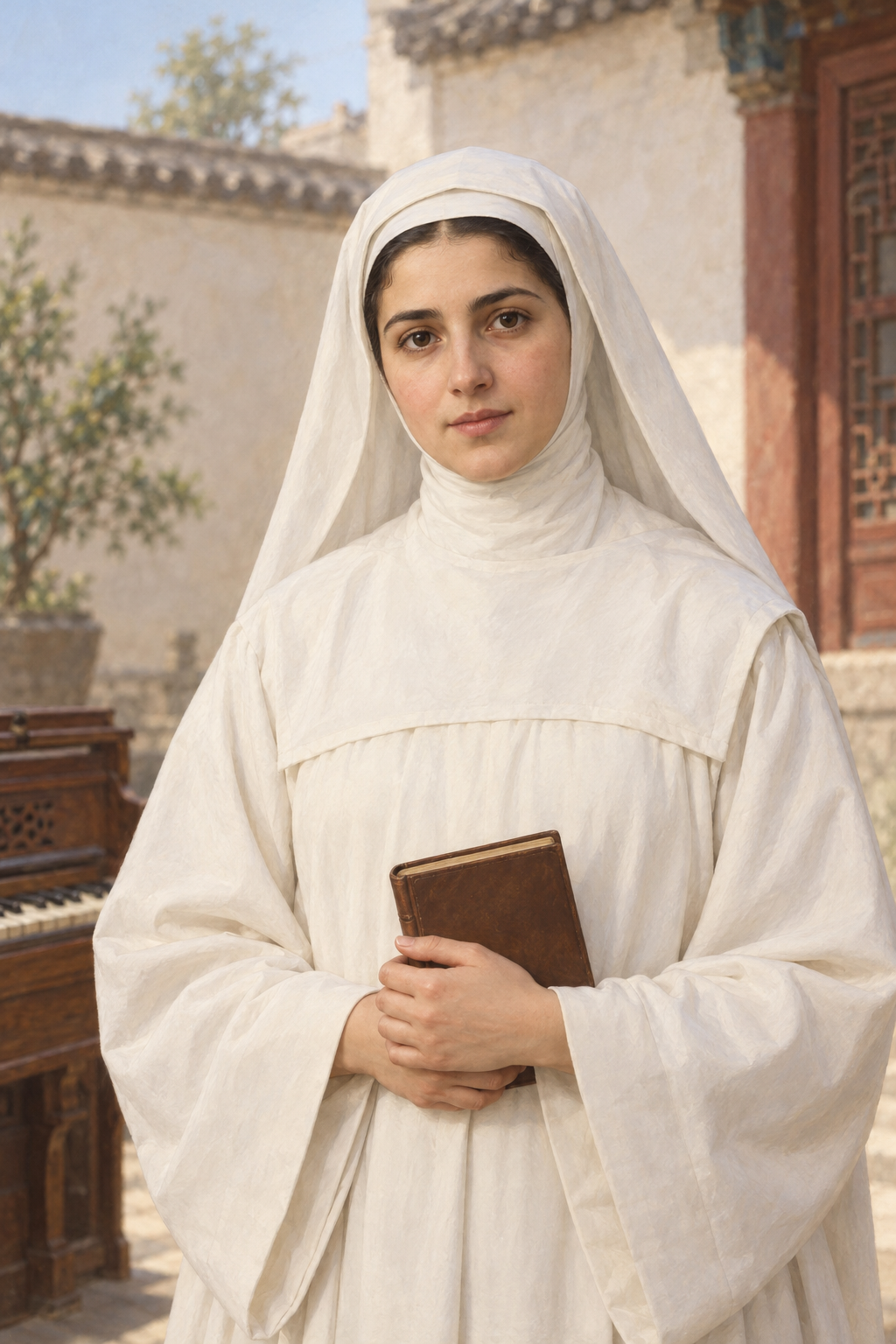
About Marianna Giuliani
Marianna Giuliani, known in religion as Maria della Pace, was a Franciscan Missionary of Mary who served in China. She was born in L’Aquila in December 1875 and spent part of her childhood in Bolsena. After her mother’s death, relatives helped provide for her upbringing and education.
Her path into religious life began with schooling. Relatives arranged for her to enter the community’s care in Rome, where its founder, Mary of the Passion, received her. Health concerns led to a move to France. There she continued her education and developed a desire to become a sister. Her guardians resisted that choice, but she persisted and received the habit in 1892, taking the name Maria della Pace.
A diocesan account describes the breadth of her preparation: languages, household work, embroidery, drawing, painting and music. She also cared for young and elderly people and taught catechism. Her training joined practical work with religious instruction. Before leaving Europe, she served in different communities, including one near Vienna, where she made her perpetual vows.
The New Catholic Encyclopedia remembers her work with difficult girls in Paris and later assignments at Vanves and in Austria. In China she helped organize the orphanage and used her singing voice in the community’s worship. These were the tasks of a young sister still developing her abilities within a demanding mission.
She accompanied Marie-Hermine Grivot’s group to Taiyuan in 1899. The Italian biography identifies her as the superior’s assistant and remembers her especially for teaching the girls to sing. The seven sisters brought different national backgrounds and skills to their shared work.
The sisters’ remembrance should also leave room for fear. Their congregation’s account says that Maria della Pace experienced anguish when faced with death. It does not describe courage as the absence of distress. She was the youngest of the seven, still only twenty-four when she was killed.
Marianna died at Taiyuan on July 9, 1900, with the other sisters and their companions. The Catholic martyrology remembers Chinese laypeople alongside the European missionaries.
Detailed accounts of the massacre need qualification. Historian Roger R. Thompson finds serious conflicts in later reports and questions the familiar dramatic execution narrative. His research does not deny that Christians were killed, but cautions against treating reconstructed scenes as secure eyewitness evidence.
She was beatified in 1946 and canonized on October 1, 2000. Her feast is July 9.
Her memory also remains connected with Bolsena. Luca Giuliani’s diocesan account records her commemoration inside the basilica there. It places the young missionary within the town’s religious memory, while recognizing that her service carried her far from the community where she had grown up.
Wondering how to weigh the stories and sources? Learn how to read a saint biography.