Biography
Marie-Adolphine
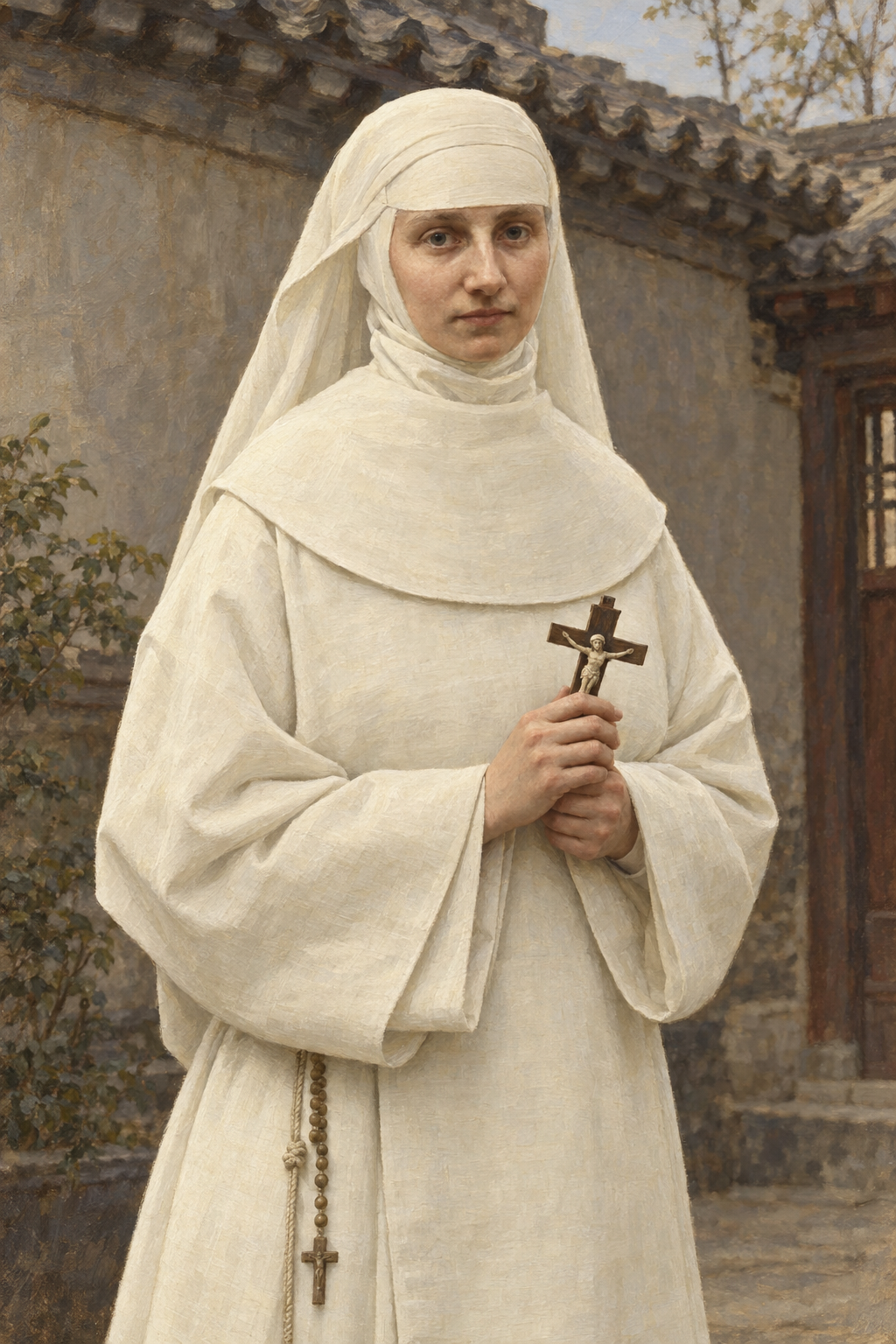
About Marie-Adolphine
Marie-Adolphine was a Dutch Franciscan Missionary of Mary who was killed in China in 1900. Born Judoca Catharina Dirks in Ossendrecht on March 3, 1866, she grew up amid considerable hardship. Her mother died in 1871, and her father left the following year. Another family took her in. She later worked in a chicory factory and as a domestic servant in Antwerp.
She entered the Franciscan Missionaries of Mary in 1893 and made her perpetual profession in 1898. In 1899 she traveled to China, reaching Taiyuan on May 4. The mission cared for about two hundred orphaned girls.
Her congregation remembers her readiness to undertake practical work. In the account it preserves, her superior valued her willingness to help with whatever needed doing. A letter attributed to Marie-Adolphine expresses affection for the Chinese women who worked alongside her. Such recollections give a glimpse of daily relationships within a mission more often remembered for its violent end.
The Heiloo community’s account also recalls the difficulty of adapting to unfamiliar languages. Marie-Adolphine had already needed to learn French in religious life; service in China brought another demanding adjustment. Her story includes this ordinary challenge of working among people whose language she did not readily understand.
During the Boxer uprising, foreign influence and Chinese Christian communities became targets of violence. Marie-Adolphine remained with her fellow sisters despite the danger. They were confined in July 1900 and killed at Taiyuan on July 9. The violence took the lives of Chinese Christians as well as foreign missionaries.
Pope John Paul II canonized Marie-Adolphine on October 1, 2000. Her memory forms part of the church’s commemoration of the martyrs of China. The Diocese of Breda lists her feast on July 8, while her congregation commemorates the seven Franciscan Missionaries of Mary on July 9. These different observances belong to different church settings.
In Ossendrecht, remembrance took a lasting local form. A foundation established in 1951 acquired her birthplace and converted it into a chapel. Road alterations later required rebuilding, but the recess associated with her birth was preserved. Bishop Ernst blessed the restored chapel on May 29, 1983. The municipal history describes an annual procession linking the chapel, Berghoeve and the parish church of Saint Gertrude. Schools also visit the site.
The chapel’s collections include objects received from Antwerp in 2012: crucifixes, a painting and pieces of clothing associated with her religious life. These objects belong to the history of devotion surrounding her; the municipal account records their arrival without establishing each object’s individual provenance.
The sisters of the Servants of the Lord and the Virgin of Matará in Heiloo explicitly honor Marie-Adolphine as the patron of their community. A signed reflection by one of the sisters states this patronage directly. An interview in the 2025 jubilee magazine likewise records the community’s attachment to her. This is a specific, documented community patronage.
The same jubilee magazine preserves memories of local pilgrims who traveled to Rome for the canonization in 2000. Its interview describes two buses carrying people connected with Ossendrecht and recalls the occasion as a shared celebration. These later recollections show how the memory of a woman who had left the Netherlands continued to shape relationships in her home village.
In December 2025, the pastoral zone formerly called Brabantse Wal took the name Heilige Marie Adolphine. The Diocese of Breda announced the change the following month, presenting her as an example and source of inspiration for the parishes. The announcement concerned the zone’s name and shared mission rather than the creation of a new governing structure. It adds another chapter to the local remembrance of her life.
Wondering how to weigh the stories and sources? Learn how to read a saint biography.