Biography
Marie-Hermine Grivot
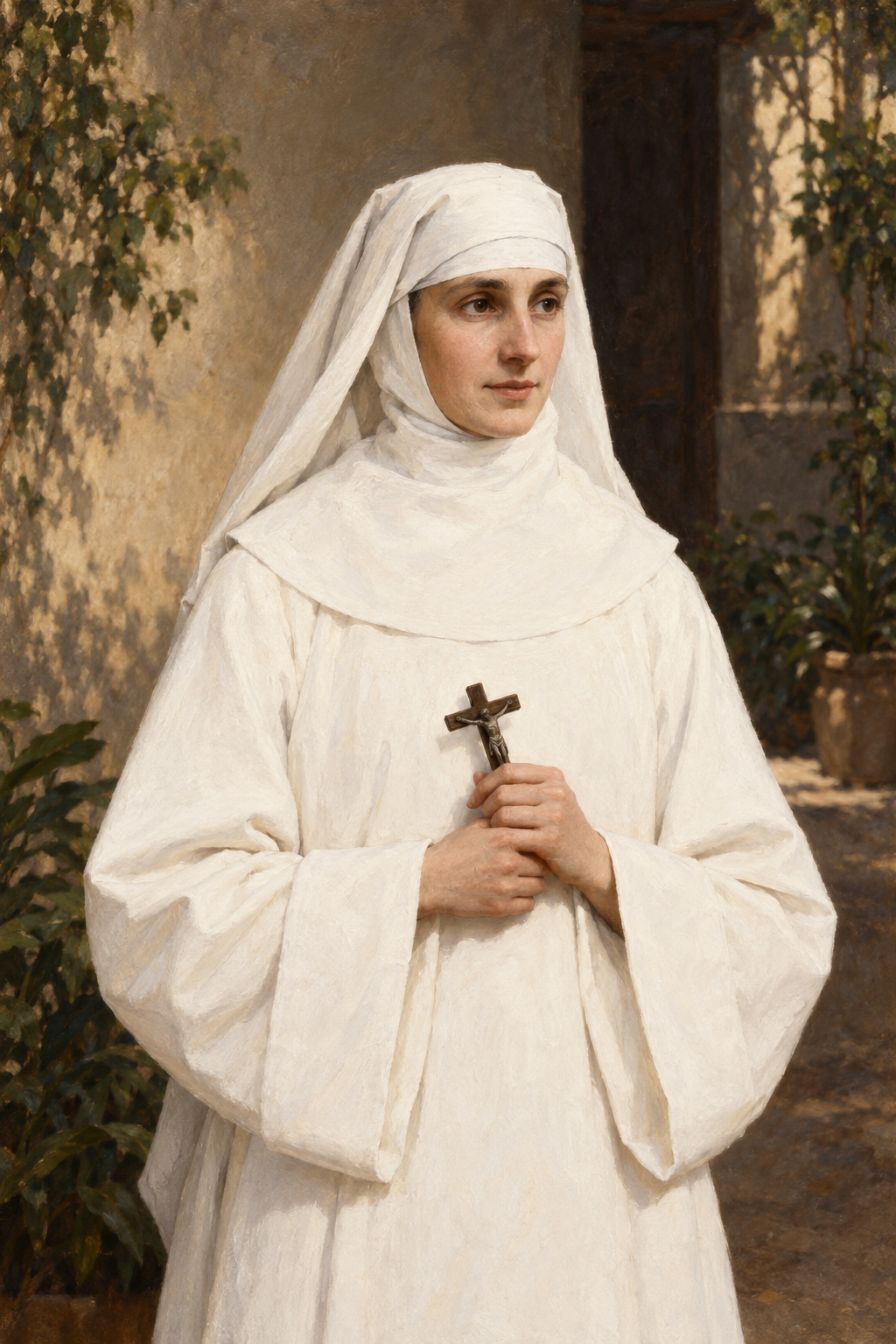
About Marie-Hermine Grivot
Marie-Hermine Grivot was a Franciscan Missionary of Mary who led a community of seven sisters at Taiyuan in northern China. Born Irma Grivot in Beaune on April 28, 1866, she came from a family of modest means. The early biography records a painful division between her religious aspirations and her family’s wishes.
Her father made barrels. She completed elementary studies in 1883 and supported herself through private teaching before entering religious life. Her parents opposed her vocation, and her poor health complicated the decision. In 1894 she joined the Franciscan Missionaries of Mary at Vanves, near Paris. She began her novitiate at Les Châtelets in Brittany that July, receiving the religious name Marie-Hermine de Jésus. After her first vows she returned to Vanves as a bookkeeper. Preparation for China included nursing experience in Marseille. These responsibilities brought together education, administration and care of the sick before she became a mission superior.
The early biography connects her missionary desire with the example of Father Damien and care for people with leprosy. It also recalls her kindness toward a difficult younger girl during formation. Such memories present a vocation expressed through bodily care and patient attention, before the dramatic circumstances of her death came to dominate the telling of her life.
A letter written in Marseille on March 8, 1899, lets us hear her anxiety before departure. Writing to Mother Marie Notre-Dame de la Garde, she admitted that imagining the future unsettled her. She tried to concentrate on the duty immediately before her. Leadership was not a responsibility she would have sought; she preferred quiet and feared what the new appointment would demand. Her trust in Christ did not remove that apprehension. In the same letter, she described a hurtful response to news of her departure and entrusted the people she loved to God.
The letter also records ordinary concerns amid the approaching separation. She thanked her former guide for books, asked for an image of Saint Pascal Baylon and hoped to continue writing from China. These requests place her departure within relationships sustained by correspondence and shared devotion. Her spiritual language accompanied an immediate need for reassurance, familiar objects and continued contact with someone who understood her. Even before sailing, the exchange shows her depending on friendship across an approaching distance.
Another letter, addressed to her childhood friend Alice, shows how deeply the family estrangement troubled her. Her parents still regarded her entrance into the congregation as abandonment. She had not visited them, explaining that the community’s rule did not permit family visits. She asked Alice to stay close to them and help them return to religious practice. Her concern was especially urgent as they grew older.
She also proposed a way for Alice to begin the difficult conversation: ask to see her photograph and speak gently about the mission departure. The letter reveals both affection and a sharp religious division. Marie-Hermine judged her family’s beliefs harshly, seeing their distance from Catholic practice as a danger to their salvation. Her appeal cannot be reduced to an uncomplicated farewell; it shows the cost of her choice for those who understood it differently. Her brother and sister no longer lived in Beaune. She feared that her parents would face old age without anyone nearby who shared her religious convictions.
In China, plans met material limits. The early biography describes drought and hunger delaying the proposed hospital; money intended for building had to buy provisions. It also records friction with Chinese women already caring for children. Its dismissive descriptions reflect the missionaries’ perspective rather than a neutral assessment of those women. The work depended on negotiating responsibilities across language and cultural differences, while correspondence with superiors in Europe was slow and uncertain.
The seven sisters were killed at Taiyuan on July 9, 1900, during the Boxer crisis. They died alongside Chinese Christians and other missionaries.
The precise circumstances of the massacre require caution. Historian Roger R. Thompson questions the familiar detailed account of an execution ordered by the governor. He identifies conflicting reports, the lack of surviving Western witnesses and later narratives shaped by familiar martyr stories. His research distinguishes the certainty of deaths from the reliability of particular speeches and scenes. It also places the violence within a wider crisis of local order and warfare. A biography of Marie-Hermine should therefore avoid presenting reconstructed final conversations as independently verified eyewitness testimony. Thompson notes that diplomatic authorities did not conduct an investigation. Later repetition made particular versions familiar without resolving the weaknesses in their original evidence.
Pius XII beatified her in 1946, and John Paul II canonized her with the Martyrs of China on October 1, 2000. Her feast is July 9. The Church’s remembrance names her as an individual within the community she led, alongside the Chinese and European Christians killed with them.
Wondering how to weigh the stories and sources? Learn how to read a saint biography.