Biography
Marie of Saint Natalie
About Marie of Saint Natalie
Jeanne-Marie Guerguin, also spelled Kerguin, took the religious name Marie de Sainte-Nathalie. She was a Franciscan Missionary of Mary from Belle-Isle-en-Terre in Brittany. Her vocation eventually carried her from France to North Africa and China.
She was born in May 1864 into a farming family. Borrelli and Flocchini describe a childhood divided between tending sheep and helping at home. She began attending a village school, but family difficulties and domestic responsibilities interrupted her education. After her mother died, she took on more work to support her father.
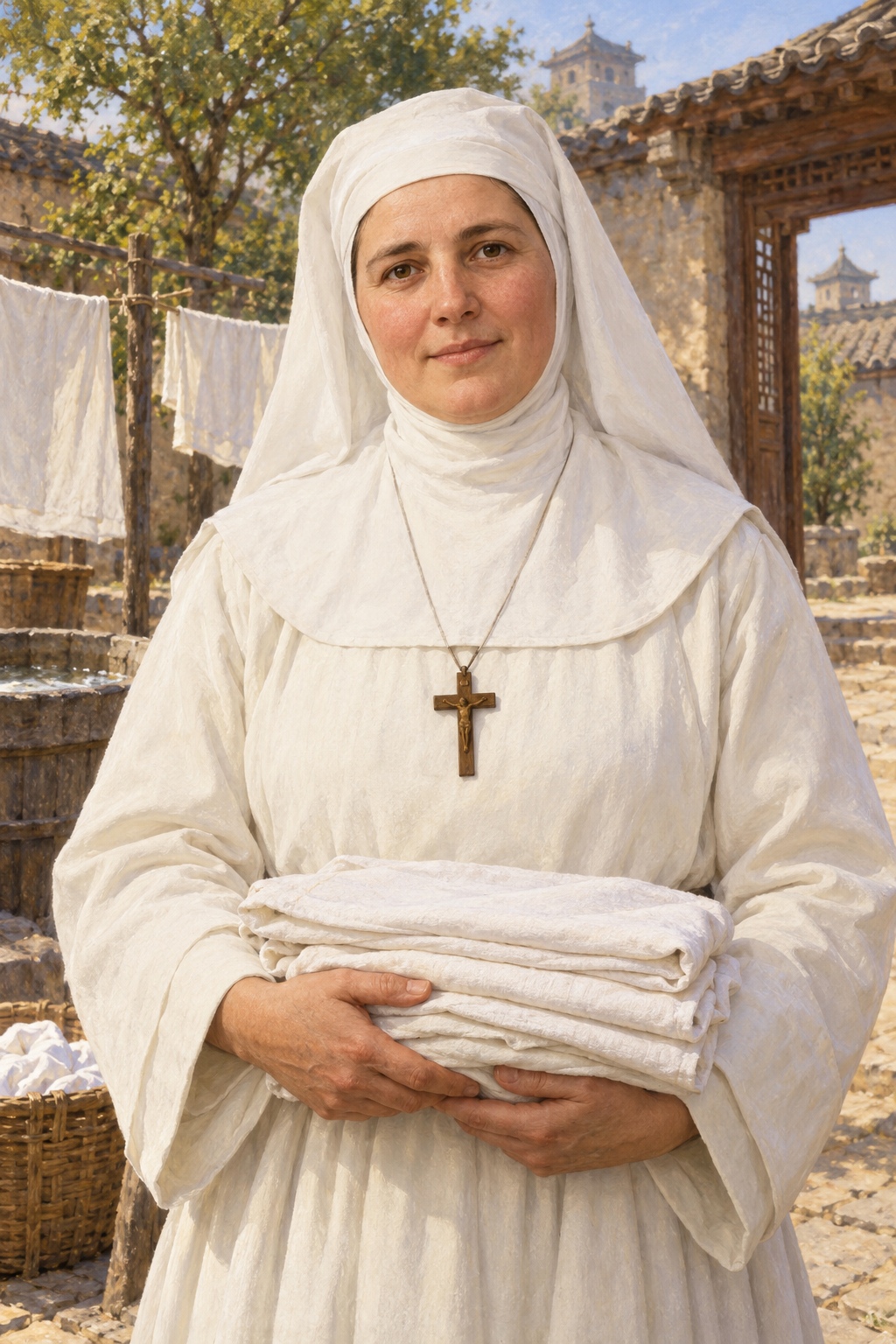
The same account remembers her determination to enter religious life despite family resistance. Within the congregation, she readily took on laundry, ironing and other heavy tasks. Poverty had limited her schooling, but her practical abilities gave her a substantial part in the community’s daily work.
The diocesan account places her novitiate at Ploufragan, near Saint-Brieuc. She later served in Paris and Carthage. Illness interrupted her work in Tunisia, and she was sent to Italy. Mary of the Passion, the congregation’s founder, subsequently selected her for the group assigned to the girls’ orphanage in China.
At Taiyuan, serious illness again restricted what she could do. Borrelli and Flocchini report that, after months in bed, she resumed smaller tasks as her strength allowed. Her missionary life included receiving care as well as giving it.
Pius XII recalled this reversal when addressing pilgrims after the martyrs’ beatification in 1946. He described a woman who had hoped to contribute her physical strength, only to find herself suffering instead. His address interpreted her endurance in religious terms, as preparation for martyrdom. This is the Church’s devotional interpretation of her experience, rather than an independent medical record.
She was killed at Taiyuan on July 9, 1900. She was beatified in 1946 and canonized on October 1, 2000. Her feast is July 9.
Historian Roger R. Thompson questions the reliability of detailed reconstructed execution scenes. Their dramatic particulars should therefore be treated cautiously.
In Brittany, her memory is visible in the chapel of Locmaria. Jean-Jacques Tilly identifies her in a stained-glass window from 1931, among images connected with the area’s religious history. The window links the missionary’s distant death with the community where she was born. It records local remembrance, without establishing that she is the parish’s patron saint.
Wondering how to weigh the stories and sources? Learn how to read a saint biography.