Biography
Mechtilde of Hackeborn
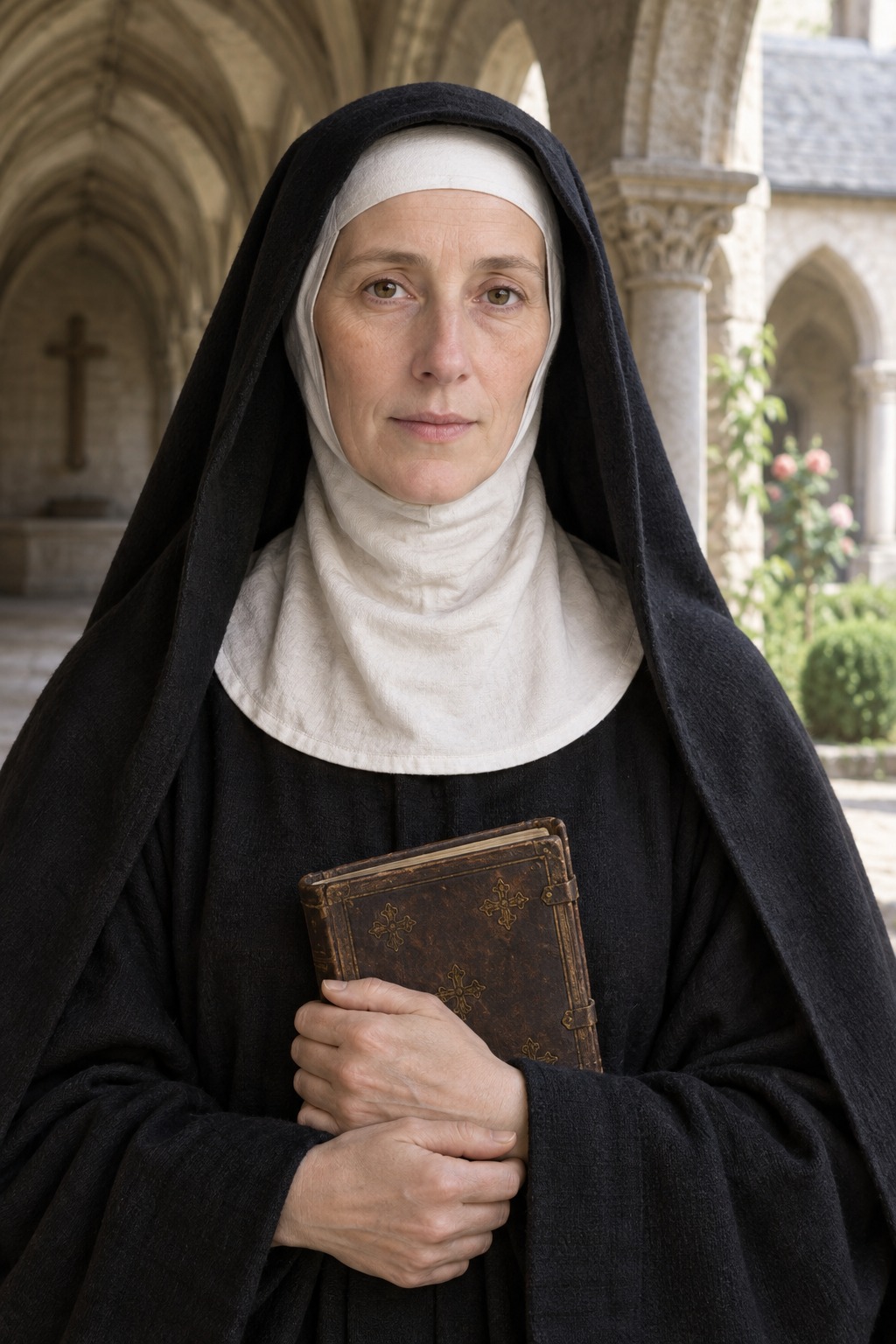
About Mechtilde of Hackeborn
Mechtilde of Hackeborn was a thirteenth-century nun, teacher, musician, and mystic associated with the monastery of Helfta in Saxony. Her name appears in several modern forms: Mechtilde and Matilda in English, Mechthild in German, and Mechtildis in Latin. Linus Ubl's peer-reviewed biographical study places her birth about 1241 or 1242 and her death about 1298 or 1299. Exact dates cannot be recovered with certainty from the surviving evidence. Her family belonged to the Hackeborn nobility, and her elder sister Gertrude became abbess of the community in which Mechtilde spent almost all her life. The two sisters must be distinguished from Gertrude the Great, Mechtilde's younger pupil, and from the older writer Mechthild of Magdeburg.
According to the prologue of the Liber specialis gratiae, Mechtilde entered the convent at Rodarsdorf when she was seven. Medieval entry at that age combined schooling with gradual formation; the evidence does not require imagining a modern adult vocation decision by a child. The community educated her in Scripture, Latin liturgy, reading, and music. Her sister Gertrude became abbess in the early 1250s. In 1258 the entire house moved from Rodarsdorf to Helfta, on property connected with the Hackeborn family. The move created the institutional setting in which Mechtilde's teaching and devotional life developed. Both the childhood story and its chronology come through a hagiographically shaped prologue, so they are best treated as probable rather than exact administrative history.
Helfta is often labeled either Benedictine or Cistercian. Benedict XVI describes Mechtilde as a Benedictine nun, while modern scholarship notes the community's close relationship to Cistercian customs and networks. The labels should not be collapsed into a confident claim of formal incorporation where the evidence is debated. What is clear is that the convent maintained a demanding common life of prayer, study, education, and work. Under Abbess Gertrude of Hackeborn, it became known for learned women and theological writing. Mechtilde of Magdeburg probably spent her final years there, and Gertrude the Great was formed there. This was not an isolated genius surrounded by passive companions; Helfta's achievements depended on a literate community.
Mechtilde served as chantress and taught in the convent school. Sources praise her voice and knowledge of sacred music, sometimes calling her the nightingale of Helfta. The title is devotional, but the responsibilities behind it were practical. A chantress prepared and led music for the daily offices, trained other singers, and helped sustain the community's liturgical calendar. The Neue Deutsche Biographie also identifies her as leader of the school. Gertrude the Great, who entered Helfta as a child, became her best-known pupil and later a close collaborator. Mechtilde's influence therefore traveled through instruction, rehearsal, correction, and repeated common prayer, even before any book circulated under her name.
The work associated with Mechtilde is the Liber specialis gratiae, the Book of Special Grace. It records visions, prayers, scriptural meditations, and teaching arranged around worship and the church year. Its authorship is collaborative. According to its own account, two sisters began writing material that Mechtilde had shared orally, initially without telling her. When she discovered the project, she was distressed, then eventually reviewed and corrected it. Benedict XVI identifies Gertrude the Great as contributing to the sixth book, while Ubl emphasizes that several sisters participated in the textual process. It is therefore misleading to call the Liber a private diary or a book simply written down by Mechtilde alone.
The Liber presents Mechtilde's spiritual imagination through the language of Scripture and liturgy. Its compilers say that Gospel words were nourishment to her and describe her meditating on Christ, Mary, the Eucharist, the Trinity, and the communion of saints. Images of the heart, music, light, and mutual exchange give the work much of its character. These visions are testimony preserved by her community, not events accessible to independent historical verification. Their significance lies in the theology and devotional practice they communicate. Mechtilde joined close reading with the sounds and repeated texts of worship, turning familiar antiphons, readings, and feasts into material for sustained reflection.
The text also reveals a culture of shared intellectual labor. Mechtilde taught and spoke; companions remembered, selected, organized, and copied; she later participated in correction; readers and scribes carried the work beyond Helfta. Modern manuscript research shows that the Liber circulated in multiple forms and was often excerpted or abridged. A digitized Latin edition preserves the six-book structure known in print, but no single late edition erases the earlier stages of composition and transmission. Collaboration is therefore one of the clearest virtues connected with her legacy. The book survived because a community judged her teaching useful and undertook the slow work of preserving it.
Mechtilde experienced serious illness during the final years of her life. The Liber and later summaries connect this period with the disclosure and completion of the book. Illness should not be treated as proof of holiness or made into a dramatic device that explains her thought. It changed her circumstances and increased her dependence on companions, while the community continued the intellectual and practical work around her. Ubl cautions that illness descriptions may employ literary conventions. The most defensible conclusion is modest: she lived with significant illness near the end of her life and died at Helfta around 1298 or 1299. Claims about an exact death day vary and are not firm enough to preserve as historical certainty.
Mechtilde's reputation spread through copies and translations of the Liber. The work reached readers outside Saxony and contributed to later traditions of affective devotion, liturgical meditation, and imagery of Christ's heart. Influence is difficult to trace as a single line because manuscripts were adapted and because Helfta's writers shared themes and collaborators. Her legacy is nevertheless substantial: she helped teach Gertrude the Great, led music and education in her own community, and became the central voice in a book produced through collective memory. Roman Catholic tradition commemorates her as a saint, commonly on November 19, while historical scholarship continues to examine the institutional and textual complexity behind that reception.
Mechtilde remains significant not as a solitary visionary detached from ordinary work, but as a teacher whose thought grew within communal disciplines. Music required rehearsal; schooling required attention to younger members; manuscript production required trust, judgment, and correction. The visions reported in the Liber belong to received religious testimony and should remain identified as such. The school, choir, relationships, and textual transmission are historically accessible forms of action. Together they show how a medieval woman's influence could move through teaching and collaborative authorship even when another person held formal authority as abbess. That combination of learning, art, prayer, and cooperation gives her a durable place in the history of Christian spirituality.
Wondering how to weigh the stories and sources? Learn how to read a saint biography.