Biography
Meinrad of Einsiedeln
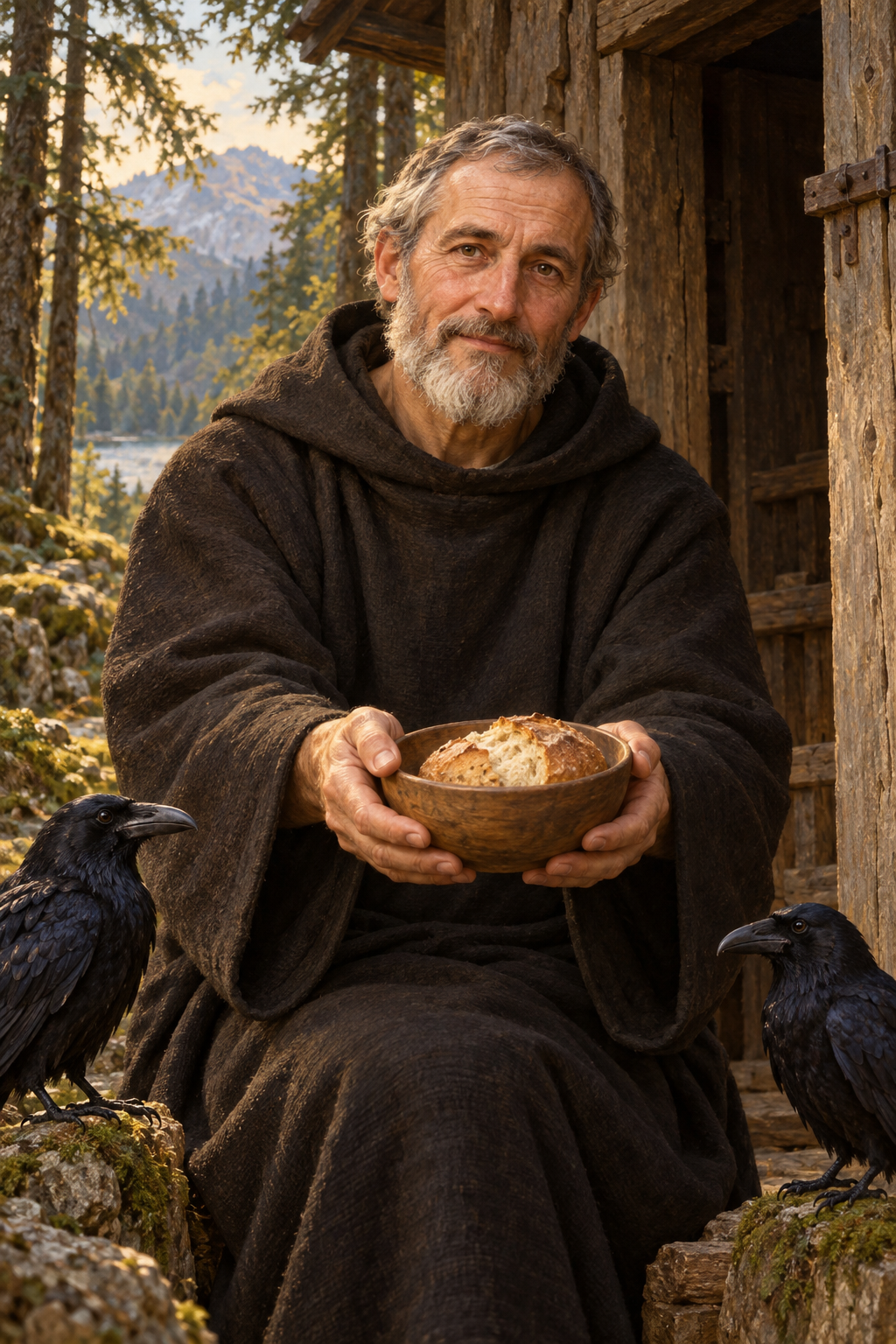
About Meinrad of Einsiedeln
Meinrad of Einsiedeln was a priest and Benedictine monk who became a hermit in the region south of Lake Zurich. His life belongs to the ninth century, before the founding of the monastery that now bears the name Einsiedeln. The Historical Dictionary of Switzerland places his origins in the Sülchgau of Swabia but considers his social background unknown. A birth year cannot be established.
He received his formation at Reichenau, an island monastery. The historian Franz Xaver Bischof describes his ordination as deacon at twenty-five and his subsequent priestly ordination. He entered the monastic community under Abbot Erlebald and later taught at a school near the upper part of Lake Zurich. Its identification with Benken remains a scholarly hypothesis. These details place his solitude after a period of education, priesthood and service in community.
Around 828 he withdrew to the Etzel. About seven years later he moved farther into the forest, to the site associated with present-day Einsiedeln. The abbey itself was established in 934, long after his death. Calling him its first abbot would therefore confuse the hermit whose memory shaped the place with the later institution.
Einsiedeln’s account describes a man seeking greater quiet as visitors continued to find him. It remembers fasting, prayer and generosity to people who came to his dwelling. According to the story, he welcomed even the two men who intended to rob and kill him, offering them food before his death. Those intimate details belong to the devotional narrative handed down about him; they are not a surviving eyewitness transcript.
Meinrad died on January 21, 861. Bischof reports the account of his murder by robbers while warning that martyrdom cannot be established with certainty. The designation martyr expresses the religious interpretation of his death within his cult. It should not be expanded into an otherwise undocumented execution by authorities for refusing to renounce Christianity. His remembered hospitality, rather than a known judicial persecution, gives the story its distinctive emphasis.
The familiar ravens also belong to that story. The abbey recounts two birds following the killers toward Zurich and helping bring their crime to light. Their pursuit is a legend, not independently verified evidence of how the murder was discovered. The birds nevertheless became a recognizable part of Meinrad’s image, preserving the tale in a form that could be understood without a written life.
The earliest surviving biography came from Reichenau in the tenth century. The Historical Dictionary dates demonstrable veneration to that century and records a much later expansion of the legend by Georg of Gengenbach in 1378. Its account also notes that devotion to Mary gradually overshadowed Meinrad’s cult at Einsiedeln. His continuing place in the monastery’s memory thus developed alongside a wider pilgrimage tradition rather than remaining its only focus.
His remains were brought from Reichenau to Einsiedeln in 1039, and he became the abbey’s patron. The return made his memory tangible at the place associated with his hermitage. Bischof also traces the later literary tradition into an illustrated block book of the fifteenth century, bringing the story to new audiences.
An engraving catalogued by the Einsiedeln archive and dated 1600 offers one example of that visual tradition. Its central scene shows the killing, accompanied by the two ravens, while twenty-seven smaller scenes surround it. The work is dedicated to Abbot Augustin. It documents how Meinrad was remembered many centuries after his death; it cannot establish an authentic portrait or make every depicted episode historical.
The monastery also remembers the translation of the relics on the second Sunday of October. In a 2026 homily, Father Philipp Steiner connected that observance with their return on October 6, 1039. He explained the raising and honoring of remains in its medieval setting, before the later papal canonization procedure became normative. This is not evidence of a modern papal decree. Steiner emphasized human dignity and imitation of Christ rather than treating relics as magical objects.
Meinrad’s patronage extends beyond Switzerland. The Indiana archabbey explicitly calls him a patron of hospitality. Its winter 2021 newsletter explains that the monks chose him as their monastery’s patron when they founded it in 1854, linking their new home with Einsiedeln. A commissioned statue by Alexander Tylevich was designed to show him holding bread and a cup. These ordinary objects make welcome, rather than the violence of his death, the subject of remembrance. The newsletter describes the artist’s use of the lost-wax process to cast the figure in bronze.
A cycle pilgrimage route opened in 2019 links Sülchen with Einsiedeln through Beuron, Reichenau and Fischingen, giving his remembrance a further geographical expression.
At Einsiedeln his principal celebration remains January 21, when the monastery and parish commemorate the saint associated with the beginning of their history. His memory invites attention to a demanding combination: a desire for silence and a willingness to receive another person. The celebration keeps that inherited example within the prayer and shared life of the community.
Wondering how to weigh the stories and sources? Learn how to read a saint biography.