Biography
Pega
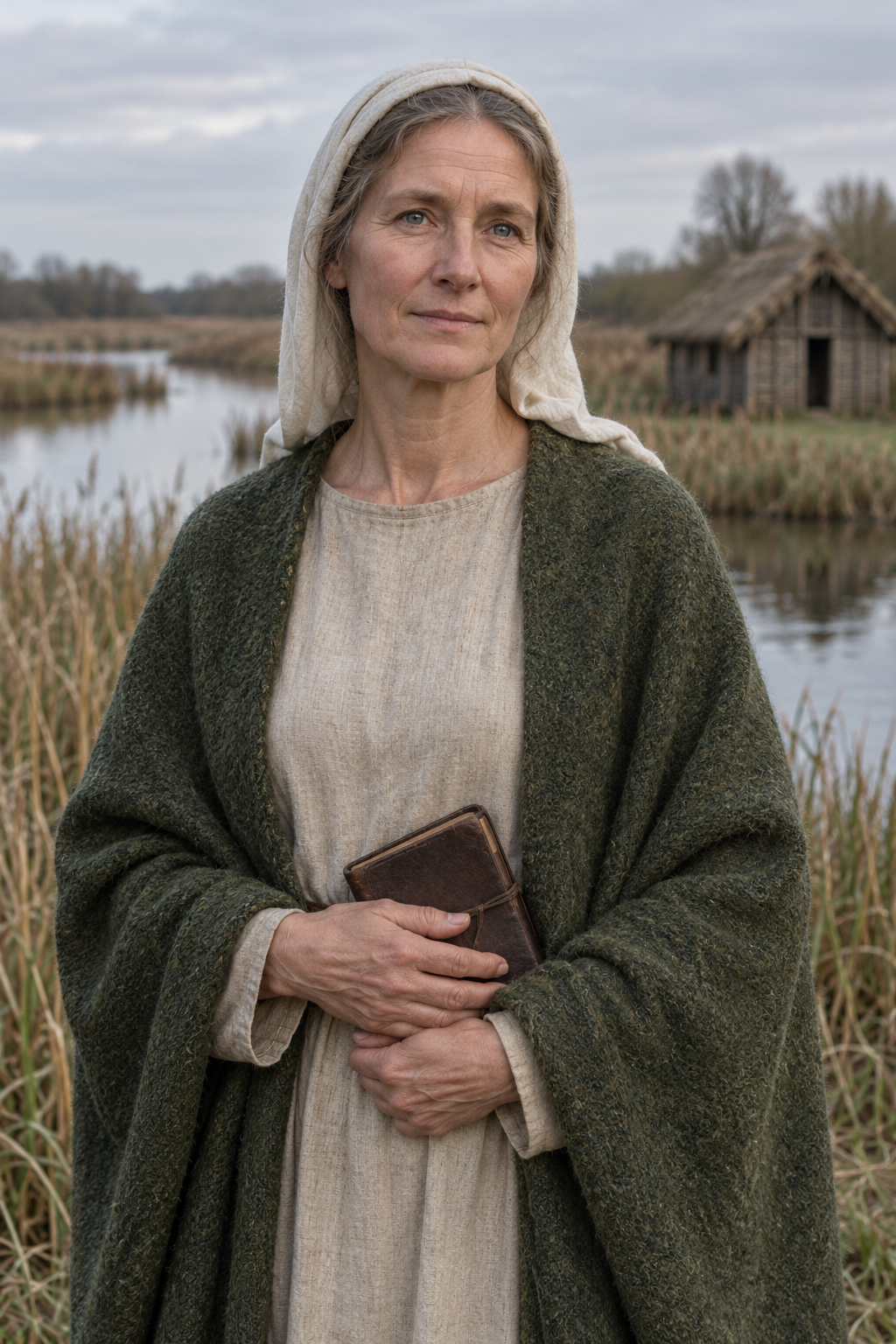
About Pega
Pega was an early eighth-century Mercian Christian woman, remembered as a hermit and the sister of Guthlac of Crowland. Her earliest appearances are in Felix’s Life of Guthlac, written within a generation of his death. Whether she had taken formal religious vows is unclear.
Felix describes Guthlac’s instructions to his servant before his death. Afterward, the servant was to tell Pega what had happened and ask her to prepare his body for burial. Guthlac explained their separation during life through his hope that they would meet in eternal joy.
The servant carried the news to Pega, who was overwhelmed with grief and came to the island the next day. She spent three days in prayer and praise before burying her brother in his oratory. A year later she arranged a further burial ceremony. Felix reports that Guthlac’s body was found incorrupt and that Pega wrapped it again before its enshrinement.
Another episode tells of a blind man who came to Guthlac’s oratory after his death. Pega admitted him and applied water containing salt that Guthlac had blessed. The Life presents the recovery of his sight as a miracle.
Later accounts place Pega’s hermitage at Peakirk. Orderic Vitalis, writing in the twelfth century, also claimed that she traveled to Rome after Guthlac’s reburial and died there around 719. Her association with Peakirk rests largely on later literature, place-name evidence and local tradition.
Pega is Peakirk’s traditional patron saint. Research by the local archaeological survey team has questioned the story of her Roman burial, while offering a possible local burial only as a hypothesis.
The village preserves her name and a church dedicated to her. Its earliest surviving masonry is late Anglo-Saxon, several centuries after her lifetime. The Catholic Church in Norway lists her feast on 8 January.
Wondering how to weigh the stories and sources? Learn how to read a saint biography.