Biography
Philip of Jesus
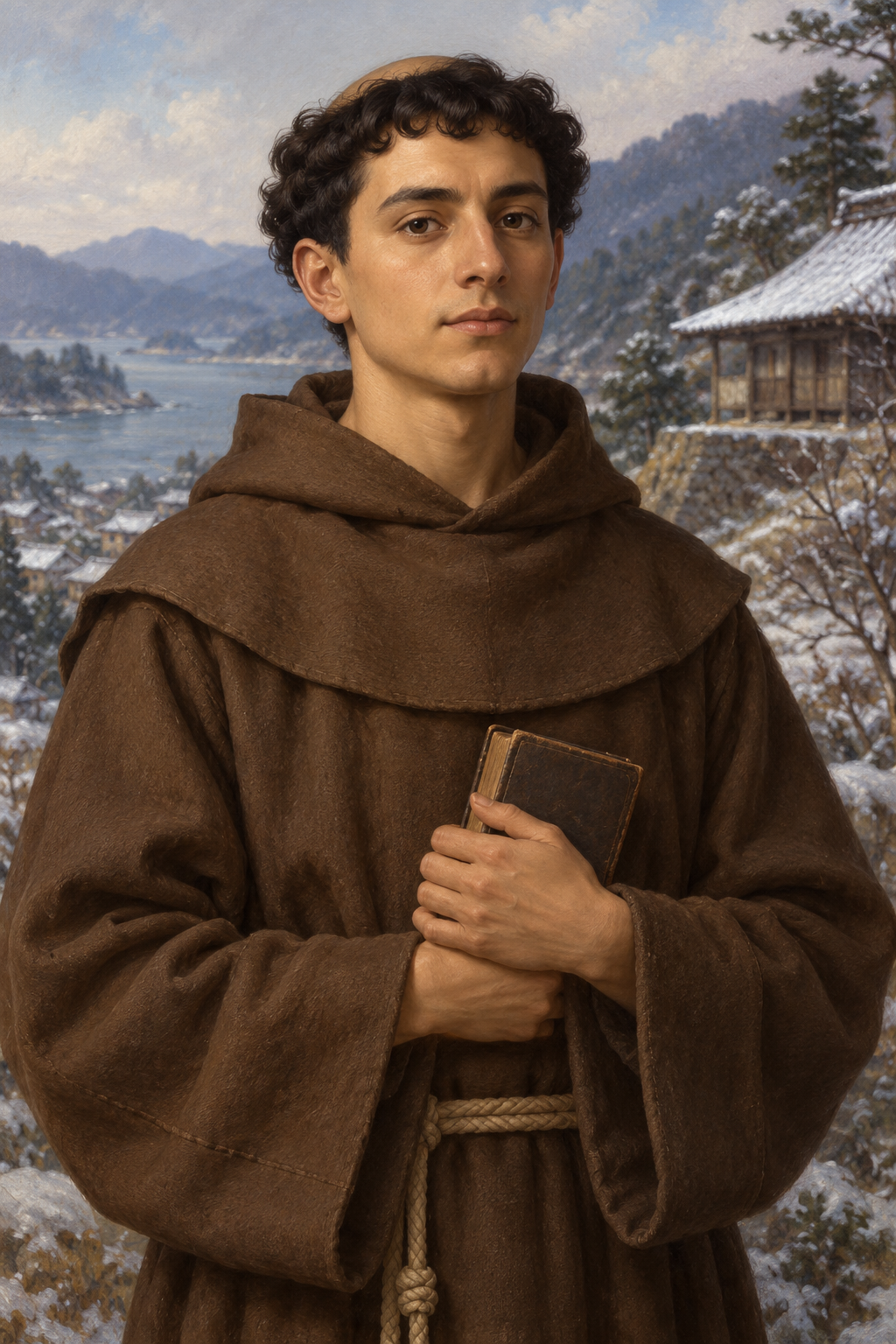
About Philip of Jesus
Philip of Jesus was a Franciscan friar from Mexico City whose interrupted journey home ended in martyrdom in Japan. Born in 1572 to Spanish parents, he belonged to a family connected with the commerce linking New Spain and the Philippines. Historian Enriqueta Vila Vilar identifies his parents as Alonso de las Casas and Antonia Martín and traces their migration through surviving passenger records. His childhood included an Atlantic crossing with his family, an early connection with the wider world through which he would later travel.
Accounts of his youth often emphasize disobedience and a dramatic change of life. Vila Vilar cautions that this presentation was shaped by hagiographers and should not be accepted uncritically in every detail. She records an early, unsuccessful attempt at Franciscan life in Puebla and his association with silversmithing. The craft later claimed him as a patron. These elements provide a firmer outline than the elaborate stories of youthful wrongdoing attached to him.
In Manila he returned to Franciscan life at the convent of Our Lady of the Angels. The historical dictionary of the Church in Latin America records his profession in 1594 and his work caring for sick people. In 1596 he embarked on the San Felipe, intending to return to Mexico for ordination. Storms drove the damaged vessel to Japan instead. He reached the Franciscan community associated with Peter Baptist, but his position as a stranded passenger did not protect him when the friars were arrested.
The prisoners were publicly punished and sent toward Nagasaki. Philip died there on February 5, 1597, among the Twenty-Six Martyrs of Japan. The accounts remember him holding to his Christian faith through the journey and execution. He had not completed the return for priestly ordination that had been the purpose of his voyage, and is remembered as a Franciscan religious rather than an ordained priest.
His reputation developed across the Pacific after his death. Art historian V. David Almazán Tomás describes the growing individual cult of Philip after the martyrs’ beatification in 1627. Pictures, printed lives and sermons helped connect the young friar with the pride of people born in New Spain. Public reading and preaching brought these stories to audiences who might never possess a book of their own.
The images also belong to the history of that remembrance. Almazán discusses the martyrdom murals preserved at Cuernavaca, where the group’s execution became a monumental subject. Their authorship remains unknown, and proposed connections with paintings brought from Macao are hypotheses. Such works show how a distant death was made present to worshippers in Mexico; they should not be treated as photographs or independent eyewitness accounts of every detail they depict.
Cornelius Conover’s study complicates the idea of an uninterrupted, universally popular devotion. Its published extract describes an established February 5 procession and cathedral ceremony in late-seventeenth-century Mexico City, but much less attention during the rest of the year. He identifies religious rivalry, civic self-promotion and belief as factors in the cult’s development. Philip’s place in the city’s memory was shaped by those social interests as well as personal devotion.
Canonization followed on June 8, 1862. The Archdiocese of Mexico’s newspaper identifies Philip as patron of the archdiocese and associates him with Mexican youth. It also reports later plantings of shoots from the fig tree linked to his story. The claim that a dry tree revived at the moment of his martyrdom belongs to devotional tradition; the subsequent commemorative plantings do not establish that miracle as a historical event.
His patronage took other local forms. Noé Guerra Pimentel, the official chronicler of Villa de Álvarez, traces Colima’s civic choice of Philip as patron against earthquakes and fires to 1668. He describes the later development of festivities at Villa de Álvarez. These are records of religious invocation and civic custom, not promises that devotion prevents natural disasters or fire.
In Mexico City, a pastoral zone bears his name, and the Iztacalco shrine has a joint dedication including Philip. The archdiocese describes its Japanese-inspired architecture as a deliberate reminder of the country where he died. Its community project draws on the fig-tree tradition as a symbol for renewing shared spaces.
The shrine’s construction in 1994 was led by Nicolás Álvarez Casillas. Parishioners helped raise money through fairs, raffles and a trail of donated coins. Its large stained-glass windows present scenes from Philip’s life alongside the apparitions of Our Lady of Guadalupe, bringing the shrine’s shared dedications into the building’s visible architectural design.
Nagasaki also preserves an individual dedication to him in Saint Philip of Jesus Church. The prefectural tourism authority explains that donations from Mexico helped build this church, designed by Kenji Imai alongside the martyrs’ memorial museum. Together with the collective dedication of Ōura Church to the Twenty-Six Martyrs, it connects Philip’s Mexican origins with the Japanese place of his death.
Wondering how to weigh the stories and sources? Learn how to read a saint biography.