Biography
Richard Reynolds
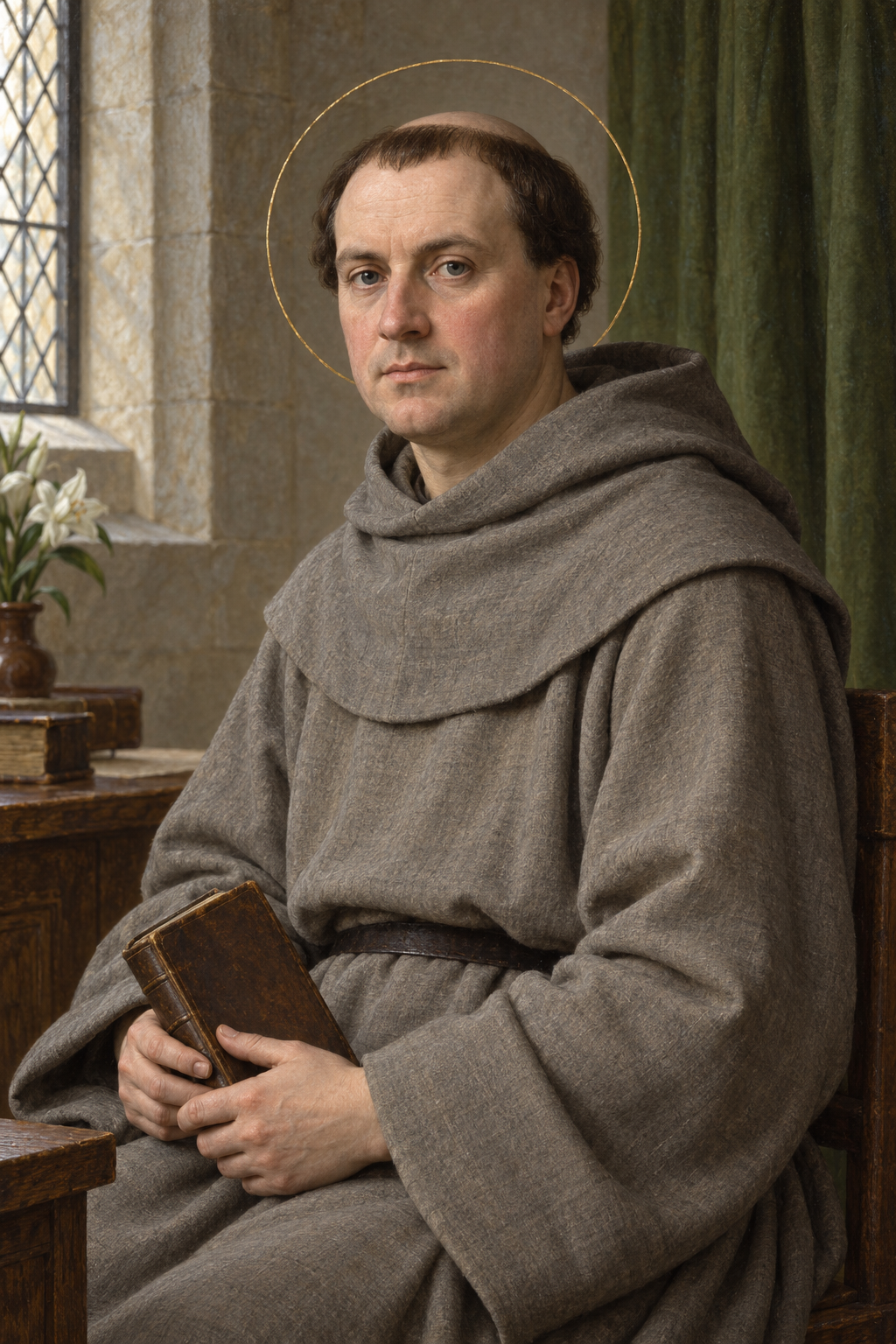
About Richard Reynolds
Richard Reynolds was a Bridgettine priest and monk of Syon Abbey who was executed at Tyburn on 4 May 1535. His refusal to accept Henry VIII’s royal supremacy brought him to trial alongside the first Carthusian martyrs. The Diocese of Plymouth remembers him among the Forty Martyrs canonized in 1970.
His early life is less certain than his university career. Adam Hamilton’s study locates him in Cambridge’s proctors’ accounts for 1504–1505 and in the following degree list. Reynolds studied at Christ’s College and later at Corpus Christi. Hamilton records a master’s degree in 1509 and a fellowship at Corpus Christi in 1510, while acknowledging uncertainty about when he moved between the colleges. His 1513 admission to the bachelor of divinity degree included an exemption from residence because he was preparing to enter religious life. Under Bridgettine rules of the period, a prospective member could spend his year of testing outside the cloister under direction. This provided a period of preparation before entering the enclosed community.
James Gairdner’s biography also identifies him as a leading scholar. It preserves Cardinal Reginald Pole’s praise of his knowledge of Latin, Greek and Hebrew, as well as a visitor’s comparison of his countenance and spirit to an angel. Such testimony helped shape his later remembrance as the Angel of Syon. The university exemption also referred to the authority he expected to preach under a papal bull.
Syon was England’s only Bridgettine house. Its community of nuns and priests valued austerity and scholarship and developed an important library. The abbey also welcomed pilgrims who came to Mass and to hear sermons in English. The site’s history places it close to the Tudor royal household across the Thames at Richmond. Reynolds’s life there brought him into a community whose religious commitments would come into conflict with the Crown.
In 1535 he was questioned before Thomas Cromwell about royal authority over the Church. He refused to accept the supremacy and was sent to the Tower. At his trial he appealed to the wider Christian Church, its councils and teachers, rather than the parliamentary judgment set against him. Gairdner relates the jury’s initial hesitation over whether the denial met the statute’s requirement of malice. Pressure from Cromwell preceded the guilty verdict. Reynolds asked for time to prepare for death.
William Roper’s life of Thomas More preserves a remembrance of the journey from the Tower. Roper reports that More, looking from his window with his daughter Margaret beside him, saw Reynolds and three Carthusian monks being led to execution. More spoke admiringly of their readiness and their long religious discipline. The scene comes through a family biography written later, but it shows how Reynolds’s death became part of More’s remembered final months.
The community he left did not immediately disappear. Syon’s official history records that the abbey was dissolved in 1539 and that many members went into exile together. After a brief return under Mary I, they maintained their identity abroad before returning to England in the nineteenth century. Reynolds’s remembrance traveled with a community that continued to preserve its liturgy, books and common life through displacement.
One object associated with him was a carved portion of the old abbey gateway. The Syon Abbey Society’s 2012 newsletter reports the belief that part of Reynolds’s body had been displayed on this stone after his execution. The community treasured it through its years of movement. In 2011, when the remaining sisters left their Devon abbey, the stone was transferred to the Church of the Blessed Sacrament in Exeter. A chasuble used for his feast, a painting and other materials concerning his life went with it. The report presents the association with his remains as a belief, rather than a demonstrated identification.
Plymouth’s diocesan calendar keeps an individual memorial on 5 May, alongside the national commemoration of the English Martyrs on 4 May. Its historical note cautiously connects him with Pinhoe near Exeter. Hamilton’s earlier investigation likewise treated a Devon origin as a conclusion drawn from family and local connections, rather than a recovered birth record. No secure account of his childhood accompanies the fuller evidence for his education and death.
Reynolds is also the patron of St Richard Reynolds Catholic College in Twickenham. Its patron page describes a painting commissioned for the college’s official opening in 2013. The artist, Jared Gilbey, represented him with a book and a martyr’s palm, accompanied by figures and places connected with his life. This is a modern devotional image. The college’s use of his name and memory joins the scholar and martyr to a new educational community near the place where he lived as a monk.
Corpus Christi College’s own history remembers Reynolds among members who suffered during the Reformation, alongside people of different religious allegiances. His place in that history keeps his scholarly life visible beside the better-known record of his death.
Wondering how to weigh the stories and sources? Learn how to read a saint biography.