Biography
Robert Bellarmine
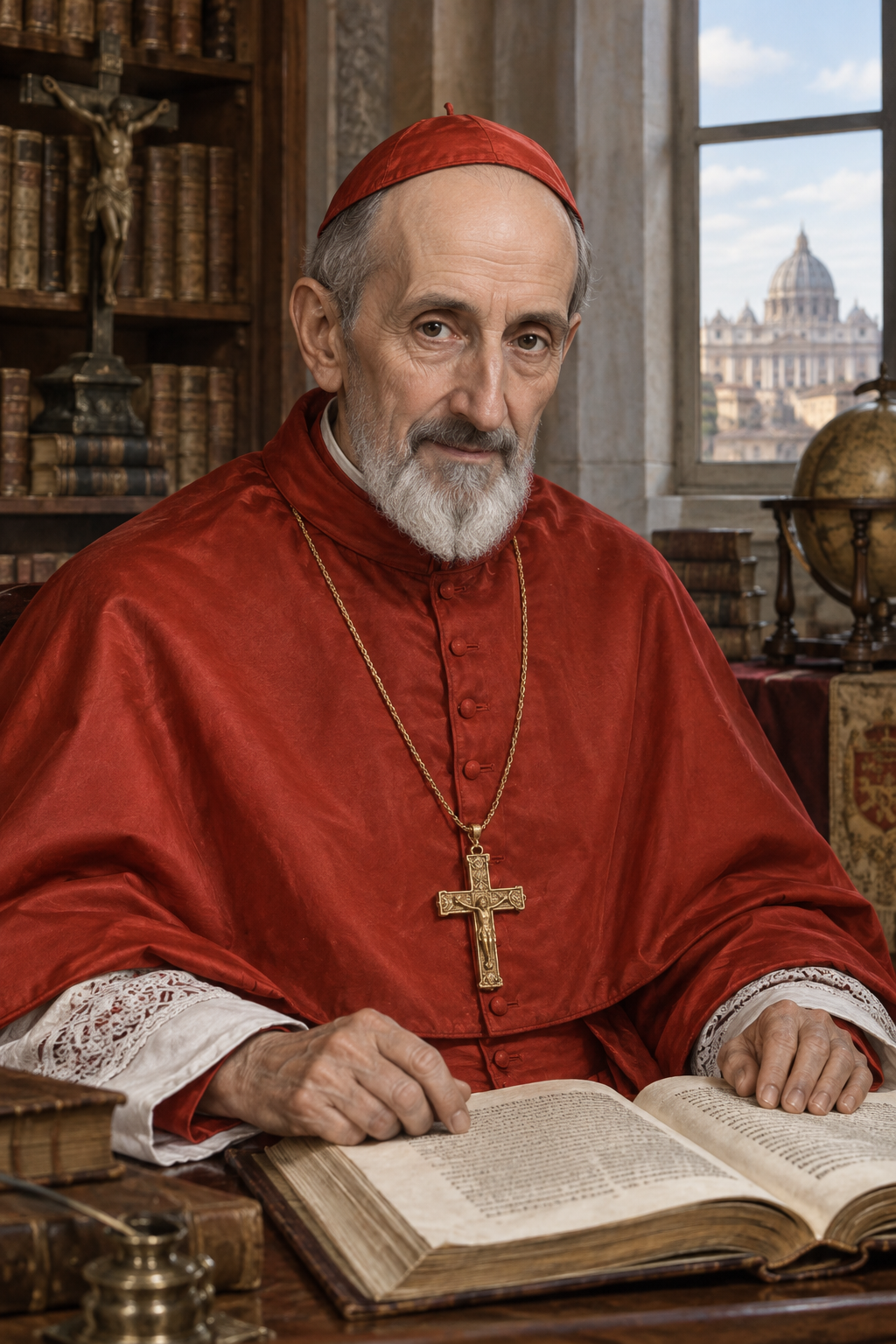
About Robert Bellarmine
Robert Bellarmine grew up in Montepulciano, where he was born on October 4, 1542. His parents were Vincenzo Bellarmino and Cinthia Cervini, whose brother became Pope Marcellus II. He entered the Society of Jesus in 1560 and studied philosophy at the Roman College. Teaching took him to Florence and Mondovì before he began theology at Padua and continued at Louvain. His formation thus combined the humanities with the theological questions that divided Christians in his time.
At Louvain he became a priest in 1570 and taught theology in the Jesuits' newly opened theologate. His courses answered objections raised against Catholic teaching by the Protestant Reformers, particularly Luther and Calvin. When he returned to the Roman College in 1576, controversy became his principal teaching responsibility. The lectures developed into the Controversies, whose first volume appeared in 1586. Alongside this substantial work he wrote a catechism for a much wider readership. His work moved between advanced theological argument and the more elementary task of explaining Christian belief.
Bellarmine's theological writing addressed revelation, the sacraments and the nature of the Church. He treated the Church as both a visible institution and a spiritual body, using the relationship of body and soul to explain their connection. In his 2011 account, Benedict XVI emphasized Bellarmine's effort to present Catholic doctrine through reason and inherited Christian teaching. The work belonged to the Catholic response to the Reformation after the Council of Trent. Its concern for the Church's identity was inseparable from the disputes in which its author was engaged.
At the Roman College he also served as spiritual director to Aloysius Gonzaga. During the epidemic of 1591, Gonzaga cared for sick people and spoke to Bellarmine about his expectation of an early death. The Jesuit account preserves this as Gonzaga's reported premonition, not as an independently established prediction. Their relationship places Bellarmine within the personal life of the college, where spiritual guidance accompanied formal study and the practical demands of caring for others.
His responsibilities expanded when he became rector of the Roman College. He contributed to the Ratio Studiorum, the educational plan for Jesuit schools. Clement VIII made him a cardinal in 1599, and in 1602 he became Archbishop of Capua. The appointment brought responsibility for a diocese as well as the work of a theologian. He remained there until 1605, when service in Rome again became central to his life. These offices brought him close to the institutions through which the Catholic Church governed, taught and regulated religious belief.
At Capua, Bellarmine preached in the cathedral, visited parishes weekly and held diocesan synods. His teaching therefore reached congregations and parish clergy as well as students. He later served on several Roman congregations and defended the rights of the papacy in disputes involving Venice and England.
His defence of papal authority did not mean that every pope welcomed all his conclusions. Sixtus V considered placing the first volume of the Controversies on the Index because it allowed only indirect papal power over temporal affairs. The pope's death prevented the proposed action. In the dispute over grace and human freedom, Bellarmine advised allowing further theological discussion while restraining the opposing schools from condemning one another.
Bellarmine's role in the Galileo affair requires equal care. In 1616 he admonished Galileo against holding or defending the Copernican doctrine. He believed that a demonstrated account of nature could require reconsideration of a biblical interpretation, but did not accept that the necessary demonstration had been supplied. For him, successful mathematical prediction did not by itself establish the physical arrangement of the heavens. That position limited what Galileo could publicly maintain and was more than a general request for scientific caution. The later proceedings against Galileo took place in 1633; the significance and wording of the earlier restrictions remained disputed in the case. The episode exposes a conflict over evidence, biblical interpretation and institutional authority within the intellectual world Bellarmine helped govern.
His spiritual writings addressed another form of preparation: how to live in view of death. In the opening chapter of The Art of Dying Well, he distinguishes guidance for people in health from guidance for those approaching death. He begins with conduct and virtue, then turns to the sacraments. The example of the penitent thief allows him to discuss repentance even at life's end. Bellarmine does not treat that example as a reason to delay conversion; he describes the thief's defence of Jesus and concern for his companion as real acts of faith and charity. The chapter connects a good death with the shape of the life that precedes it, making preparation a present responsibility.
Even as a cardinal, Bellarmine maintained a simple manner of life and gave surplus money to poor people. His annual retreats became occasions for writing on spirituality. In old age he sought permission to withdraw to the Jesuit novitiate in Rome, receiving it only shortly before his final illness.
He died in Rome on September 17, 1621. Pius XI beatified him in 1923, canonized him in 1930 and declared him a Doctor of the Church in 1931. His legacy includes catechetical and spiritual works alongside theological arguments shaped by an age of religious division.
Wondering how to weigh the stories and sources? Learn how to read a saint biography.
Explore similar vocations
Prayers for Robert Bellarmine
Robert Bellarmine: sourced prayer excerpt
grant, through his intercession, that in the integrity of that same faith your people may always find joy.