Biography
Robert of Knaresborough
About Robert of Knaresborough
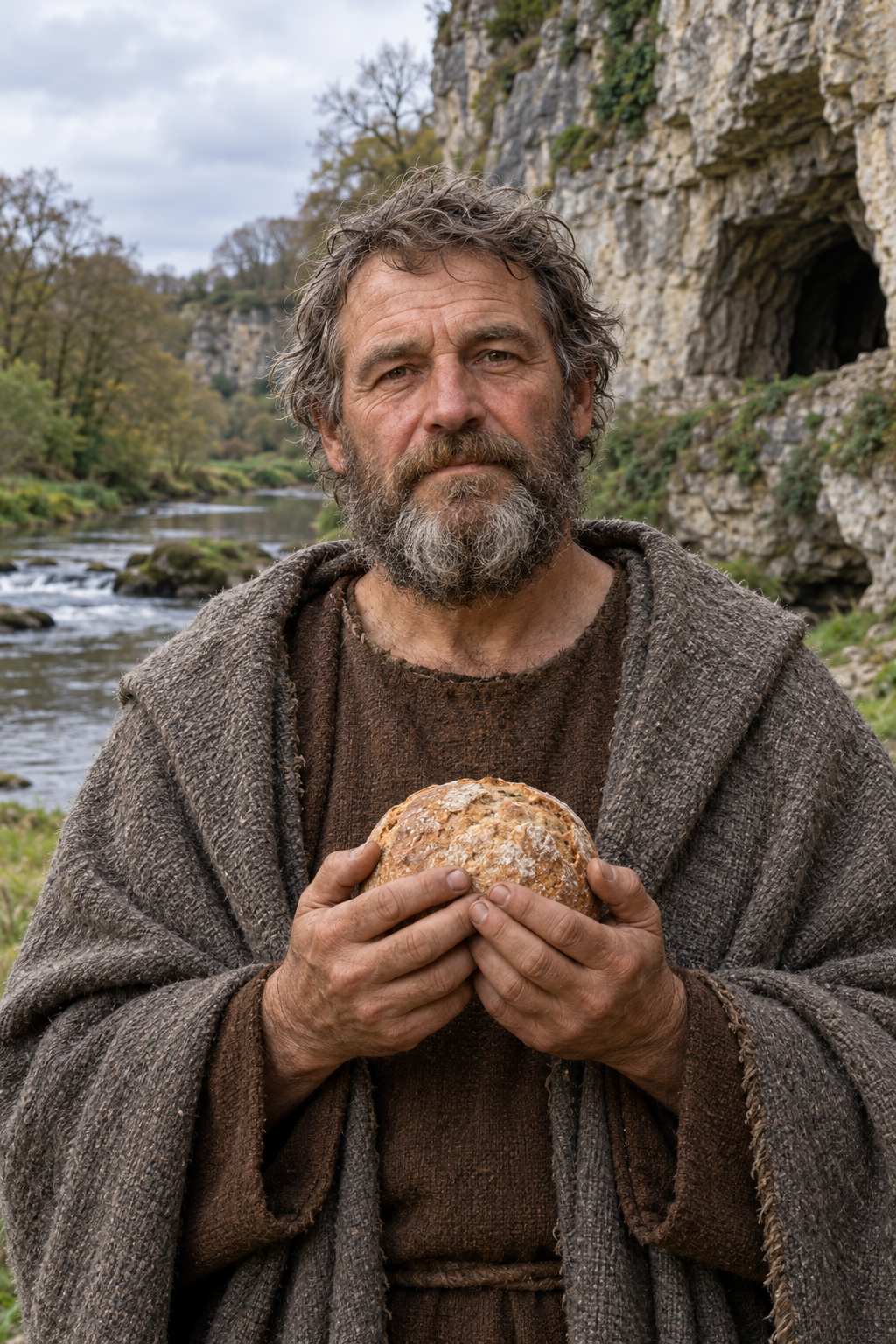
Robert of Knaresborough is remembered as Robert Flower, a man from York who made his home beside the River Nidd. His family name also appears as Floure or Fleur. The local church’s accounts place his birth around 1160 and his death on 24 September 1218.
The received account describes a young man from a prosperous family who was ordained subdeacon and frequently visited churches and monasteries. He spent time at the Cistercian abbey of Newminster before choosing the life of a hermit. His reputation drew pilgrims who sought spiritual counsel and healing.
Stories about earlier saints were part of the religious world his biographers attributed to him. One Latin Life describes Robert teaching his companion Ivo through examples drawn from their lives.
His search for a place to live brought him repeatedly into conflict with local authority. Historic England’s account describes his first stay with another hermit, his moves between different sites, and his eventual return to the cave beside the Nidd. In the tradition, the constable of Knaresborough repeatedly evicted him before allowing him to remain in peace. The story that warning visions changed the constable’s mind belongs to that devotional narrative. His brother Walter is credited with providing a chapel and living accommodation adjoining the cave. Robert continued to live there instead of entering a monastery.
A royal document provides a firmer point in the story. In February 1216, King John instructed Brian de L’Isle to give Robert the hermit half a carucate of land in the wood of Swenesco. The land was to be conveniently situated, as close as possible to his hermitage, and chosen so as to cause least damage to the royal forest.
The medieval Lives join solitude with practical charity. In their accounts, Robert’s small community worked land and helped poor people; different versions give him a more direct or more delegated role in collecting alms. Historian Hazel Hunter Blair shows why these differences matter. Writers preserved more than a sequence of events: they presented a model of holiness suited to their readers. Robert’s remembered generosity became especially important to the Trinitarian community that later cared for his shrine.
After his death, the hermitage remained a place of religious life. The Victoria County History records that its custody was granted to Alexander Dorset in 1219, and that Brother Ives later received the land previously given to Robert. By 1238, Matthew Paris was reporting his growing fame and stories of healing at his tomb. Such reports attest to the development of his cult, while their miraculous claims remain part of the tradition. In 1252, a papal indulgence encouraged support for completing the monastery where his body lay. The wording called him a saint, but that notice should not be treated as the text of a formal canonization.
The Trinitarians adopted Robert as the spiritual patron of their priory at Knaresborough. He had not founded a Trinitarian house and was not himself a member of the order.
Four medieval Lives survive in different forms: two in Latin prose, one in Latin verse, and one in Middle English verse. Blair’s public study of these texts draws attention to their changing emphases. An early account evokes the language of the wilderness, even though Knaresborough had a castle and a town. That language expresses a religious ideal rather than a precise description of an uninhabited landscape. The English poem presents Robert in the language of heroic adventure. Its central deeds, however, concern helping poor people and overcoming spiritual trials.
The surviving cave contains an L-shaped chamber cut into the limestone cliff, with the remains of the chapel and living area beside it. Historic England protects the site as a rare surviving medieval hermitage.
Robert’s local commemoration continues on 24 September. During the eight-hundredth anniversary of his death, pilgrims walked from Pannal to Knaresborough with clergy and the Bishop of Ripon. The church’s account explicitly acknowledges that he was never formally canonized while honoring him as a saint.
Wondering how to weigh the stories and sources? Learn how to read a saint biography.