Biography
Romanos of Karpenisi
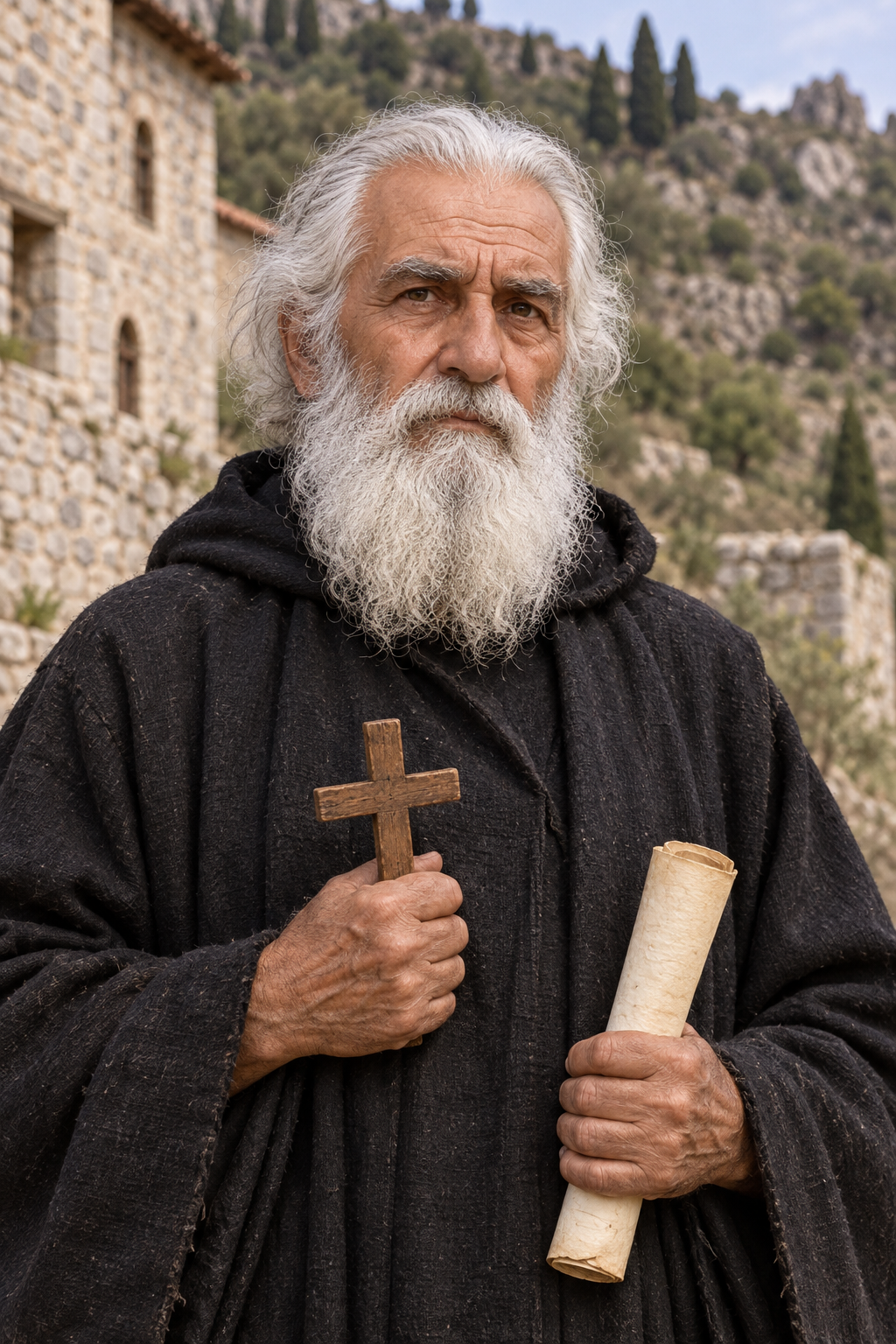
About Romanos of Karpenisi
Romanos of Karpenisi was an Orthodox monk commemorated as a martyr at Constantinople around 1694.
The New Martyrology describes a man who deliberately sought martyrdom. After confronting the authorities in Thessaloniki, he was condemned to galley service rather than executed. Christians obtained his release and sent him to Mount Athos. There he lived under the guidance of Akakios at Kavsokalyvia and received the monastic habit.
He then headed toward Jerusalem, but was warned that provoking the authorities could endanger the Holy Sepulchre. In Constantinople he publicly insulted Muslims and was arrested. The account describes imprisonment, torture and eventual beheading, while emphasizing his eagerness to die for his faith.
There is uncertainty about how this account relates to another saint named Romanos. In the Orthodox Encyclopedia, Pashkov examines a brief notice of Romanos of Lacedaemon, described as a priest-monk killed at Constantinople in 1695. The shared name, similar circumstances and neighboring dates suggest that the two notices may concern one person. A village name associated with the supposedly Laconian saint may instead point to the Karpenisi region. Pashkov favors identification, while noting that Sophronios Eustratiadis considered them distinct. The question remains unresolved; it would be misleading to present their separate notices as proof of two different lives.
Greek calendars commemorate Romanos on January 5 and February 16; the Russian calendar includes him with the Athonite saints on the second Sunday after Pentecost.
Images on Mount Athos preserve a further history of his veneration. Thomas Andreou’s study describes Romanos in the painted program at Xeropotamou as an elderly man with white hair and a full beard, carrying a cross and a closed scroll. The same study identifies an early eighteenth-century portable icon in the cell of Akakios at Kavsokalyvia, along with depictions in the cell’s chapel and the skete’s main church. These are traditional representations of a saint, not evidence that his physical appearance can be reconstructed with certainty. They show how his memory became part of the visual life of Athonite communities.
Wondering how to weigh the stories and sources? Learn how to read a saint biography.