Biography
Sigismund of Burgundy
About Sigismund of Burgundy
Sigismund of Burgundy was a king whose Christian memory includes a grave crime as well as repentance. He was the son of Gundobad, ruler of the Burgundians, and became his father’s successor in 516. Earlier he had governed as a subordinate king at Carouge, with his residence in Geneva. The Historical Dictionary of Switzerland first records him in 506 and dates his conversion from Arian Christianity to Catholic Christianity to that year. His first wife, Ostrogotho, was a daughter of the Ostrogothic ruler Theodoric.
Avitus, bishop of Vienne, helped shape Sigismund’s Catholic allegiance. The surviving traditions connect the ruler closely with churches and monasteries, particularly Saint-Maurice at Agaune. His conversion placed him within a different Christian communion from that of his father and some neighboring rulers. Accounts disagree about its exact date, so the change is clearer than its precise chronology.
Agaune was already a place of pilgrimage associated with Maurice and his companions. Sigismund’s foundation established a monastic community there and provided it with resources. The abbey dates its solemn inauguration to September 22,515, when Avitus preached. Monks gathered from several communities joined those already present. Five choirs maintained the laus perennis, the continual singing of praise. In this way the foundation joined royal support, hospitality for pilgrims and an ordered life of prayer at an existing sanctuary.
The community’s duties included guarding the sanctuary and receiving those who came to it. Its worship gave the foundation a lasting place in the religious life of the region. Continuous prayer was sustained by groups taking turns, rather than by requiring each individual to sing without rest. The abbey’s historical account describes other monasteries in Gaul adopting Agaune’s example. Sigismund’s most enduring foundation thus outlived the kingdom and the circumstances in which it began.
In 522 Sigismund ordered the strangling of his son Sigeric, the child of his first marriage. The Historical Dictionary attributes the decision to the influence of his second wife and records its political consequences: Sigeric was Theodoric’s grandson, and his death damaged relations with the Ostrogothic ruler. Sigismund became isolated between the Ostrogoths and the Franks. The following year a Frankish attack exposed the weakness of his position.
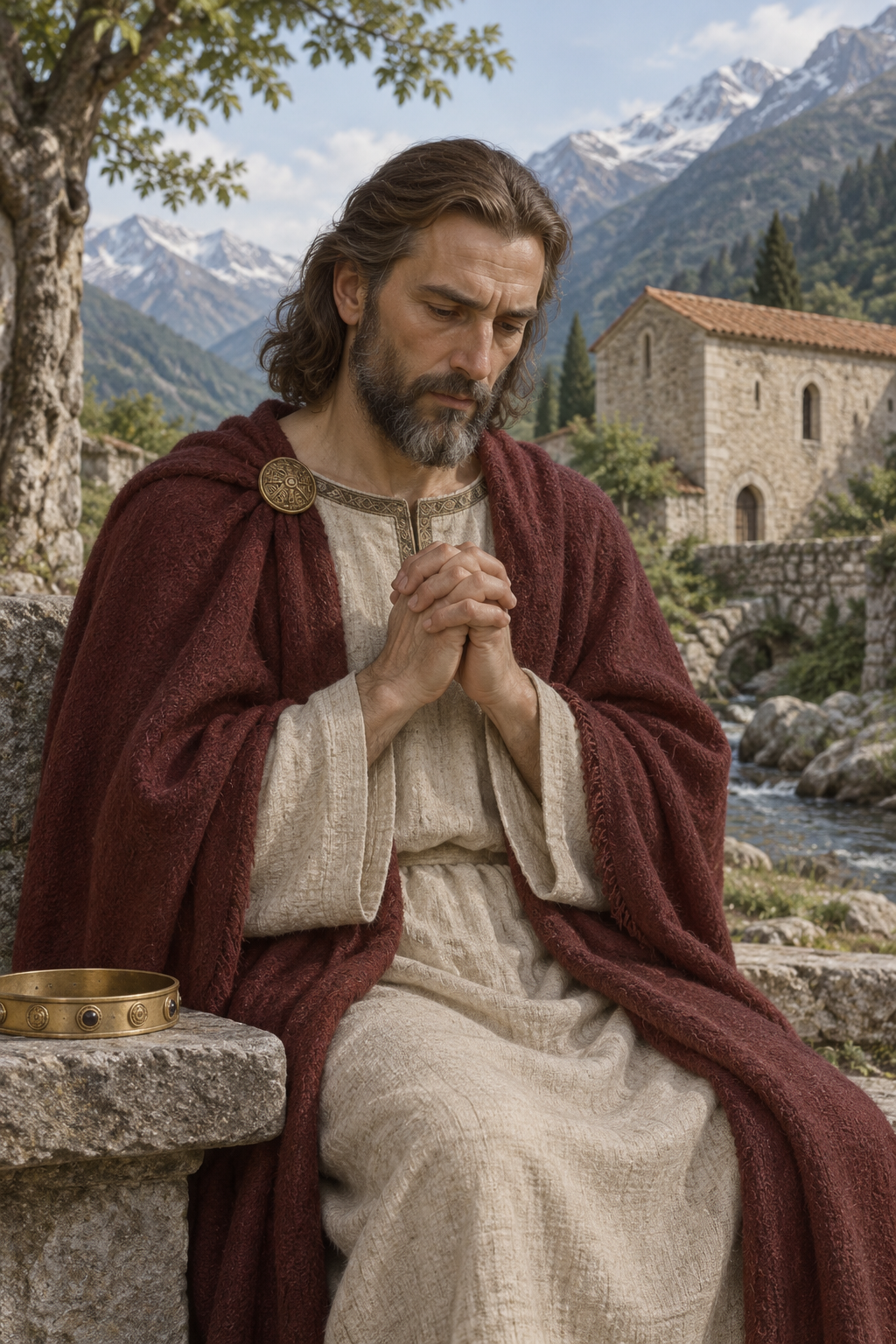
Gregory of Tours gives a fuller and sharply critical account. In his telling, the second wife accused Sigeric of plotting to take the kingdom. Sigismund accepted the accusation and had him killed while asleep. Gregory describes the father’s grief afterward, but also preserves an old man’s rebuke directing the king’s sorrow toward his own guilt. The innocence of the murdered son remains central to the story. Sigismund then went to Saint-Maurice, where he spent days weeping, fasting and asking forgiveness.
The king’s fall followed in the fighting with Clodomir. Gregory says that Sigismund was captured while trying to reach Saint-Maurice and was held with his wife and children near Orléans. An abbot named Avitus urged Clodomir to spare them. Clodomir refused, considering the prisoners a danger while he continued the war. He ordered the family killed and cast into a well at a village Gregory calls Columna. The narrative presents political calculation alongside the appeal for mercy.
The death is dated to 523 or 524. The precise place has also been described differently in the sources. Olivier Roduit’s study of the commemorative well notes that Gregory names Columna near Orléans, while Marius of Avenches gives only a broad location in Frankish territory. Later tradition connects the event with the village of Saint-Sigismond in the Loiret. These differences leave the general setting more secure than a single exact reconstruction of the family’s last journey.
Sigismund’s remains were taken back to Agaune and buried in the church of Saint John. The New Catholic Encyclopedia traces the subsequent spread of his veneration through relics and local churches. By the later Middle Ages, relics were kept at Prague and in the regions of Freising and Płock. A defeated ruler had become the subject of a religious memory that travelled well beyond his former kingdom.
That memory included a particular association with healing fevers. Dragoș Năstăsoiu describes a Mass connected with Sigismund’s cult, first linked to forgiveness for the king’s sins and later to prayers for healing through his intercession. The claims of cures belong to the history of devotion. In the fourteenth century Charles IV brought important relics to Prague and promoted Sigismund among Bohemia’s patrons. His son, Sigismund of Luxemburg, later encouraged the cult in Hungary, associating the Burgundian king with Stephen, Emeric and Ladislas.
Roduit also records the continuing local remembrance near Orléans. The church at Saint-Sigismond preserves a well and stained glass depicting the murder of Sigeric, the king’s penance and his own death. In 1924 the abbey supplied relics for an anniversary celebration. A further commemoration took place in 2024 under the bishop of Orléans. The surviving images preserve the painful sequence of crime, repentance and death within the same story.
Sigismund is commemorated on May 1 in the Norwegian church calendar notice. That notice also explains that the 2001 Roman Martyrology no longer gives him the martyr title used in earlier editions. His veneration centers on a penitent king and monastic founder, while the historical account continues to name the innocent son whose death he ordered.
Wondering how to weigh the stories and sources? Learn how to read a saint biography.