Biography
Simeon Berneux
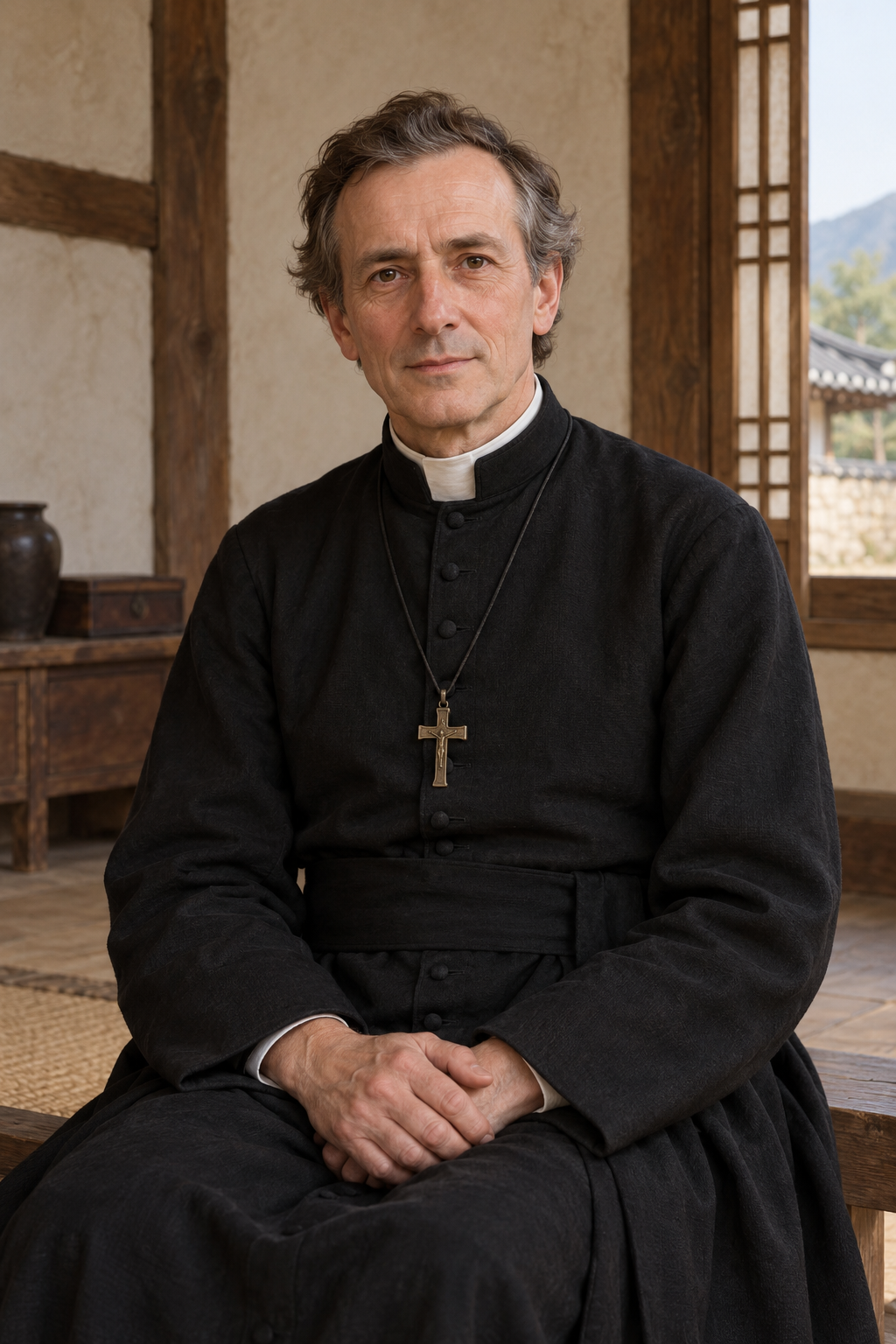
About Simeon Berneux
Siméon Berneux taught philosophy at the seminary in Le Mans after his ordination as a priest in 1837. He entered the Paris Foreign Missions Society two years later and left France in 1840. His first mission was in Tonkin, where he was arrested soon after arriving and condemned to death. He remained imprisoned until a French naval officer obtained his release in 1843. Berneux then went to Manchuria, studied the language and worked with Bishop Emmanuel Verrolles. After serving there for several years, he was appointed vicar apostolic of Korea and consecrated a bishop in 1854.
In a letter written in September 1856, Berneux described the voyage that finally brought him into Korea with two fellow missionaries. The party left Shanghai in January, but contrary winds kept their vessel waiting in Chinese ports. To conceal their presence, they spent much of the journey below deck in a cramped compartment. After reaching Korean waters in March, they still had to find the boat sent by the mission to meet them. For several days their ship searched the inlets and displayed the agreed signal, a flag bearing a cross. Korean Catholics eventually arrived and arranged a transfer to their smaller boat. Berneux and his companions later changed into mourning clothes, with broad hats and coarse garments that helped hide their faces. They completed the last part of the journey on foot and waited at a Catholic household until Seoul’s gates opened.
Writing to his former pupil Henri de la Bouillerie the following year, Berneux described his life in the capital. A Catholic family occupied the front of the house where he stayed, while he remained in the more private rooms behind it. His small room served as a place for study, meals, visitors and worship. Only a few catechists knew how to reach him. They brought news of sick Catholics and accompanied him when he went out to administer the sacraments. The catechists chose houses and arranged the times of gatherings, after which Berneux examined the participants’ knowledge of the catechism, gave instruction and heard confessions. He described celebrating Mass before daylight, then moving to another house before the city became busy. Outside Seoul, he walked between villages in the mountains.
In November 1857, Berneux reported another development in the mission’s organization. He had called his fellow missionaries to Seoul for Antoine Daveluy’s consecration as his coadjutor bishop. The ceremony took place at night behind closed doors. Although local Catholics wished to attend, he considered their presence too risky. The priests remained together for a three-day synod to discuss the work of the mission. During this gathering, the unexpected arrival of Father Féron increased the small group of clergy available to serve its communities. Berneux also reported that several Catholics previously imprisoned had been released, while two had been sent into exile. He welcomed the quieter circumstances but warned that this limited respite could end. His account describes organization and pastoral planning undertaken with the continuing possibility of arrest in view.
A letter to the mission’s directors in August 1858 explains some of the decisions behind that pastoral work. Berneux said that new converts were being required to receive more instruction and undergo a longer period of preparation before baptism. He also reported a painful loss: Father Maistre had died during the previous winter. When news reached him that Maistre was seriously ill, Berneux went to see him. Father Petitnicolas joined them after a long walk, and the two remained with their colleague during his last days. Berneux administered the sacraments and later helped bury him. He remembered Maistre as an adviser as well as a fellow missionary, describing the death as a personal loss within a mission already short of priests.
By 1861, Berneux was again writing about communities disrupted by persecution. He recalled traveling at night in search of shelter during the winter troubles that began in 1859. Along the way he encountered families fleeing through the snow, with children carried or led by their mothers. He also explained why the training of future priests remained scattered across several villages: a larger group studying with a European would attract attention. This letter records his hope that French naval pressure might obtain religious freedom in Korea. That was his expectation, rather than a concession already secured from the Korean government.
Berneux’s work included establishing a seminary and supporting the publication of Catholic books. On February 23, 1866, he was arrested and imprisoned. The priests Henri Dorie, Louis Beaulieu and Justus de Bretenières were also taken into custody. After interrogation and torture, they were condemned to death. The Korean bishops’ conference account dates their execution at Saenamteo to March 7, 1866. His letters preserve details of the Korean guides, hosts and catechists who enabled his ministry, together with the small gatherings and dispersed study that kept it concealed.
Wondering how to weigh the stories and sources? Learn how to read a saint biography.