Biography
Theodore Ushakov
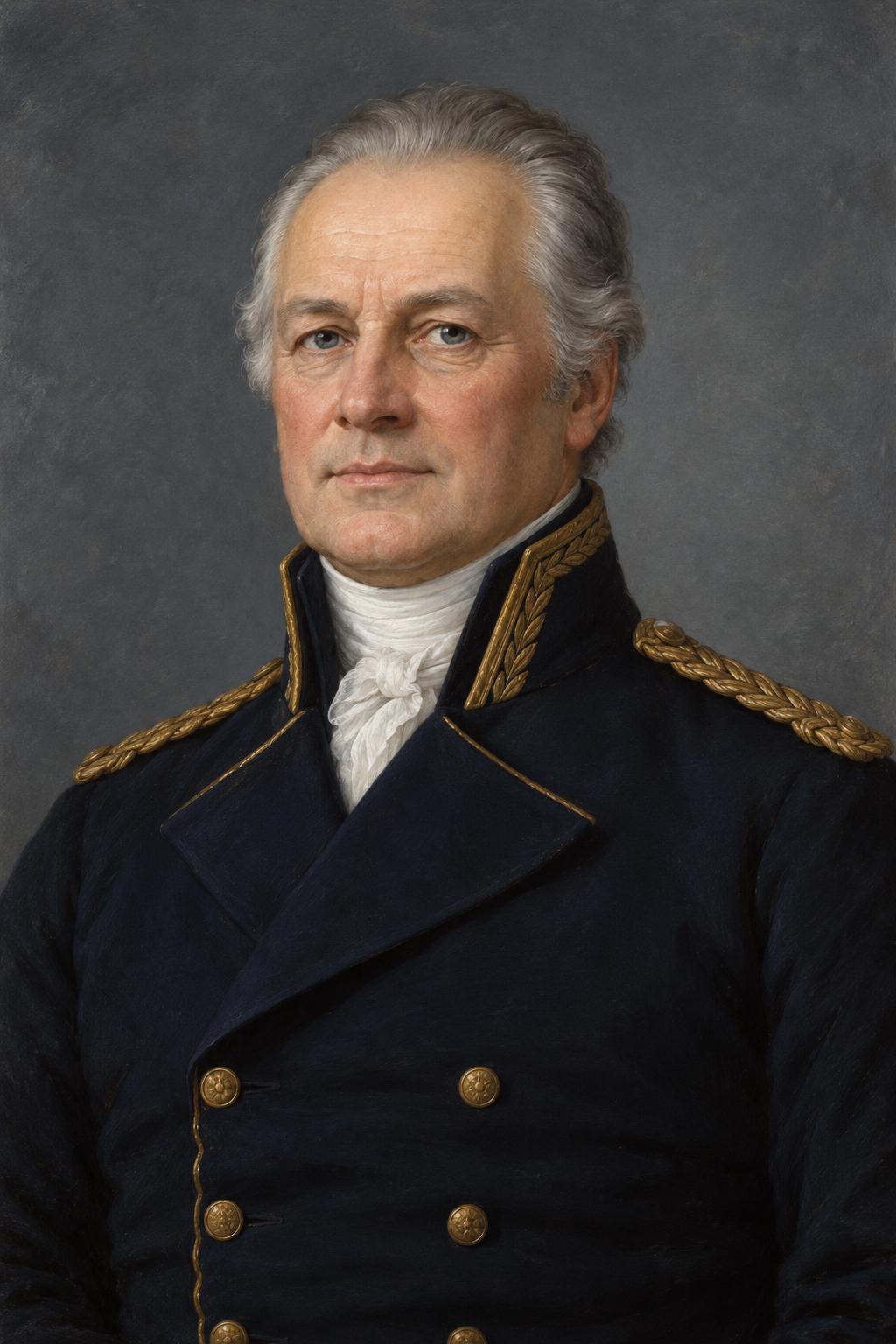
About Theodore Ushakov
Theodore Ushakov was a Russian admiral whose career included fighting in the Black Sea and the Mediterranean. He served in the Russo-Turkish War of 1787–1791 and also fought against French forces. The Orthodox Church in America remembers his visit to Corfu, where he venerated the relics of Saint Spyridon and supported Orthodox Christians.
Born at Burnakovo, Ushakov entered naval training as a teenager. His duties eventually brought him to the imperial yacht, but he soon returned to service aboard a warship. In 1783, while preparing the ship Saint Paul at Kherson, he confronted an outbreak of plague. The Presidential Library’s account describes his moving the crew into tents outside the city and separating the sick from healthy sailors. A hospital and individual quarantine tents formed part of the arrangement. This episode concerns practical care for a crew before battle, rather than a victory at sea.
As a commander, he became known for concentrating force against selected parts of an opposing fleet. Instead of maintaining an evenly matched line throughout an engagement, he used maneuver and concentrated fire to disrupt enemy command, especially by attacking flagships. His Black Sea career also involved developing harbor facilities at Sevastopol. Naval organization and construction accompanied the fighting for which he became better known.
The Mediterranean expedition placed him in an unusual alliance. Russia and the Ottoman Empire, previously enemies, cooperated against France as French expansion threatened both powers. Ushakov commanded their combined naval force in the Ionian campaign of 1798–1799. The historian Valeriy Morkva emphasizes this shared operation: the ships and soldiers taking the islands did not belong to Russia alone. After the smaller islands fell, the stronger defenses of Corfu required a sustained siege.
The island of Vido was a key to those defenses. The naval museum describes ships covering the landing troops with artillery fire, followed by the surrender of the remaining French garrison there. Fighting also reached the forward defenses of Corfu itself. French representatives then approached Ushakov to seek a truce, and he demanded surrender within a day. The capitulation was signed in March 1799. The museum records deaths and injuries among the attackers as well as French losses; the operation should not be presented as a bloodless victory. Its outcome depended on the cooperation of ships, landing parties and allied troops against an extensively fortified position. The landing force included naval grenadiers and cadets from the Nikolaev naval school, whose participation brought men trained for different responsibilities into the same difficult coastal operation.
Military victory left political responsibilities. Ushakov and the Ottoman commander Kadir Bey proclaimed an amnesty for islanders who had collaborated with the French, promising respect for religion and private property. An assembly subsequently prepared a constitution that extended voting beyond the nobility to commoners meeting an income requirement. These arrangements did not settle the islands’ future by themselves. The Russian and Ottoman governments continued negotiating, and the Septinsular Republic emerged under their joint protection in 1800. Ushakov’s work on the islands therefore belonged to a larger diplomatic process, as well as to his naval command.
His naval formation began in Saint Petersburg, followed by service in the Baltic, Don-Azov and Black Sea forces. He became a senior commander and retired in 1807. Aristide LaVey’s study records that, when asked to return to duty during the war of 1812, he instead helped fund hospitals for wounded veterans.
In retirement, Ushakov lived near Sanaxar Monastery. He attended its Sunday and feast-day services and stayed there during Lent. The monastery’s abbot remembered him as a generous supporter. The church’s account also recalls his almsgiving to people in need. He remained a layman; his relative Theodore of Sanaxar was a different person, a monk who had died years earlier.
Ushakov died in 1817 and was buried beside the monastery church. The Orthodox Church in America records his recognition for veneration throughout the Russian Church in 2004. Its account places his religious life alongside his military reputation, particularly his prayer, material help for others and attachment to the monastery.
The Main Cathedral of the Russian Armed Forces names him as a patron of the Russian Navy. This is a specific modern Orthodox patronage, associated with the institution in which his military memory has a continuing place.
LaVey distinguishes the charitable reputation emphasized in his veneration from military success alone. The researcher also describes encountering an icon of Ushakov aboard the British warship HMS Ocean, where it had been given by visiting Russian naval officers. That encounter shows how representations of the admiral traveled beyond Russian churches.
His later image also has political uses. LaVey argues that Russian church, military and political leaders employ Ushakov’s image to promote an ideal of the Orthodox warrior and to extend cultural influence. This interpretation concerns the modern use of his memory, rather than a claim about the admiral’s own intentions.
Wondering how to weigh the stories and sources? Learn how to read a saint biography.