Biography
Thérèse of Lisieux
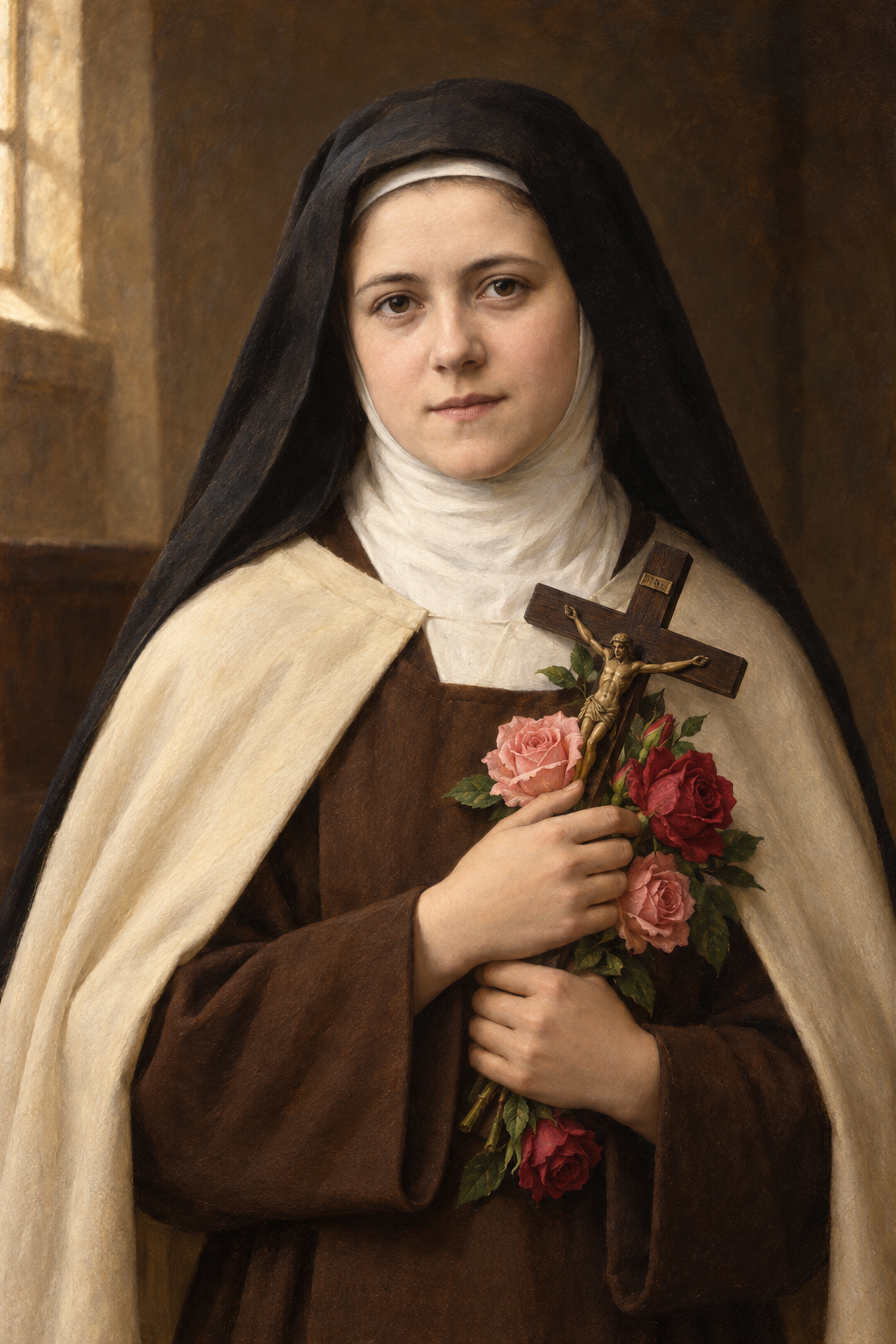
About Thérèse of Lisieux
Thérèse Martin was born in Alençon, France, on January 2, 1873, the youngest child of Louis Martin and Zélie Guérin. She was baptized two days later as Marie-Françoise-Thérèse. After her mother died in 1877, the family moved to Lisieux, where affection at home and education by Benedictine sisters shaped her childhood. Her First Communion on May 8, 1884, and Confirmation on June 14 became important markers in the spiritual memory she later recorded.
Thérèse's childhood was marked by grief, illness, and an intense religious imagination rather than by an uninterrupted serenity. She associated her recovery from a serious illness in 1883 with the intercession and smile of the Virgin Mary. At Christmas 1886 she underwent what she called a complete conversion, a turning from childhood sensitivity toward a more determined life of faith and service. Her prayer for the condemned prisoner Henri Pranzini then became an early expression of the missionary concern that would continue inside the cloister.
Because she desired Carmelite life before the customary age, Thérèse joined a diocesan pilgrimage to Rome and appealed directly to Pope Leo XIII on November 20, 1887. She entered the Carmel of Lisieux on April 9, 1888, received the habit on January 10, 1889, and made religious profession on September 8, 1890. Her religious name, Thérèse of the Child Jesus and the Holy Face, joined contemplation of Christ's infancy with his suffering and self-gift. The Church remembers her as a Discalced Carmelite whose vocation unfolded within a small enclosed community rather than through public office or travel.
At Carmel she followed the ordinary schedule of prayer, community worship, work, and obedience, carrying out the tasks assigned to her. Her father's grave mental illness and death in 1894 deepened her meditation on the suffering face of Christ. She helped form novices and corresponded with two missionary priests, supporting their ministry through prayer and sacrifice. Her missionary identity therefore rested on intercession and charity: the conviction that a hidden life of love could serve people far beyond Lisieux.
On June 9, 1895, Thérèse made her Offering to Merciful Love, entrusting herself to God's initiative rather than to a record of personal achievement. That year she wrote the childhood recollections now called Manuscript A; in September 1896 she composed the texts known as Manuscript B; in the summer of 1897 she began the unfinished Manuscript C. Together these writings traced her experience from childhood and entrance into Carmel to mature reflection on love, faith, and approaching death. They were written under obedience or at the request of her sisters, not as a finished autobiography planned for a modern reading public.
Thérèse's teaching is commonly called the little way of trust and love, or the way of spiritual childhood. It did not deny effort or responsibility; it rejected the illusion that holiness could be secured by self-sufficiency, status, or impressive works. She acknowledged her limitations and placed bold confidence in divine mercy, then joined that trust to concrete love of the sisters around her. Her most famous vocational insight was that love stands at the heart of the Church and can animate every genuine calling.
During the night of April 3, 1896, Thérèse experienced the first bleeding that signaled the illness leading to her death. At the same time she entered a prolonged trial of faith, describing spiritual darkness while continuing the common life and acts of charity. Her health worsened, and she was moved to the infirmary on July 8, 1897; her sisters recorded conversations from these final months. She died at the Lisieux Carmel on September 30, 1897, aged twenty-four, bringing a brief and outwardly hidden life to its close.
After her death, her sisters assembled the manuscripts and related material into Story of a Soul, first distributed in 1898 in place of the customary convent death notice. The book spread rapidly, but its early editorial form did not show readers the three manuscripts exactly as Thérèse had left them. Twentieth-century critical work published the autograph notebooks and clarified Manuscripts A, B, and C as distinct witnesses. Her letters, poems, prayers, plays, and reported final conversations further reveal a writer whose biblical and theological reflection exceeded the small scale of her setting.
Ecclesial recognition came with unusual speed: Pius XI beatified Thérèse on April 29, 1923, and canonized her on May 17, 1925. On December 14, 1927, he named her patroness of the missions together with Francis Xavier, affirming the missionary power of contemplative prayer. John Paul II proclaimed her a Doctor of the Universal Church on October 19, 1997, recognizing the depth and broad value of her teaching despite her youth and lack of academic training. The United States calendar keeps her Memorial on October 1 as Saint Thérèse of the Child Jesus, Virgin and Doctor of the Church, while her little way continues to invite ordinary acts of trust, love, and mission.
Wondering how to weigh the stories and sources? Learn how to read a saint biography.