Biography
Domingo Henares de Zafra Cubero
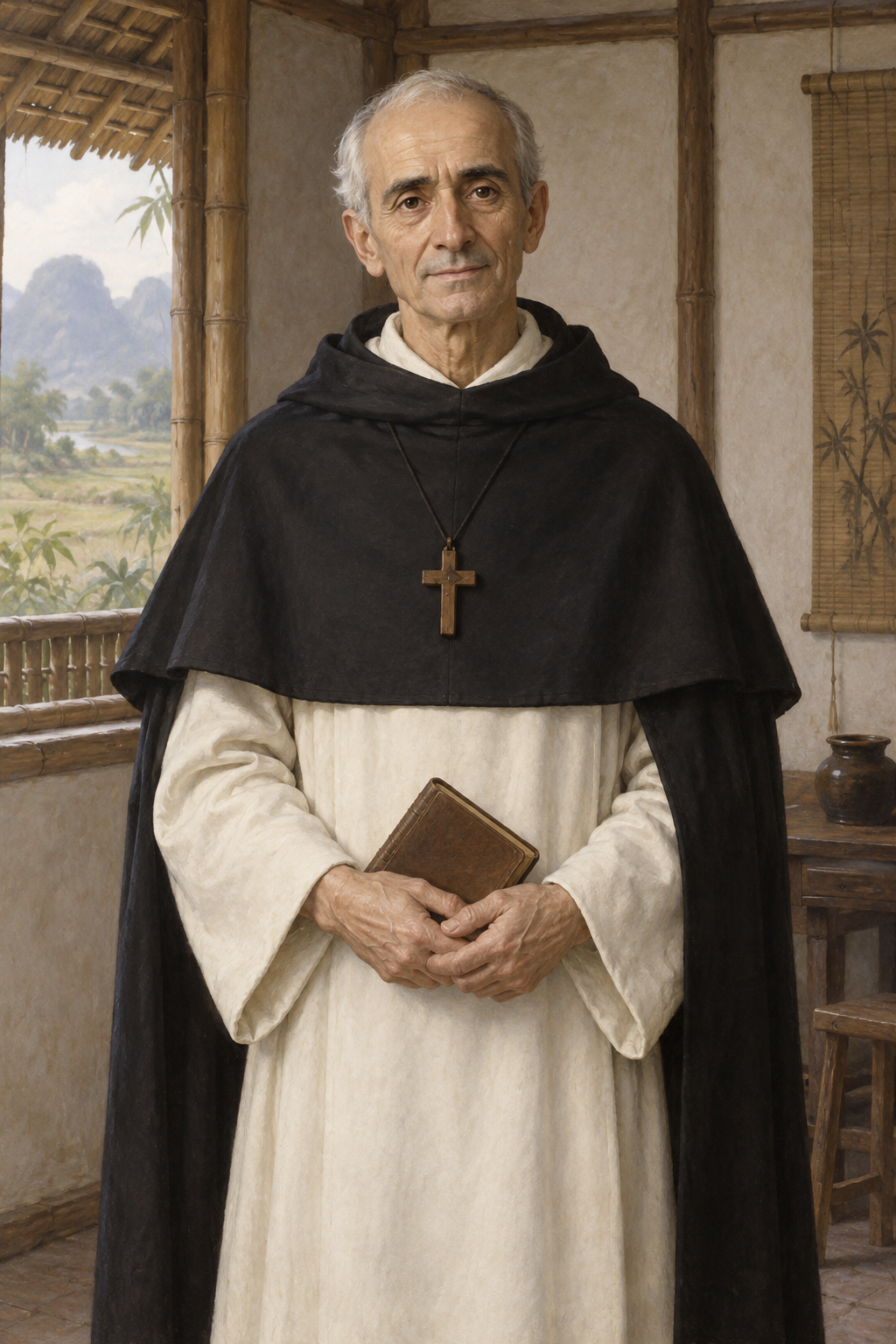
About Domingo Henares de Zafra Cubero
Domingo Henares was a Spanish Dominican whose missionary work took him to the Philippines and then to Tonkin. The Dominican account remembers both his intellectual interests and a gentle manner in dealing with others. His life joined study to pastoral work, eventually placing him alongside Ignacio Delgado in the leadership of the Catholic mission.
Carlos Villoria Prieto dates his birth at Baena to December 19, 1766, citing a published baptismal record. Some devotional accounts instead give 1765. His parents were Pablo Henares Vázquez and Francisca de Zafra Cubero y Roldán. He received the Dominican habit in 1783 and made profession the following year. The record quoted by Villoria identifies his affiliation with the convent at Guadix, a useful distinction from accounts that simply place his entry at Granada. Before profession, he underwent an examination in July 1784. The formal Dominican commitment followed on August 31. Villoria’s use of the profession record helps anchor this early stage in documentary evidence.
His departure for Asia required a journey through the Americas. Villoria traces the expedition from Spain through Puerto Rico, Havana and Veracruz, then overland to Acapulco. The missionaries crossed the Pacific to Cavite in 1786. Henares continued his studies at Santo Tomás in Manila and also taught there. Villoria places his priestly ordination at Vigan in September 1789, before his arrival in Tonkin the following year.
Letters excerpted by the Diocese of Córdoba describe years of preparation. In January 1787 he told his father that further study remained. Writing from Macao in March 1790, he described the difficulty of finding passage toward a country whose ports were closely watched.
Guido Pettinati’s account places him in charge of the seminary at Tiên-Chu, where Vietnamese candidates prepared for the priesthood. It also describes successive responsibilities within the Dominican mission before his appointment as Delgado’s coadjutor bishop in 1800. He was consecrated in 1803. These responsibilities involved supporting a local clergy, not simply travelling as an isolated European preacher.
The diocesan biography describes him buying cloth, sewing and repairing garments during hours otherwise available for rest. Children and older people received particular attention. This practical care gives a concrete form to his remembered generosity.
His letters also addressed family concerns. An excerpt reproduced by Sonia Fournet-Pérot advises saving earnings and acquiring property to support a household when its members could no longer work. The passage shows concern for people dependent on personal labour; it is known here through the published Epistolario.
Medicine and astronomy were further interests. The Dominican synthesis describes Henares as knowledgeable in both and respected by local officials. Its present-day reflection interprets his career as an example of learning placed at the service of human dignity. That is the Order’s reading of his legacy; it should not be turned into a claim that he held a modern medical qualification or established a scientific institution.
Persecution increasingly disrupted his work. A letter dated May 24, 1827, quoted by the diocesan account, reports eleven changes of residence since January. This small detail conveys the instability behind the later story of arrest: continuing the mission meant repeatedly finding another shelter.
In 1838 Henares tried to escape the search for missionaries with the Vietnamese catechist Francisco Chiêu. Pettinati describes an attempted coastal journey frustrated by contrary winds, followed by arrest and transport to Nam Định. The bishop was carried in a bamboo cage. Henares and Chiêu were beheaded on June 25. Remembering the catechist by name matters: the mission and its suffering were shared with Vietnamese Christians, not borne by foreign clergy alone.
News of the deaths reached Rome while the danger continued. In a letter of August 4, 1839, Gregory XVI named Henares as Delgado’s coadjutor and addressed the surviving Christians of Tonkin and Cochinchina. He expressed concern about communities deprived of their pastors and the need to provide new leaders. This contemporary response records the loss as a continuing pastoral crisis, not only a completed story of heroic death. The pope also addressed those who had renounced Christianity under threat, urging repentance, and encouraged others to remain steadfast. His language reveals the severe religious judgments as well as the consolation offered to survivors.
John Paul II canonized the Vietnamese martyrs in 1988. In his homily he honoured Vietnamese witnesses alongside missionaries from abroad and greeted members of the diaspora. He also acknowledged political tensions and economic and social factors in the history of persecution. This wider setting helps keep Henares’s remembrance connected with the Vietnamese Church to which he devoted his life.
His memory also returned to Spain through religious art. The Andalusian heritage inventory records a painting at San Pablo in Córdoba showing him in Dominican clothing, seated with a rosary and looking toward its crucifix. Such an image expresses devotion; it is not evidence of an authenticated portrait from his lifetime.
Wondering how to weigh the stories and sources? Learn how to read a saint biography.