Biography
David Lewis
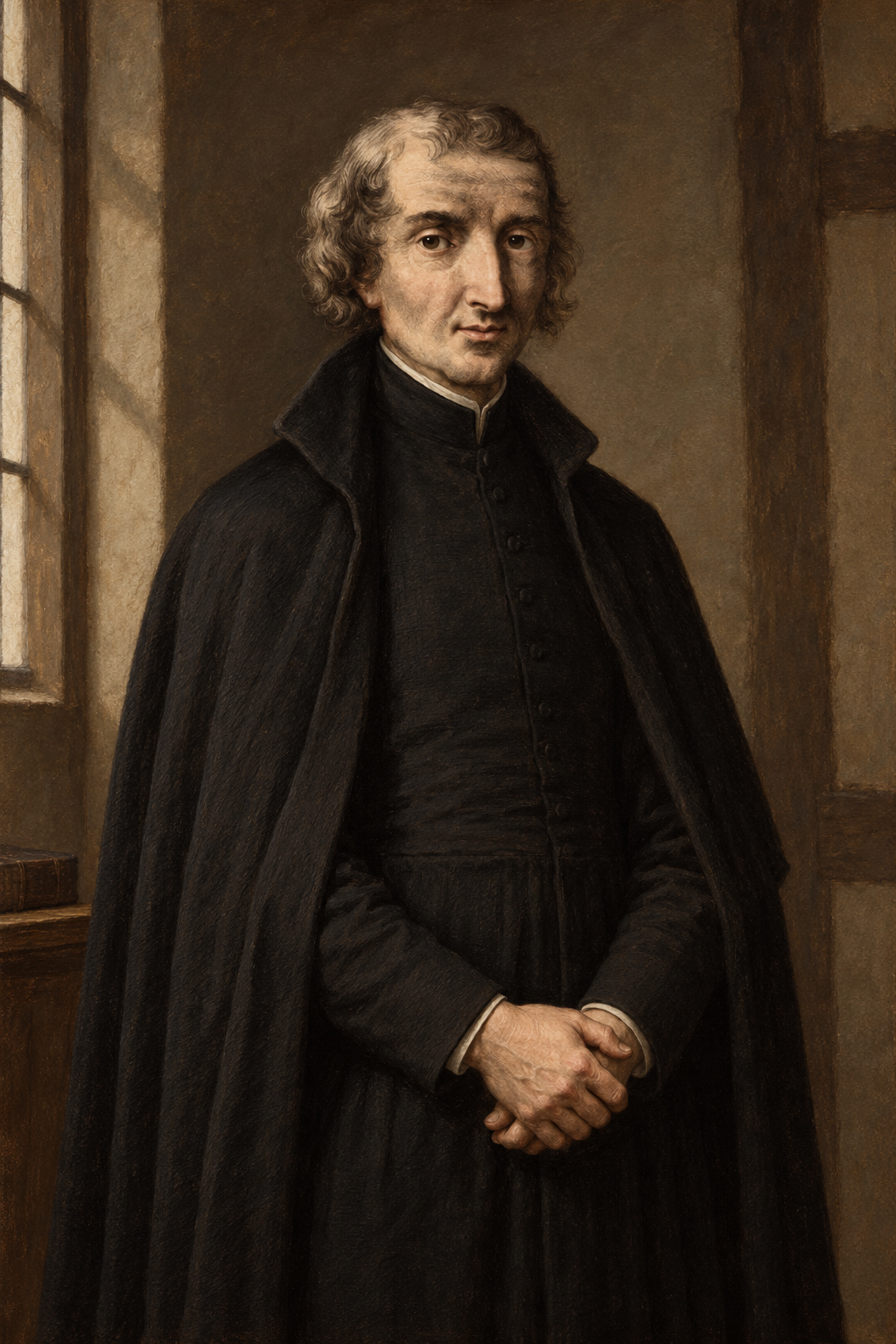
About David Lewis
David Lewis was a Welsh Jesuit priest remembered for more than thirty years of ministry among Catholic communities in his homeland. He preached in Welsh and English and became known as Father of the Poor. His life ended at Usk in 1679, when practising his priesthood was treated as treason. The name by which he served his mission, Charles Baker, also appears in records of his life.
He was born at Abergavenny, where his father, Morgan Lewis, was a Protestant clergyman and schoolmaster. His mother, Margaret Pritchard, was Catholic. David initially conformed to the established church before becoming Catholic during a visit to Paris. He entered the English College in Rome in 1638 and was ordained in 1642. Three years later he joined the Society of Jesus. After his novitiate and further service in Rome, he returned to the Welsh mission in 1648.
The Jesuit account of his vocation recalls the loss of both parents before his departure for Rome. It also places particular emphasis on his care for poor and vulnerable people after his return. His mission was a sustained pastoral commitment: providing religious leadership and support over decades, before the political crisis that brought his work to an end.
That work belonged to a wider network of concealed Catholic worship. Plas Gunter Mansion in Abergavenny preserves the memory of a chapel where Lewis and the priest Philip Evans celebrated Mass. The house helps locate his ministry in an ordinary town setting, among people whose religious lives depended on private meeting places. His story was not confined to a remote refuge or to the final months of imprisonment.
The mission’s headquarters were at the Cwm, near the borders of Monmouthshire, Herefordshire and Gloucestershire. Historian Hannah Thomas explains that its title, the College of Saint Francis Xavier, described a missionary district rather than a school. Its farms supported the priests’ work across a large territory. Their location near several civil jurisdictions could also make pursuit more difficult, since officials had to respect county boundaries. Thomas interprets that geography as a practical protection for a community carrying out prohibited religious work. The setting helps explain how such a mission could operate for many years despite the danger.
The fabricated Popish Plot allegations changed the immediate circumstances. In November 1678 Lewis was arrested after information supplied by a former servant. According to the British Jesuit Archives, the search found vestments, crucifixes, books and other objects associated with Catholic worship. At his trial, witnesses described his celebration of Mass, preaching, baptisms and marriages. These familiar duties of a priest became evidence against him.
A pamphlet containing his account of imprisonment and trial survives. Cardiff University’s discussion of its copy draws an essential distinction: he was not convicted at that trial of conspiring to murder the king. The charge concerned foreign ordination, his return to the country and the exercise of Catholic priesthood. The pamphlet therefore preserves both a legal defence and an explanation of what Lewis believed his ministry meant. It should be read as his own account, rather than mistaken for a neutral transcript agreed by every participant.
His final speech makes that understanding explicit. Lewis describes celebrating Mass, hearing confessions, anointing the sick and administering other sacraments as the actions for which he was condemned. He recalls being urged in London either to reveal a plot or to conform. He says he knew of no plot and could not change his religion against his conscience. Those claims are his own testimony about the choices put before him.
He also speaks directly about forgiveness. After acknowledging the impulse toward retaliation, he rejects it and forgives those involved in his betrayal, arrest, trial and sentence. He asks forgiveness from anyone he has offended. His advice to friends joins perseverance in faith with respect for the king, patience under suffering and forgiveness of enemies. The speech ends in prayer. Its surviving words explain why later Catholics remembered his death as a witness to faith and charity.
His remembrance includes objects preserved after his death. The Jesuit collection holds a rope relic formerly kept by the Carmelites at Lanherne. A letter records its transfer to the Jesuits in 1874, showing how religious communities safeguarded material associated with the martyrs. Such a recorded transfer documents the later history of the relic; it is distinct from an eyewitness record of the execution itself. The transfer followed a request from the Jesuit historian John Morris, whose research into the martyrs brought him into contact with communities holding memories and possessions associated with their deaths.
Lewis was canonized among the Forty Martyrs of England and Wales in 1970. At their canonization Paul VI welcomed Anglican representatives and expressed hope for Christian unity.
The official Welsh calendar honours him on August 26, the day before the anniversary of his death.
Wondering how to weigh the stories and sources? Learn how to read a saint biography.