Biography
Carmelo Bolta Bañuls
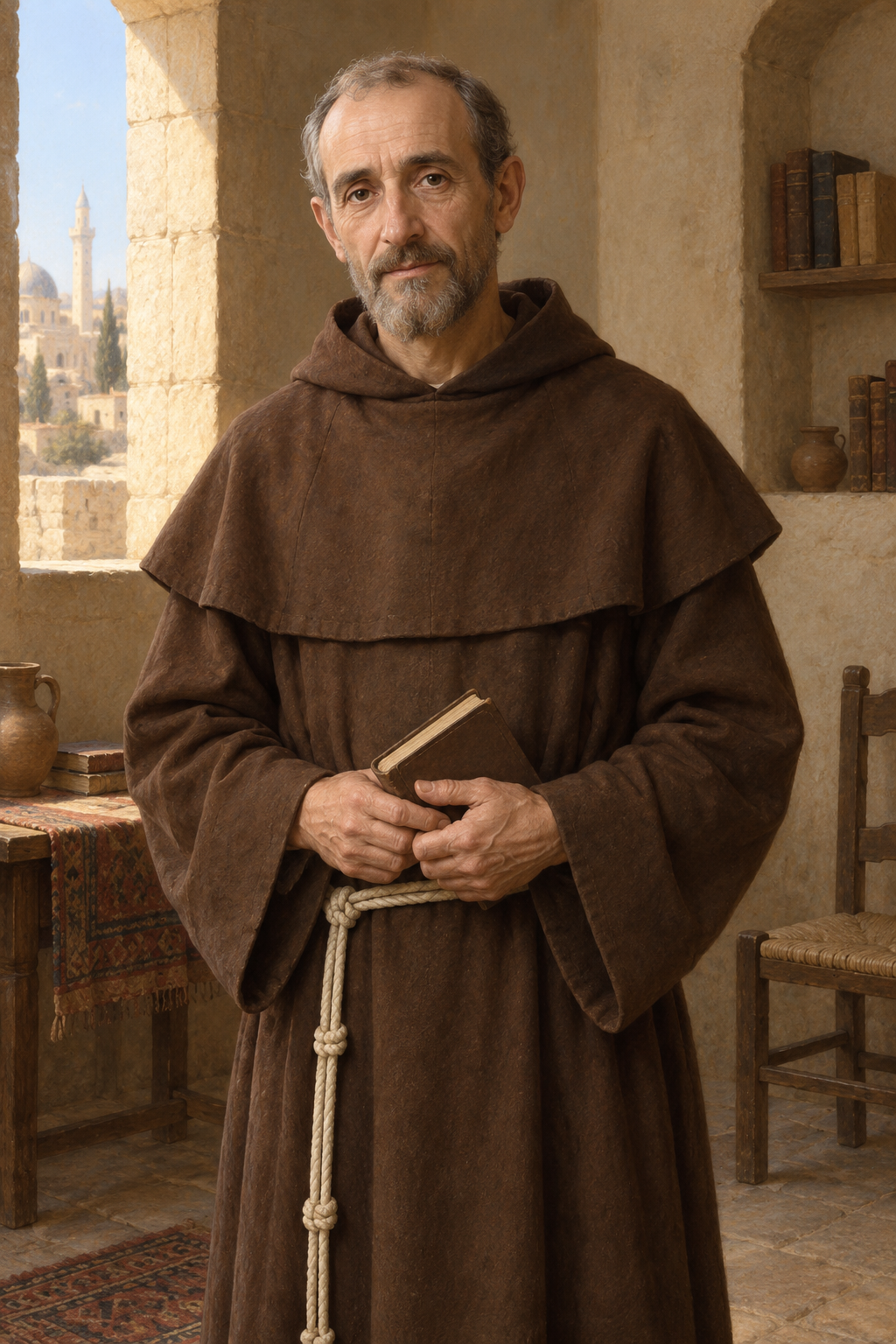
About Carmelo Bolta Bañuls
Carmelo Bolta Bañuls was a Spanish Franciscan priest whose work in the Holy Land centred on parish ministry and the teaching of languages. Born at Real de Gandía on 29 May 1803, he was baptized Pascual. His uncle Isidoro Bañuls, himself a Franciscan, encouraged his religious vocation. The young man entered the novitiate at the Franciscan convent in Valencia, studied for the priesthood and was ordained in 1829. He then preached at the convent of San Blas in Segorbe before receiving permission to go abroad.
He reached Jaffa on 3 August 1831. In the Custody’s account, his linguistic ability became an important part of his service, particularly in preparing younger friars for their work. His health was less reliable: an appointment as superior in Jaffa ended after a few months because the climate affected him badly. Teaching, however, continued to offer a way to serve the community. The same account remembers him as educated, approachable and friendly, rather than only through the violence that ended his life.
His assignments took him between several Franciscan communities. The Order’s account names Jaffa, Damascus and Ain Karem, and identifies him as both a parish priest and a teacher of Arabic. These were related responsibilities: priests arriving from Europe needed the language used by the people among whom they would work. By his final years Carmelo was serving in Damascus. The detailed accounts differ over the year when he assumed the parish appointment, so a precise sequence of every office is difficult to establish.
The attack on the Franciscan community came during the night of 9–10 July 1860. The Vatican’s canonization account places it at Saint Paul’s convent in Damascus, during anti-Christian violence that had spread from Lebanon into Syria. Carmelo was one of eight Franciscan victims. Three Maronite lay brothers, Francis, Mooti and Raphael Massabki, were also killed. Their shared remembrance therefore includes people with different responsibilities and family circumstances, united in the Church’s recognition of their martyrdom.
The Custody’s vice-postulator, Ulise Zarza, identifies Naame Massabki as a witness to Carmelo’s death. Naame was a child who had hidden when the attackers entered. In the account preserved through his testimony, Carmelo was threatened with death unless he abandoned his Christian faith. He refused and was killed. This reported refusal explains his remembrance as a martyr; it is not necessary to reconstruct a dramatic speech or add details that the surviving account cannot independently establish.
The Franciscan account describes the recovery and common burial of the victims, followed by the rebuilding and consecration of the convent church in 1866. Their tomb became a focus of devotion in Damascus. The cause initially concerned the Franciscans; the Massabki brothers were subsequently included through a special procedure requested by the Maronite patriarchate. The history of their recognition brought the religious community and its lay collaborators together in a single celebration.
Pius XI beatified the eleven martyrs on 10 October 1926. Almost a century later, Pope Francis canonized them on 20 October 2024 in Saint Peter’s Square. The liturgical booklet names Carmelo within the group and records the formula by which the new saints were enrolled for veneration throughout the Church.
In Carmelo’s birthplace, devotion had remained part of parish and family life. An archdiocesan report published in August 2024 interviewed the president of the local confraternity, who described a small image made in 2010 for the anniversary of the martyrdom. It travelled among homes and was brought to people asking for prayers in illness or need. The parish priest described preparations for a pilgrimage to the canonization. The church also had an altar dedicated to Carmelo and paintings connecting his death with the town where he had grown up. These practices show how his memory continued through ordinary households as well as public celebrations.
Archbishop Enrique Benavent’s letter before the canonization drew attention to Carmelo’s years of teaching Arabic to future missionaries. He presented that patient work of formation as a practical service, giving others the tools they needed for their ministry. The letter also invited Christians to renew their life of prayer. In that remembrance, Carmelo’s death is inseparable from the longer vocation that preceded it: learning, teaching and serving a parish far from his birthplace.
Wondering how to weigh the stories and sources? Learn how to read a saint biography.