Biography
Charles Garnier
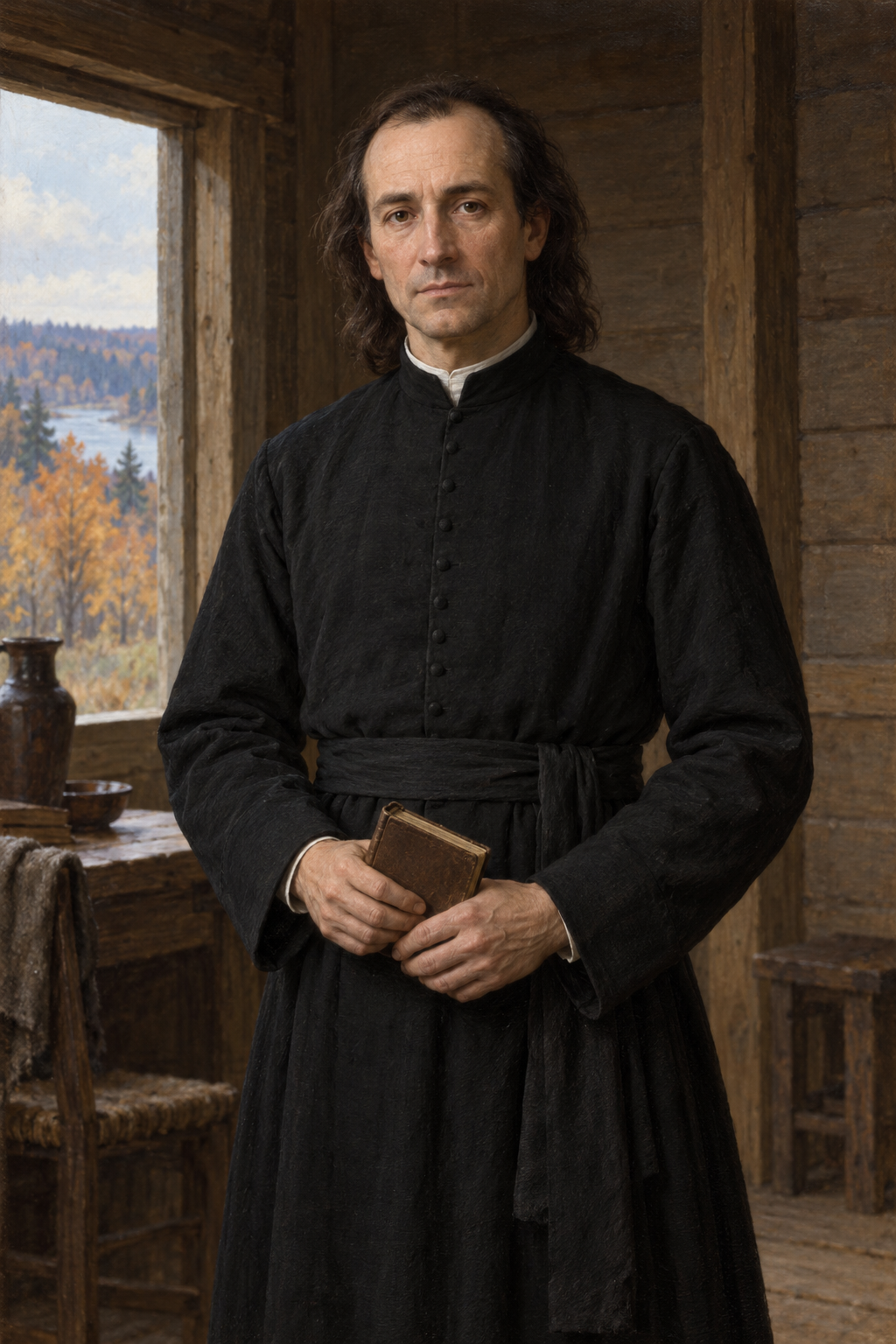
About Charles Garnier
Charles Garnier was a French Jesuit priest who spent thirteen years in the missions of New France. Born in Paris in 1606 or possibly 1605, he studied at the Jesuit Collège de Clermont and entered the Society of Jesus in 1624. He was ordained in 1635 and reached Québec in June 1636. The following month he travelled with Pierre Chastellain into Huron country.
The Jesuit account by Tom Rochford describes a young man whose father opposed his departure for Canada. Once there, Garnier had to learn the language before he could preach effectively. His first years included work at Ossossané. An early mission among the Petun, whom the French called the Tobacco nation, encountered strong resistance. Epidemic disease had made the arrival of the missionaries a cause of fear. The account connects that fear with the refusal to receive Garnier and his companions, rather than presenting their welcome as immediate or universal.
The story also includes cooperation and hospitality. Edward James Devine’s account describes the establishment of the residence at Ossossané in 1637. Local people offered to build a cabin, and men and women helped carry the missionaries’ grain and furniture from Ihonatiria. The new residence therefore depended on Indigenous labour and willingness to receive it. Remembering those contributions gives a fuller picture of Garnier’s setting than an account in which missionaries appear to act alone. Acceptance in one village, however, did not mean that other communities would welcome the same project. Devine places the move in the spring of that year.
Garnier’s own correspondence gives a more personal view of this difficult work. Writing to his brother in June 1641, he described a mission with Pierre Pijart among people who had rejected them during their first winter but were more willing to listen during the second. He also recalled danger on a frozen lake, where two other men died. His account names cold, smoke, food and lodging among the hardships of daily life. These were practical conditions of travel and residence, as well as experiences he interpreted through his faith.
The same letter combines spiritual counsel with ordinary needs. Garnier urged his brother not to despair over failings and recommended prayer compatible with other responsibilities. He requested medicinal seeds and instructions for growing them because French remedies were difficult to obtain locally. His correspondence preserves a missionary who needed help as well as one who offered it.
From 1641 to 1646 Garnier worked at Saint-Joseph, or Teanaostaiaë, among the Cord clan. He then returned to the Petun communities near Georgian Bay. His last mission was at Saint-Jean, where he died during an attack on 7 December 1649. These successive assignments distinguish his story from those of the other missionaries later honoured with him; they did not all live at one mission or die in a single attack.
Paul Ragueneau’s report describes the attack on Saint-Jean as a catastrophe for the village. Garnier remained among people who were fleeing or wounded. A surviving Christian woman reported seeing him, already injured, trying to reach a dying man. Her own injury prevented her from following everything that happened afterward. The narrative therefore contains both testimony and limits: it does not give one witness’s uninterrupted view of his final moments. Two priests found his body the next day and buried it at the ruined church.
Ragueneau also remembered Garnier caring for sick people and sharing humble work. His admiring account nevertheless includes behaviour that requires candid reading: Garnier sometimes entered homes despite efforts to keep him out. Such passages reveal tensions between missionary zeal and the wishes of the people being approached. They belong beside the descriptions of compassion, rather than disappearing from an account of his ministry.
The reports through which much of this history survives were written by missionaries for readers in Europe. Toronto Public Library introduces its collection with a warning that settler accounts can preserve offensive attitudes and must be read with attention to who is telling the story. That caution helps readers distinguish a missionary’s interpretation from the full experience of Indigenous communities. Garnier’s letters and his companions’ reports are valuable evidence, but they cannot supply every voice from the villages in which he lived.
Garnier was canonized with the Canadian Martyrs on 29 June 1930. The eight are secondary patrons of Canada and are celebrated there on 26 September; their universal observance is 19 October.
A modern novena hosted by the Archdiocese of Toronto places remembrance of Garnier alongside a call to hear Indigenous experiences and work toward reconciliation. It distinguishes the seventeenth-century martyrs from the residential-school harms of a much later period. Its invitation is to acknowledge truth and take practical steps toward healing. This contemporary use of his memory asks devotion to remain attentive to suffering, including suffering that familiar religious narratives have failed to hear.
Wondering how to weigh the stories and sources? Learn how to read a saint biography.