Biography
Alonso Pacheco
About Alonso Pacheco
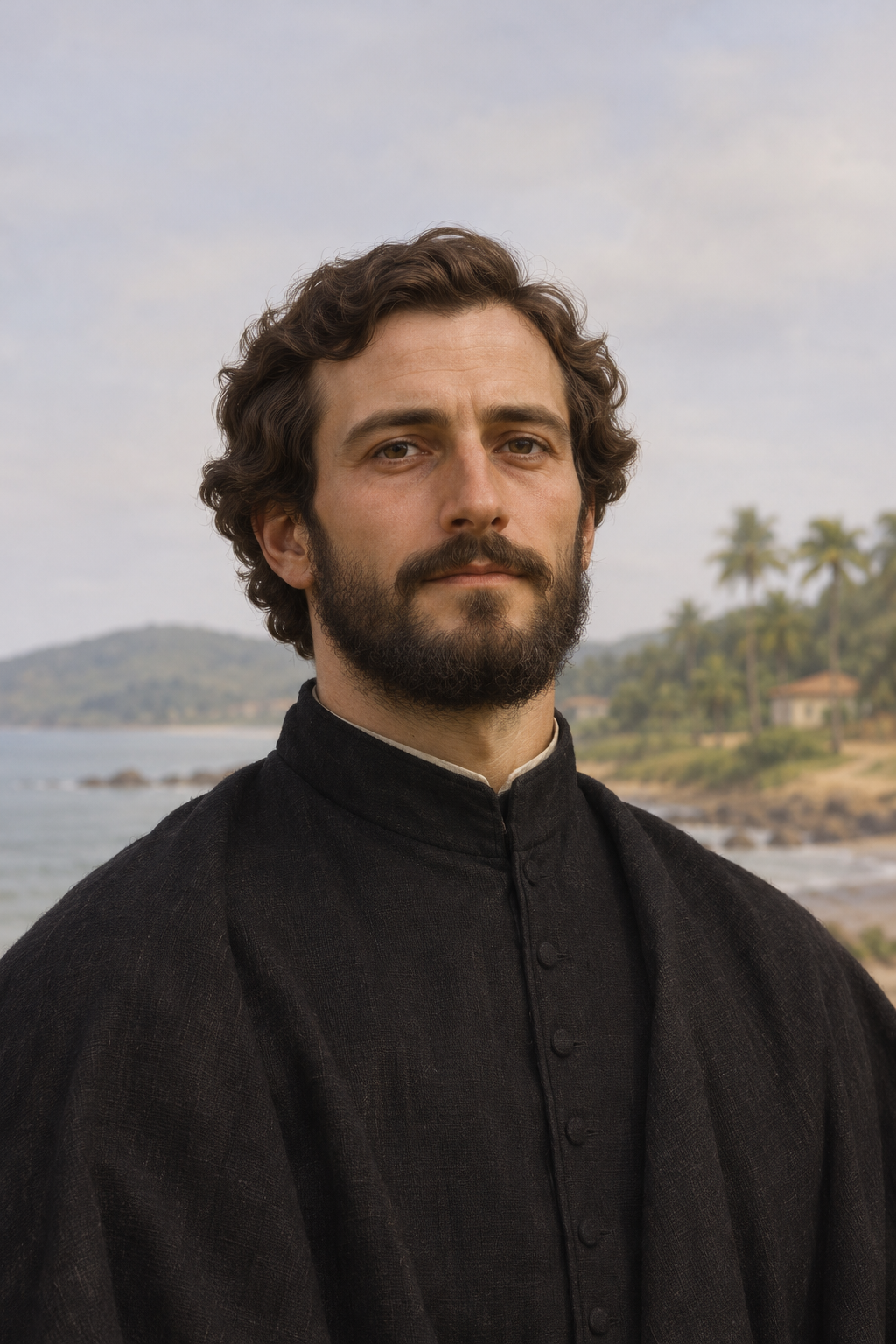
Alonso, or Alphonsus, Pacheco was born at Minaya in Spain and educated in Jesuit colleges at Belmonte and Alcalá. He entered the Society of Jesus while its mission in Asia was expanding through the Portuguese empire. The Jesuit account says he hoped to go to Japan, but his superiors assigned him to India. He reached Goa in September 1574 and served at Saint Paul’s College, one of the Society’s principal houses in the region.
After service at Saint Paul’s, Pacheco took on responsibility in the Jesuit province and traveled to Europe on mission business. He returned in 1581 with new missionaries, including the younger Antonio Francisco. At Salsette he served as superior until Rodolfo Acquaviva succeeded him in 1583; the Jesuit account says he then guided Acquaviva among the mission stations. This succession gives Pacheco a more precise place in the final months than a general description of him as a mission leader. The district was under Portuguese rule, and its work involved local Christians, Hindu villages, and the colonial state.
Pacheco was personally involved in the conflict that preceded Cuncolim. The older Catholic account says he accompanied expeditions that destroyed Hindu shrines, and Tavares likewise identifies him among Jesuits who had participated in earlier destruction. This was a rich agricultural and trading village whose temples were important to religious and economic life. Modern historians place the attack in a setting of coercive conversion, temple destruction, and local resistance. For villagers, these encounters took place in the aftermath of the destruction of places of worship.
On 25 July 1583, Pacheco went with other Jesuits and Indian Christian companions to Cuncolim to place a cross and select a site for a church, according to Tavares. Villagers attacked the party, and he and four fellow Jesuits were killed. The Holy See’s martyrology names the five as Pacheco, Antonio Francisco, Pedro Berno, Francisco Aranha, and Rodolfo Acquaviva. The number of Indian Christians killed is reported differently: Tavares counts twelve, while Cañeque reports fourteen. Their presence is essential to a truthful account of the violence, even though later commemorations often foregrounded the five Jesuits.
The events were quickly written into the Society’s understanding of mission and martyrdom. Jesuit letters and later narrative accounts portrayed the dead men as examples of steadfast faith; Cañeque shows how those accounts took literary form within colonial society. They are valuable sources for what missionaries believed and reported, but their devotional purpose means that an individual’s last words or every detail of the attack cannot be read as neutral eyewitness fact. Pacheco’s own place in the record is clearest in his assignments, his leadership at Salsette, and his death in the group.
Pope Leo XIII beatified the five Jesuits on 30 April 1893. Their liturgical commemoration is recorded for 4 February in the Holy See’s notice, while their death occurred on 25 July. Pacheco is remembered as a missionary and martyr whose life linked Spanish Jesuit formation to service in Goa and Salsette. The wider history also includes the Indian Christians who died beside the Jesuits and the Hindu villagers whose conflict with the mission shaped the attack.
Wondering how to weigh the stories and sources? Learn how to read a saint biography.