Biography
Andrew
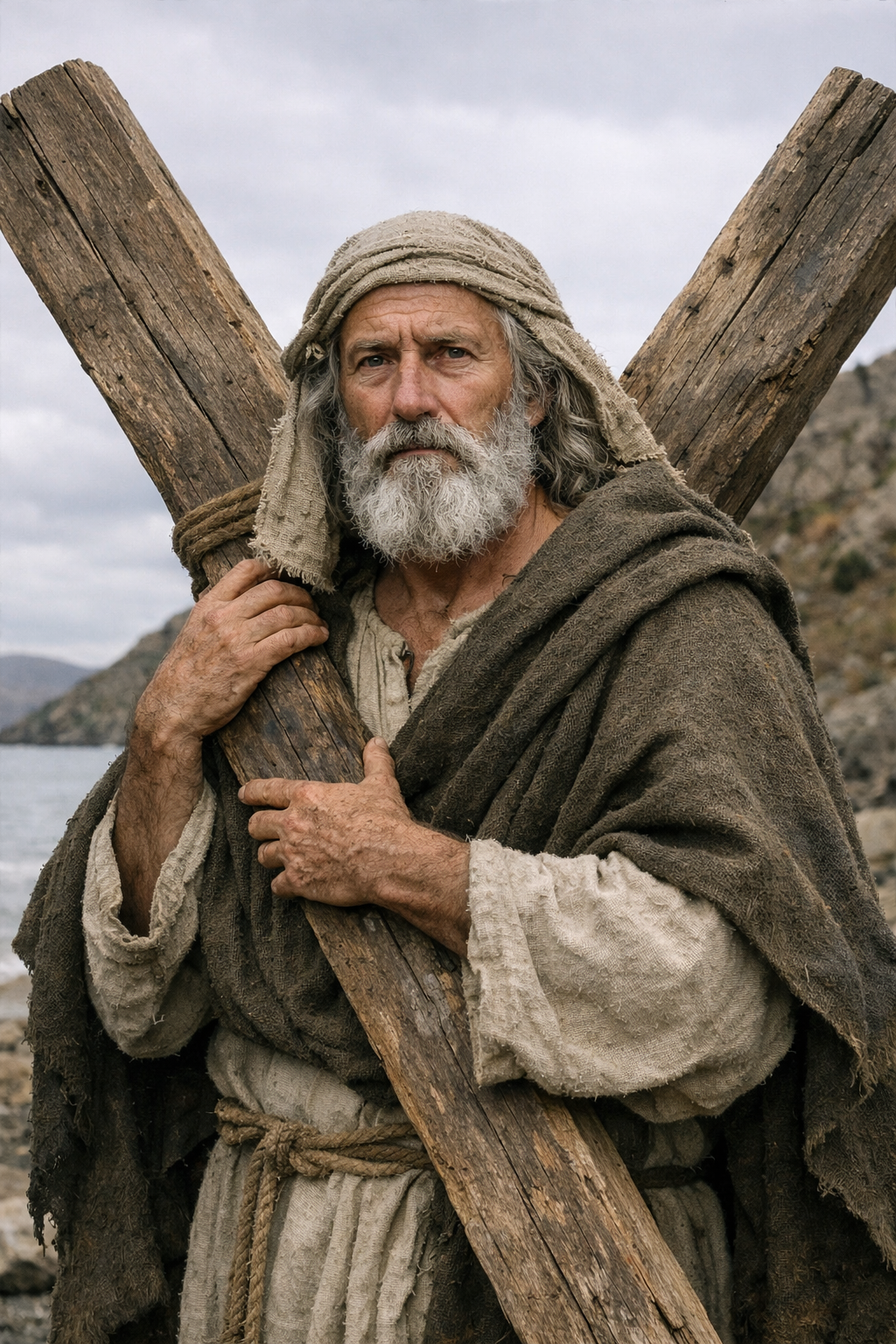
About Andrew
The earliest sources give only a compact outline of Andrew's life, and they provide neither his birth year nor his age. The Gospel of John identifies him as Simon Peter's brother and says that Bethsaida was the town of Andrew and Peter. His Greek name, Ἀνδρέας, is securely present in the New Testament text, but the sources do not identify his parents or establish the circumstances of his childhood. Bethsaida can therefore be retained as his historical place of origin while its exact archaeological identification and any modern equivalent remain unsettled. Later biographies often fill these silences, but responsible history begins by leaving them open.
Mark presents Simon and Andrew as fishermen casting a net into the Sea of Galilee when Jesus calls them to follow and become fishers of people. They leave their nets, and the narrative soon enters a house in Capernaum described as the home of Simon and Andrew. This account anchors Andrew in working life and in a shared household, but it does not say that fishing was his lifelong occupation or locate the call more precisely than the lakeshore. John tells the beginning differently and should be heard as a distinct narrative witness rather than forced into a single reconstructed timetable. The two accounts agree that Andrew's discipleship begins with a prompt response to Jesus.
In John's account, Andrew is initially one of two disciples who hear John the Baptist identify Jesus and then follow Jesus for part of a day. Andrew next finds Simon and tells him, “We have found the Messiah.” He then brings Simon to Jesus, making introduction rather than prominence Andrew's first individually described action. The Byzantine title Protoclete, or First-Called, grows from this Johannine sequence and remains a traditional title rather than an additional biographical event. John's wording supports a relationship to John the Baptist as a teacher and to Peter as both brother and person whom Andrew actively guided toward Jesus.
Andrew appears by name in the New Testament lists of the Twelve. Mark also places him with Peter, James, and John in a private question about Jesus' prediction concerning the temple. After the ascension, Acts lists Andrew among the apostles gathered in Jerusalem and says that the community devoted itself to prayer. These notices establish his membership and continued place in the apostolic community. They do not, however, provide a post-Pentecost itinerary, the length of his ministry, or an account of his death.
John gives Andrew another brief role when a large crowd needs food. He points out a boy who has five barley loaves and two fish, while also acknowledging that this is inadequate for so many people. The narrative does not portray him as solving the crisis or as understanding in advance what Jesus will do. It does show the practical attentiveness of noticing a person and a limited resource that others might overlook. For a modern reflection, that observed action is firmer ground than invented claims about Andrew's inner motives.
John's final Andrew scene concerns Greek visitors seeking Jesus. They first approach Philip; Philip tells Andrew, and the two together tell Jesus. This action supports describing Philip as Andrew's collaborator and again shows Andrew serving as a human connection rather than acting alone. Their Greek names do not prove that either man spoke Greek, and the episode does not establish a later mission to Greek-speaking lands. The text documents their cooperative response to the visitors in Jerusalem.
The earliest surviving geographical tradition about Andrew's later work is already separated from the apostolic period by centuries. Writing in the early fourth century, Eusebius says that tradition allotted Scythia to Andrew and attributes the report to Origen. That testimony demonstrates that a Scythian mission tradition circulated early; it does not supply a contemporary diary or a route that can be mapped point by point. Broader claims that send Andrew through many countries belong to later ecclesial remembrance. They may be displayed as tradition, but not converted into documented events, exact coordinates, or a missionary chronology.
The apocryphal Acts of Andrew, composed in the second or third century, became a major carrier of stories about his travels and death. The original work is lost and is known through fragments, epitomes, and later revisions, which makes its historical use especially difficult. Church tradition locates Andrew's martyrdom at Patras, where he was said to have been crucified. The familiar X-shaped cross is later still, and Benedict XVI explicitly presents it as a later tradition. No reliable early evidence establishes a death year, so this packet leaves the date unset and marks Patras and martyr status as traditional.
Devotion to Andrew also produced relic traditions connecting Patras, Constantinople, and Rome. In 1964 Pope Paul VI returned to the Greek Orthodox metropolitan of Patras a relic venerated in Rome as Andrew's head. That modern transfer is a documented ecumenical act, while the relic's chain of identity remains a matter of ecclesial tradition rather than a conclusion established here. The distinction allows the event to be remembered without asking a historical biography to authenticate sacred remains. It also illustrates how Andrew's reception has linked Eastern and Western Christian communities.
Roman Catholic, Eastern Orthodox, and Anglican calendars all commemorate Andrew on November 30, though their ranks and local language differ. The Orthodox Church in America calls him the Holy and All-Praised First-Called Apostle, while the Church of England keeps Andrew as a Festival. These observances document living traditions, not new facts about his first-century itinerary. Andrew's most secure portrait remains the restrained one in the canonical narratives: a fisherman who responds, brings his brother, notices a small provision, helps strangers make contact, and remains with the praying apostolic community. Those specific actions support reflection on faith, attentiveness, and cooperation without requiring legendary detail to carry the story.
Wondering how to weigh the stories and sources? Learn how to read a saint biography.
Explore similar vocations
Prayers for Andrew
Andrew the Apostle collect excerpt
call us by your holy word, and give us grace to follow you without delay