Biography
Bartholomew
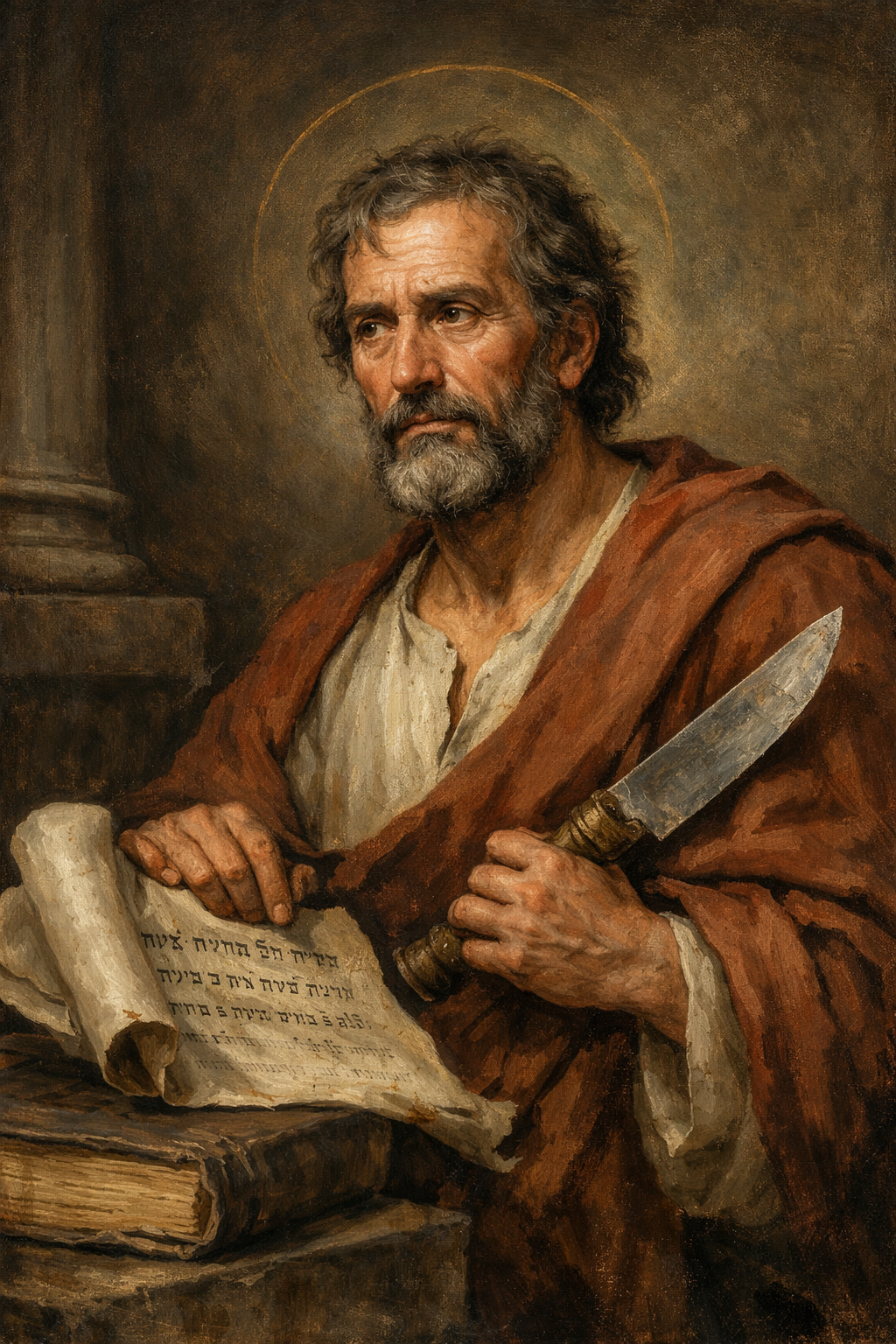
About Bartholomew
The New Testament gives Bartholomew a secure place in the apostolic group but almost no individual biography. Matthew names him among the Twelve whom Jesus commissions, placing him after Philip and before Thomas. The list presents the Twelve as a group authorized to proclaim, heal, and serve; it does not describe a separate journey by Bartholomew. No canonical passage states his age, birthplace, occupation, family, or date of death. The familiar dates and places once attached to this catalog entry therefore exceed the evidence and are removed rather than converted into approximate facts.
Mark and Luke also include Bartholomew in their lists of the Twelve. Mark places him beside Philip, while Luke lists Philip and Bartholomew together; Acts later names Bartholomew among the apostles gathered in Jerusalem after the ascension. These independent list settings make his membership in the remembered apostolic circle historically probable. They still give no direct speech or personal action under the name Bartholomew. Even the order of neighboring names varies, warning against constructing friendships or an itinerary merely from list position.
The Fourth Gospel never uses the name Bartholomew, but it gives a vivid account of a man named Nathanael. Philip tells Nathanael that he has found the one described by Moses and the prophets, and Nathanael questions whether anything good can come from Nazareth. Philip answers with the invitation “Come and see.” Jesus then describes Nathanael as an Israelite without deceit, says that he saw him under a fig tree, and receives Nathanael's confession that Jesus is the Son of God and King of Israel. The text does not call Nathanael one of the Twelve or identify him as Bartholomew.
John names Nathanael once more in its final chapter. He is identified as being from Cana in Galilee and is present by the Sea of Tiberias with Simon Peter, Thomas, the sons of Zebedee, and two unnamed disciples when the risen Jesus appears. This establishes Cana as Nathanael's origin and the lakeshore appearance as an event in Nathanael's story. It becomes part of Bartholomew's biography only if the traditional identification is accepted. For that reason, neither Cana nor the Sea of Tiberias should be presented as an unqualified Bartholomew location.
The identification of Bartholomew with Nathanael is old and plausible, but it is not explicit in the earliest texts. Benedict XVI explained that Bartholomew is a patronymic, probably Aramaic for son of Talmay, and that Bartholomew appears only in lists of the Twelve. He described the Nathanael identification as traditional and linked it to Philip's position beside each man in different Gospel settings. That pattern offers a reason for the identification, not proof that two differently named figures must be one person. This packet therefore retains Nathanael as a variant with traditional confidence and marks every Nathanael-derived event, quotation, relationship, and virtue in the same way.
The earliest substantial notice of a later mission is itself a report about an earlier report. Eusebius says that Pantaenus, an Alexandrian teacher active in the late second century, traveled as far as a region called India. There he reportedly found people who said Bartholomew had preached to them and left a Hebrew-script Gospel of Matthew. Eusebius wrote more than a century after Pantaenus and did not define the geography precisely. The passage documents an early tradition connecting Bartholomew with an eastern mission; it does not establish a route, date, settlement, or modern country.
Jerome repeated the Pantaenus story in the late fourth century. His account calls Bartholomew one of the Twelve, says he had preached in India, and reports that Pantaenus brought back a Gospel written in Hebrew characters. Jerome's testimony shows that the tradition continued in Latin Christian memory. It does not turn the story into contemporary evidence, and the ancient term India could cover territories broader or different from the modern republic. A map may therefore show only an indeterminate traditional region and must not draw a travel line from Galilee to South Asia.
Later hagiography greatly expands Bartholomew's travels. The Orthodox Church in America transmits missions with Philip and Mariamne in Syria and Asia Minor, a journey to India, preaching in Greater Armenia, royal conversions, imprisonment, miracles, and continued preaching during execution. It locates his death at Alban, identified on that page with Baku, and describes crucifixion, flaying, and beheading. These details form a coherent devotional narrative but are not contemporary documentation and conflict with other inherited versions. They belong under legendary confidence; they cannot support a year of death, a verified Albanopolis coordinate, or a route through the named regions.
Western reference tradition is equally candid about the uncertainty. The Catholic Encyclopedia says that nothing further is known for certain after the apostolic lists, describes the Nathanael identification as scholarly opinion, and calls the mission countries traditional. It records competing death accounts—beheading or flaying and inverted crucifixion—and labels the manner of death uncertain. Martyr and missionary remain meaningful traditional statuses, but neither should imply that a particular execution narrative or geography has been historically established. The knife associated with Bartholomew in art comes from the flaying tradition, not from a canonical portrait or eyewitness likeness.
Church calendars preserve Bartholomew with firmer precision than his life chronology. The Roman Catholic lectionary celebrates the Feast of Saint Bartholomew, Apostle, on August 24, and the Church of England keeps Bartholomew the Apostle on the same date. The Orthodox Church in America commemorates Apostle Bartholomew of the Twelve on June 11. These are documented liturgical observances, not historical death anniversaries. A responsible portrait of Bartholomew therefore rests on a modest foundation: probable membership among the Twelve, a traditional identification with the candid and responsive Nathanael, and later mission and martyr narratives preserved as tradition and legend rather than mapped certainty.
Wondering how to weigh the stories and sources? Learn how to read a saint biography.
Explore similar vocations
Prayers for Bartholomew
Saint Bartholomew festival collect excerpt
Almighty and everlasting God, who gave to your apostle Bartholomew