Biography
James (son of Alphaeus)
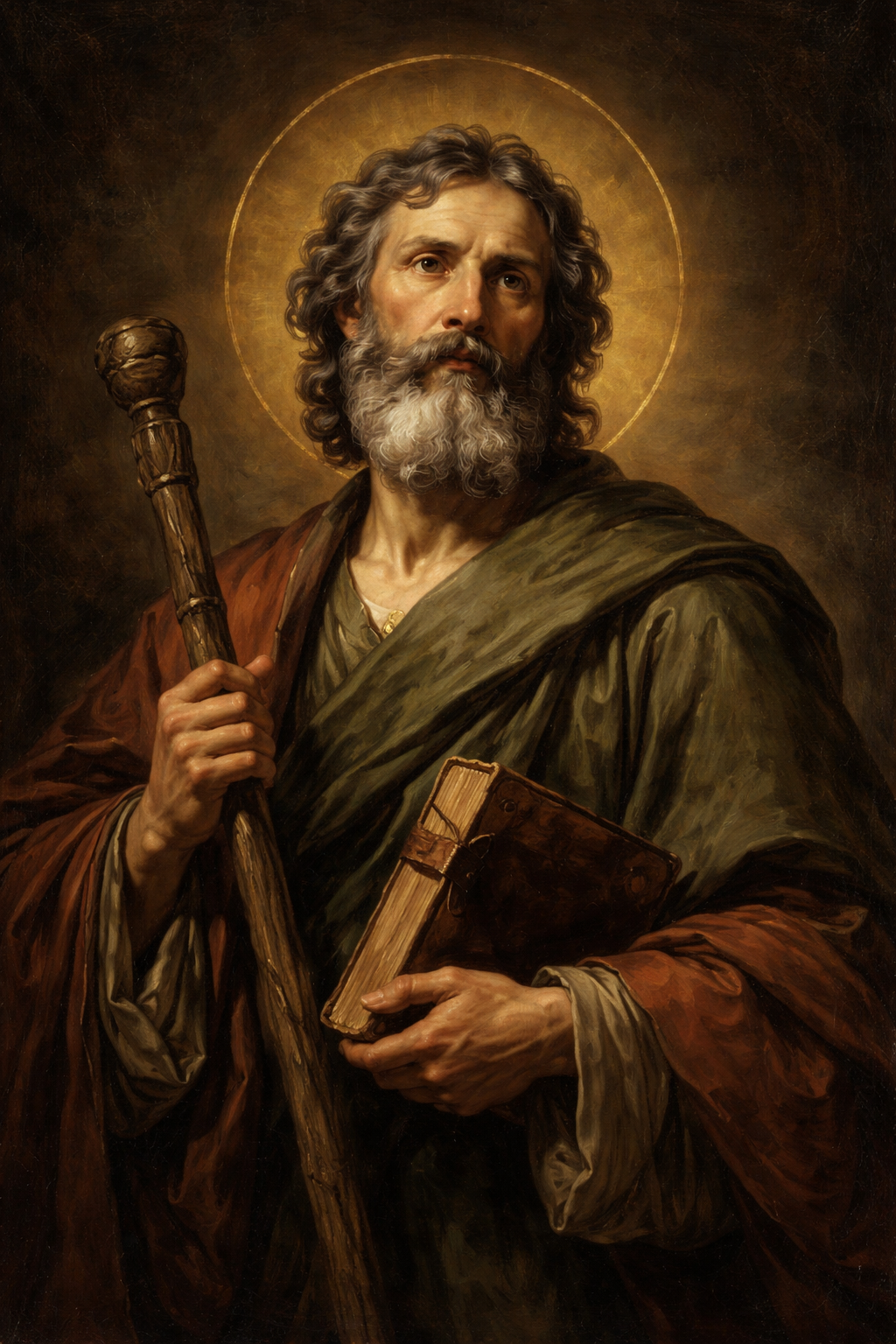
About James (son of Alphaeus)
James son of Alphaeus is one of the least individually described members of the Twelve. Matthew, Mark, Luke, and Acts all preserve his name, but no New Testament scene assigns him a separate speech or action. Even his identifying phrase tells little beyond his father's name. Scripture supplies no birthplace, occupation, age, birth date, or death date. A responsible biography must therefore be largely an account of what membership in the Twelve means in the texts, followed by a careful description of later traditions and the identity problems that surround them.
Mark says that Jesus went up a mountain, summoned those he wanted, and appointed twelve to be with him, to be sent to preach, and to have authority over demons. James son of Alphaeus appears near the end of that list, after Thomas and before Thaddeus. Matthew likewise names him when Jesus summons the Twelve and sends them to proclaim that the kingdom of heaven is at hand, heal the sick, and travel without turning the mission into personal profit. These commissions apply to James as a member of the named body; neither Gospel narrates how he personally carried them out.
Luke places the selection after a night in which Jesus prays on the mountain. At daybreak he calls the disciples and chooses twelve, whom Luke also calls apostles. James son of Alphaeus stands between Matthew and Simon called a Zealot. The surrounding narrative immediately turns to teaching, healing, blessings for the poor, warnings to the rich, love of enemies, mercy, and refusal of hypocritical judgment. James is a hearer within that apostolic circle. It would go beyond the evidence to attach a particular saying, miracle, temperament, or private response to him.
After the Ascension, Acts names James son of Alphaeus among the apostles who return from the Mount of Olives to Jerusalem. In an upper room they join in sustained, common prayer with several women, Mary the mother of Jesus, and Jesus's brothers. This is the only post-Easter New Testament notice that unambiguously identifies him. It shows continuity rather than celebrity: James remains with a community waiting together before the Pentecost narrative. Acts does not single him out in the events that follow, and silence cannot safely be converted into an imagined ministry schedule.
The name James creates a persistent identification problem. The New Testament also names James son of Zebedee, James the brother of the Lord, and a James called ‘the younger’ in a description of Mary at the crucifixion. Benedict XVI noted that James son of Alphaeus is often identified with James the younger or the Lord's brother, then discussed the Jerusalem leader, the council described in Acts, and the Letter of James. That teaching documents a received identification, but the names and patronymics do not prove that all these references designate one person. This packet therefore does not transfer Jerusalem leadership or authorship to the son of Alphaeus.
The distinction matters especially at death. Josephus's notice about the execution of ‘James, the brother of Jesus who was called Christ’ is important evidence for that James, but it does not name Alphaeus and cannot simply become this apostle's martyrdom record. Likewise, Mark's ‘James the younger’ may distinguish age, stature, or another relationship, but the Gospel does not explain the term or connect that James explicitly with Alphaeus. The familiar title ‘James the Less’ is retained only as a later variant, not as a factual judgment about importance or as proof of identity.
The Orthodox Church in America preserves another received account. It calls James a brother of Matthew, associates him with Andrew in missions through Judea, Edessa, Gaza, and Eleutheropolis, and says he was crucified at Ostrachina in Egypt. These details are not found in the New Testament, and the page provides no contemporary documentary chain for them. They are recorded here as later church tradition. Ostrachina can be named as a traditional setting, but no exact route, coordinate, or date is supplied. The martyr and missionary classifications carry the same traditional confidence.
James is commemorated individually on October 9 by the Orthodox Church in America and included with the Twelve on June 30. Those official observances establish calendar practice, not the historicity of every later story. No uniquely attributable quotation survives in the sources used, so a saying is not invented or borrowed from another James. No prayer is entered without a separately traceable text and translation. The absence of personal detail leaves a restrained significance: James is securely remembered by name among those appointed, commissioned, and gathered in prayer, while honest limits protect him from biographies assembled out of other people's lives.
That restraint is not a devotional theory about hidden greatness. The sources do not reveal whether James preferred obscurity, performed unnoticed acts, or possessed a distinctive personality. What they do preserve is membership and continuity. He belongs to the apostolic group before the Passion and remains in its Jerusalem fellowship afterward. Later churches remembered him as a missionary and martyr, but their narratives must stand in their own evidentiary category. James son of Alphaeus remains significant precisely because careful reading can honor a named witness without turning uncertainty into certainty or conflating several early Christian leaders.
Wondering how to weigh the stories and sources? Learn how to read a saint biography.