Biography
Matthew
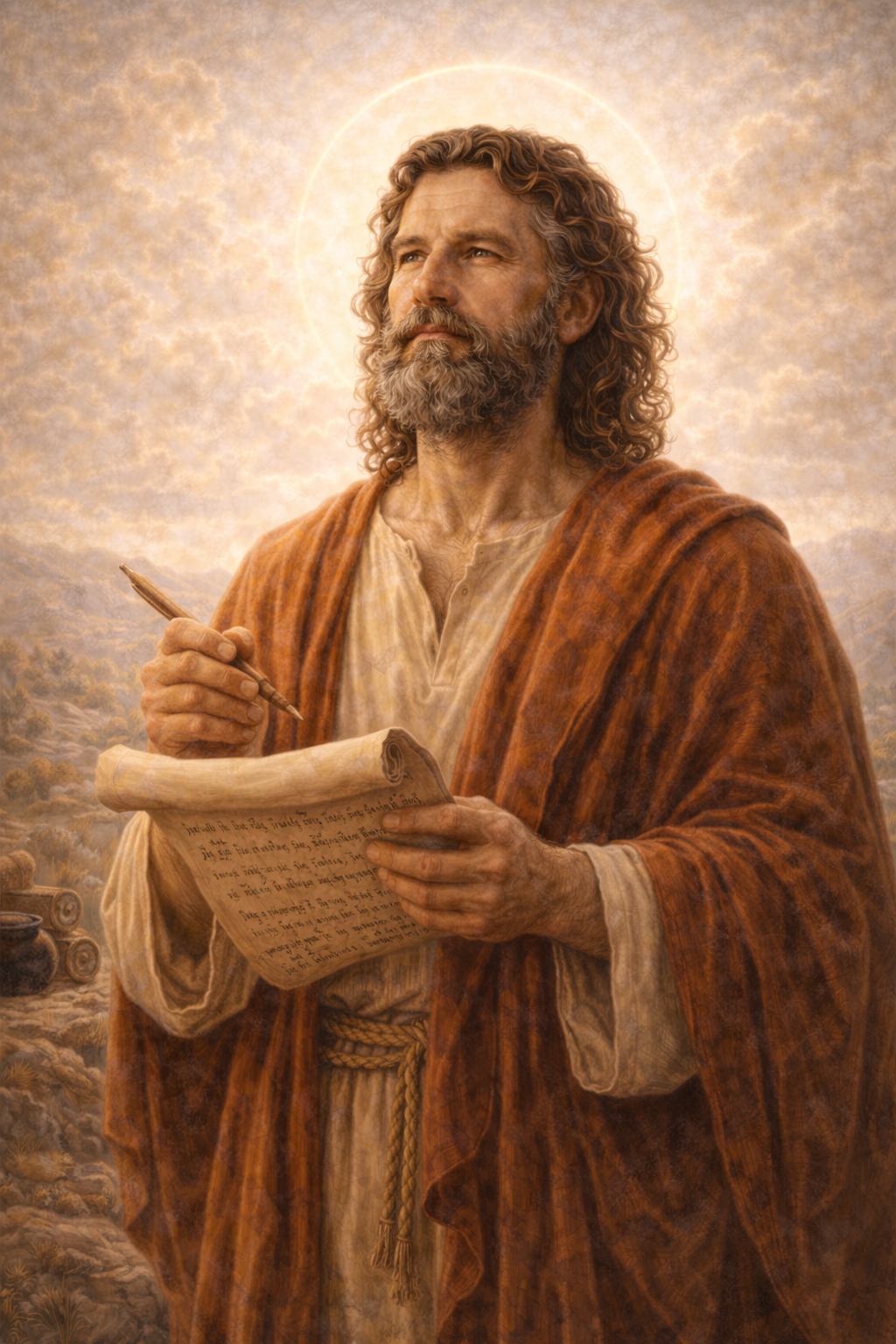
About Matthew
The earliest sources provide only a narrow outline of Matthew's life. The Gospel of Matthew names him among the Twelve and uniquely describes him in that list as a tax collector. Earlier in the same Gospel, Jesus sees a man named Matthew sitting at a customs post and calls him with the words “Follow me.” Matthew rises and follows, and the next scene places Jesus at table with tax collectors and others whom the narrative calls sinners. When critics object, Jesus answers that those who are ill need a physician and that he came to call sinners. These scenes establish Matthew's remembered occupation, response to Jesus, and membership in the apostolic circle; they do not supply his age, family, birthplace, or the date of his call.
Mark tells a closely parallel call story but names the customs official Levi son of Alphaeus. Jesus meets him beside the sea, calls him, and then eats in his house with tax collectors and sinners. Mark's later list of the Twelve names Matthew, not Levi, and does not explicitly say that the two names belong to one person. Christian tradition commonly harmonized these passages by identifying Matthew with Levi, and that identification explains the catalog's retained variant name. Because the texts themselves leave the connection unstated, it is better classified as traditional than as a securely documented second name. The phrase son of Alphaeus should not be used to make Matthew a brother of James son of Alphaeus; shared patronymics alone do not demonstrate that relationship.
Luke also calls the customs official Levi and says that, after leaving everything to follow Jesus, Levi gave a great banquet in his house. A large company of tax collectors and others shared the table. Read through the traditional Matthew-Levi identification, the banquet has long supported a portrait of Matthew as hospitable and willing to bring his former associates into contact with Jesus. Read strictly as historical evidence, however, Luke attests an action by Levi and does not independently identify him as Matthew. The virtue of hospitality can therefore be attached to Matthew only with traditional confidence, while responsiveness to the call is directly present in Matthew's own narrative.
Matthew appears in all four New Testament lists of the apostolic group. The ordering varies, but the lists consistently place him among the Twelve chosen to accompany Jesus and share the mission entrusted to them. Matthew's Gospel describes that commission as authority to heal and proclaim the approaching kingdom to Israel. No canonical narrative then isolates a preaching journey undertaken by Matthew, and no surviving first-century source gives the route of his later ministry. Calling him an apostle is therefore rooted in the earliest literary evidence about him, while calling him a missionary reflects the commission and later reception rather than a recoverable personal itinerary.
Acts supplies the last canonical notice that names Matthew. After the ascension, he is listed with Peter, John, James, and the other remaining apostles in Jerusalem. The group returns to an upper room and devotes itself to prayer together with several women, Mary the mother of Jesus, and Jesus' brothers. This brief notice places Matthew within a community rather than in an individual adventure. It supports a relationship to the apostolic body and a final securely located event in Jerusalem, but it says nothing about where Matthew went afterward or how he died. Dates sometimes supplied for his birth and death are not recoverable from this evidence and should remain unset.
By the early fourth century, Eusebius preserved much older testimony about writings associated with Matthew. He reports that Papias, a second-century bishop, said Matthew arranged sayings in a Hebrew dialect and that different people interpreted them as they could. Elsewhere Eusebius says that Matthew preached first to Hebrews and left them a writing in their own language before going to others. These passages document an ancient attribution, not the autograph or a verifiable travel diary. They matter because the title Evangelist arose from this reception, but they cannot by themselves prove that the apostle composed the surviving Greek Gospel in its present form.
Modern Catholic biblical scholarship distinguishes that early attribution from conclusions about the extant text. The introduction to the New American Bible Revised Edition describes the Gospel's author as unknown and judges direct composition by the apostle untenable because the Greek work uses Mark and other traditions. It dates the composition after the destruction of Jerusalem in 70, probably at least a decade later, and treats Antioch as a plausible setting rather than a certainty. Accordingly, Matthew may responsibly be titled Evangelist within church tradition, while a historical biography should not state that he wrote the canonical Gospel as an established fact. This distinction honors both the ancient reception of the book and the limits of textual evidence.
Later churches remember much more than the canonical sources can verify. The Orthodox Church in America transmits a sequence in which Matthew preached among Jews, traveled to peoples in several regions, reached a place called Ethiopia, and died after persecution by a ruler. The account includes wonders, fire that does not harm him, a coffin cast into the sea, dreams, and a ruler who takes Matthew's name. These details belong to hagiographic tradition and legend, not to contemporary documentation. They should not be converted into precise map routes, coordinates, a death place, or a year. The same tradition explains Eastern Orthodox use of the titles Apostle and Evangelist and its commemoration on November 16.
Western calendars likewise preserve Matthew through worship rather than additional biography. The Roman Catholic calendar celebrates Saint Matthew, Apostle and Evangelist, on September 21, and the Church of England keeps Matthew on the same civil date. Traditional martyr status remains widespread, but the manner and location of his death vary across late accounts and cannot be adjudicated from early evidence. Matthew's durable witness is therefore clearest in the compact scriptural pattern: a person associated with an unpopular revenue office responds to Jesus, shares a table across social boundaries, joins the Twelve, and remains with the praying community in Jerusalem. His story invites prompt response and generous welcome while also teaching readers to name the boundary between evidence and devotion.
Wondering how to weigh the stories and sources? Learn how to read a saint biography.
Explore similar vocations
Prayers for Matthew
Saint Matthew's Day collect excerpt
O Almighty God, who by thy blessed Son