Biography
Anselm of Canterbury
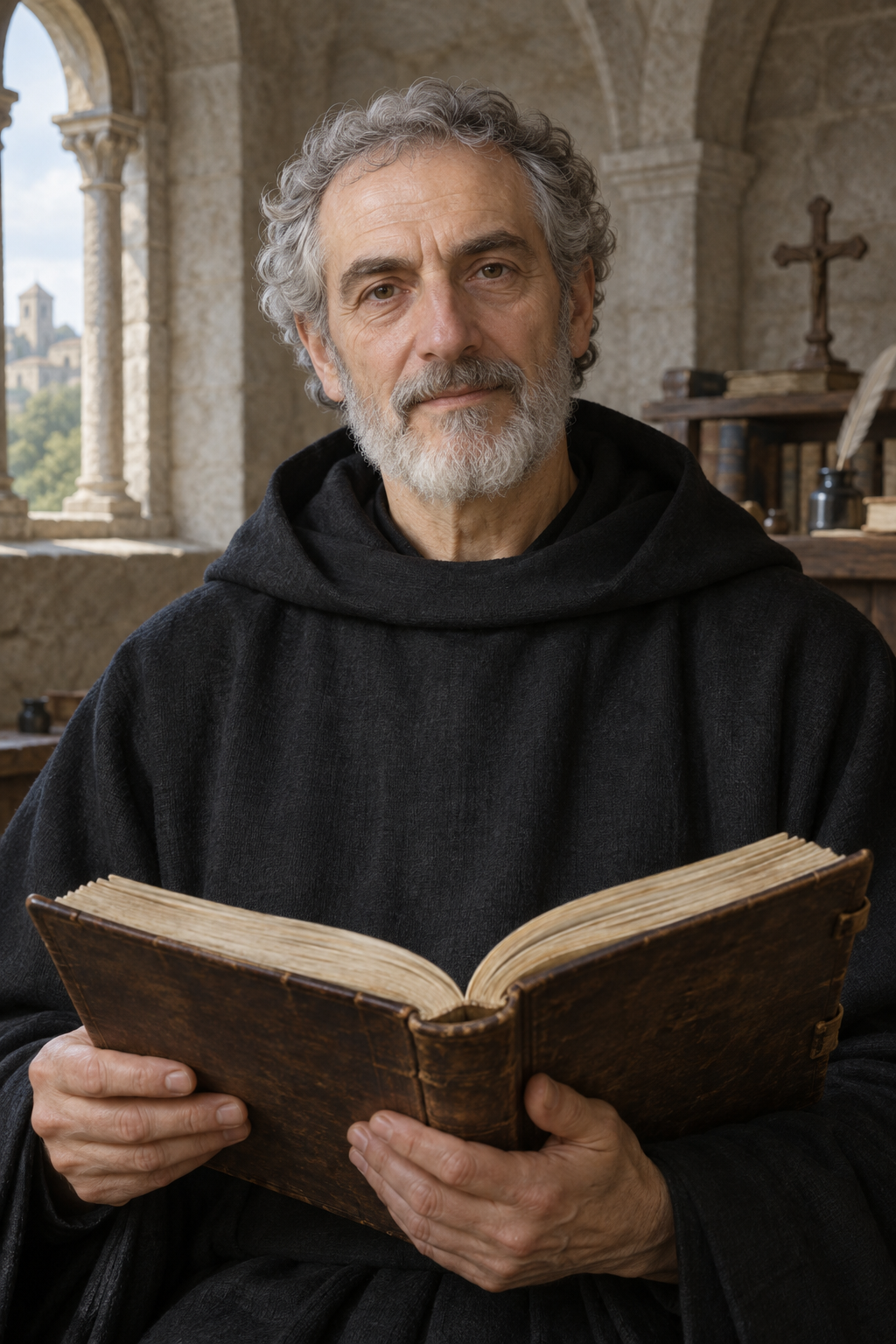
About Anselm of Canterbury
Anselm was born in northern Italy around 1033, became a Benedictine monk at Bec, and eventually served as archbishop of Canterbury. At Bec he was drawn to the teaching of Lanfranc, whose guidance helped him return seriously to study. The meeting became the beginning of a monastic vocation as well as an intellectual apprenticeship. Anselm's later work would bring together responsibilities that did not always sit comfortably together: the quiet of prayer, the demands of teaching, and the government of the Church.
He entered Bec in 1060, succeeded Lanfranc as prior in 1063, and became abbot in 1078. Alongside administration and correspondence, he wrote the Monologion in 1075–76 and the Proslogion in 1077–78. These books grew out of an active teaching community, not a life detached from other people.
The school at Bec welcomed students who sought education without necessarily intending to become monks. Under Lanfranc, its studies included classical logic and rhetoric as well as Scripture. Anselm entered that teaching world and helped develop it. G. R. Evans's account of the community also shows how intellectual friendship sustained his writing: Boso encouraged him to complete Cur Deus Homo and later became an important companion. Anselm asked for Boso to join him in England, valuing the presence of someone able to discuss difficult questions with him. His books belonged to a network of conversations, requests, and friendships rather than to solitary reasoning alone.
Teaching could reveal both severity and tenderness. Evans describes Anselm's demanding treatment of the young monk Osbern and the grief expressed in his letters after Osbern died. The same account preserves his objection to an abbot who beat his young monks without improving their conduct. Anselm compared such treatment to confining a young tree so tightly that it could not grow properly: the boys needed encouragement and room to develop.
The Proslogion begins with the effort to seek God rather than with an impersonal demonstration. In its preface Anselm recalls his search for one argument that could accomplish what the connected arguments of the Monologion had attempted. Chapter two reasons that God, understood as unsurpassable, cannot exist only as an idea, since existence in reality would be greater. The argument is offered within a prayerful search for understanding, with the writer addressing the God whom he already believes and loves.
This combination has made Anselm difficult to classify simply as either a logician or a devotional writer. The scholar Eileen Sweeney argues that the tension is central to his purpose. He wants reasoning strong enough to establish necessary conclusions, while also insisting that God exceeds human comprehension. On her reading, the expressions of longing and frustration are not decorative passages to discard before reaching the philosophical argument. They expose the distance between knowing that God exists and attaining the direct knowledge of God that the writer desires. His intellectual effort and his prayer press toward the same object, even as neither removes that tension.
Canterbury brought a different kind of struggle. Consecrated archbishop in December 1093, Anselm resisted royal interference in ecclesiastical government. His relations with William Rufus and Henry I involved sustained conflict, and his opposition to Henry led to exile beginning in 1103.
The eventual settlement did not simply remove all ties between bishops and the king. At the London council of 1107, Henry relinquished investiture of bishops and abbots, while homage for their temporal possessions remained permissible. The distinction concerned the authority represented by appointment to church office and the obligations attached to property. Anselm could resume his pastoral responsibilities and continue writing during the remaining years of his life. His earlier journey in Italy had also allowed him to complete Cur Deus Homo, a work begun in England.
Eadmer, his companion and biographer, records a smaller encounter during Anselm's travels. At Saint-Omer, parents asked him to confirm their children; he welcomed others as well, and crowds came for the sacrament. When the party was finally leaving, a young woman begged to be confirmed. His companions pressed him to continue because of the journey ahead and the dangers of travelling at night. Anselm yielded, then regretted having allowed their arguments to outweigh her request. According to Eadmer, the memory troubled him for the rest of his life. The incident preserves a pastor's failure and remorse alongside the public image of an unyielding archbishop.
Anselm died on 21 April 1109.
His recognition as a saint developed over centuries. Lambeth Palace Library preserves evidence of Thomas Becket's request for canonization in 1163, together with a later reference to a papal bull in Archbishop Morton's register for 1494. The library treats the later record as suggesting that formal canonization may have occurred only then. These surviving records warrant caution about presenting a single uncontested date.
His influence continued in monastic education. In a letter marking the nine-hundredth anniversary of his death, Benedict XVI described the Roman college bearing Anselm's name as an international institution founded by Leo XIII for Benedictine students. By 2009 its teaching in philosophy, theology, and liturgy also welcomed clergy, religious women, laypeople, and non-Catholic students. The institution's continuing purpose, as the letter presented it, was to unite intellectual work with the life of faith.
Wondering how to weigh the stories and sources? Learn how to read a saint biography.
Explore similar vocations
Prayers for Anselm of Canterbury
Petition from Anselm's Proslogion
Teach me to seek you, and reveal yourself to me, when I seek you