Biography
Anthony of Padua
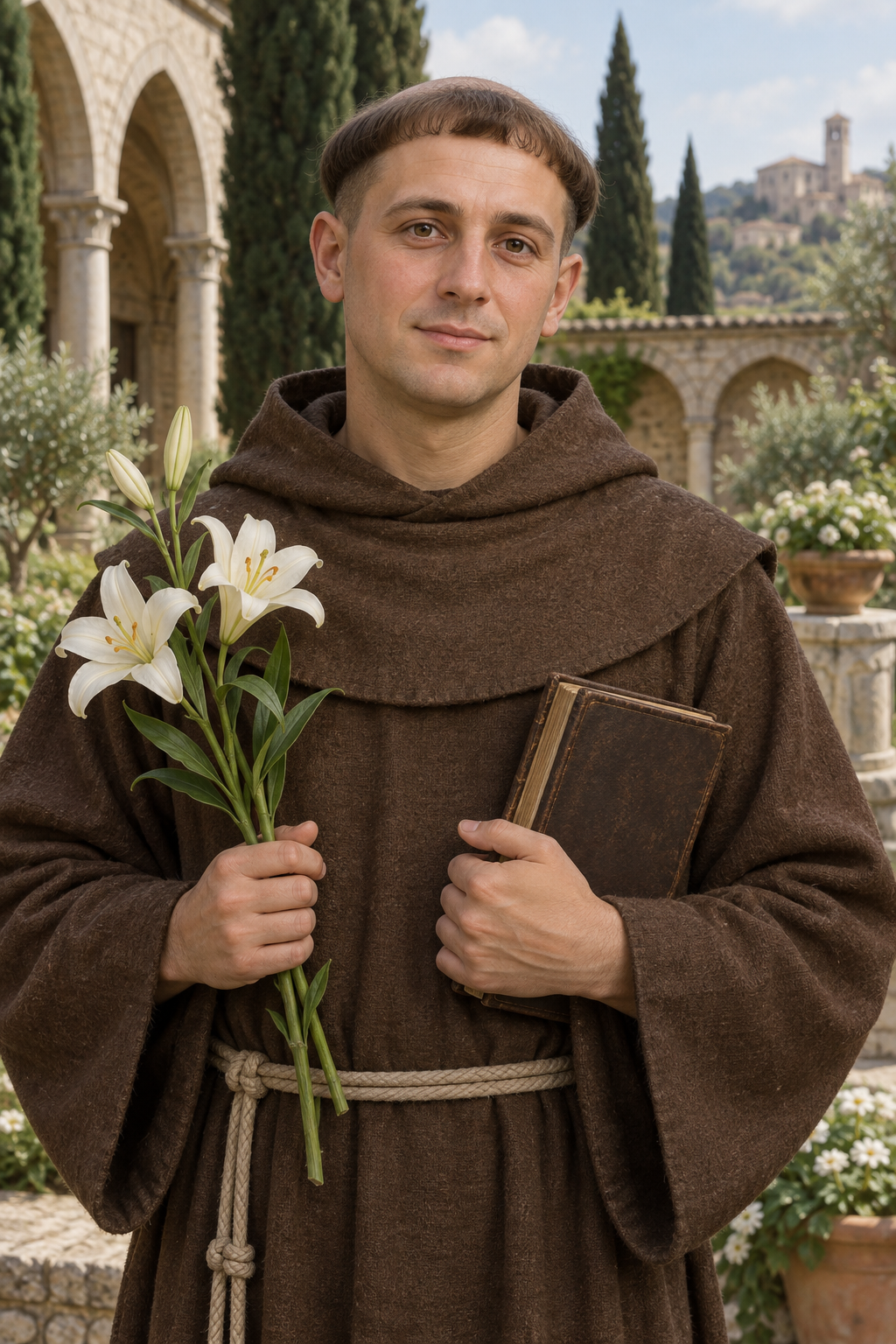
About Anthony of Padua
Anthony of Padua began life in Lisbon, not in the Italian city whose name he bears. Born around 1195 and baptized Fernando, he entered the Augustinian Canons at Saint Vincent's monastery before moving to Holy Cross in Coimbra. There he studied the Bible and the writings of the Church Fathers. That education preceded his Franciscan life: the preacher who later taught other friars had first been formed in a community of canons.
In 1220, news of the Franciscan missionaries who were killed in Morocco helped move Fernando toward a different vocation and a journey abroad. He joined the Friars Minor and took the name Anthony. He wanted to go to Morocco himself and preach there, but illness interrupted the mission.
On the return voyage, a storm drove his ship to Sicily instead of Portugal. He subsequently traveled to Assisi for the friars' gathering at Pentecost in 1221. The provincial minister sent him to Montepaolo, a hermitage near Forlì, where the brothers needed a priest. This assignment placed him in a small community before the wider preaching ministry for which he became known.
His theological training answered a practical need in northern Italy. As Franciscan historian Dominic Monti explains, friars there encountered Cathars and Waldensians and were asked to distinguish Catholic teaching from their messages. Anthony began preaching and was urged to prepare other brothers for that task. Formal study also raised a difficulty for an order committed to poverty. Books were expensive, and sustained teaching called for more settled houses. Education could become a source of prestige or inequality within the brotherhood. The question was not simply whether Anthony knew enough to teach, but how teaching would fit the way of life the friars had chosen.
A short letter from Francis gives a direct answer to that question. Francis approved Anthony's teaching of sacred theology to the brothers, while making prayer and devotion a condition of the work. The permission and the condition belong together. The letter does not demand that Anthony abandon learning; it asks that learning remain compatible with the friars' spiritual life. It is a small surviving piece of correspondence, but it connects Anthony's work as a teacher directly with the founder's instructions.
Anthony taught in Bologna and preached in Italy and France. He also served as provincial superior of northern Italy. After leaving that responsibility, he devoted himself to preaching in and around Padua. Benedict XVI describes the Sunday and festival sermons as manuals for preachers, drawing together theology and its practical application.
Anthony's own sermon collection shows how carefully he organized material for other preachers. In its prologue, he explains a structure joining the Gospel with other liturgical readings, the Introit, and the Epistle. He divides material into sections and supplies an index to help readers find subjects. He also uses natural history and explanations of words as teaching aids. These pages are a preacher's working resource, not a verbatim record of everything he said to a crowd. The organization reflects his concern to make complicated material usable.
His public work also brought him into questions of debt and political violence. Niccolò Dal-Gal's account credits his intervention with a Paduan law of March 15, 1231, favoring debtors unable to pay. It also records an unsuccessful appeal to Ezzelino at Verona for prisoners' release. The failure matters: the story should not be turned into an effortless victory over a ruler. Anthony's advocacy could seek relief for people caught in civic conflict without obtaining the result he wanted. This aspect of his ministry places him among the practical pressures of a medieval city, not only in accounts of preaching and devotion.
In his final Lent, he preached in Padua, speaking at various stations throughout the city. Monti connects this ministry with reconciliation between hostile groups and concern for social justice. His audience included people whose religious commitments and civic disputes met in the same streets.
On June 13, 1231, he collapsed while eating with the friars. He asked to return to Padua, but the journey stopped at the Poor Clares' house at Arcella. There he received the anointing of the sick and died. The basilica's account places his last hours near the city, not in Lisbon.
His recognition as a teacher continued long after his death. Pius XII declared him a Doctor of the Church on January 16, 1946. Vincenzo Criscuolo's account explains that this honor involved a judgment about his holiness and teaching, followed by a papal declaration. It was not an academic degree earned during his lifetime. The designation directs attention to the intellectual work of a friar often remembered primarily through miracle stories and popular devotion.
At his basilica today, prayers for finding lost things extend from ordinary objects and documents to the recovery of faith. This is a continuing devotional practice, not a historical claim that every request receives its desired answer.
Wondering how to weigh the stories and sources? Learn how to read a saint biography.
Explore similar vocations
Prayers for Anthony of Padua
Anthony of Padua: collect petition
permets qu'avec son aide, et fidèles à ses leçons de vie chrétienne, nous ressentions dans toutes nos épreuves le bienfait de ton secours.
Prayer to St. Anthony
O glorious St. Anthony, since God has given thee the power of miracles, a power thou hast exercised for more than six centuries, and since He has given thee in particular the power of finding that which has been lost, I come to thee with the confidence of a child to the best of fathers.
Grant me, above all, to find the grace of God, if I have had the misfortune to lose it; grant me to find also my former fervor in the service of God and in the practice of virtue; and as a pledge of these graces, so important for my eternal salvation, grant me to find also the things I have lost. Thus, thou shalt make me experience the presence of thy goodness, and thou wilt increase my confidence and my love for thee.
(Our Father.)