Biography
Ephrem the Syrian
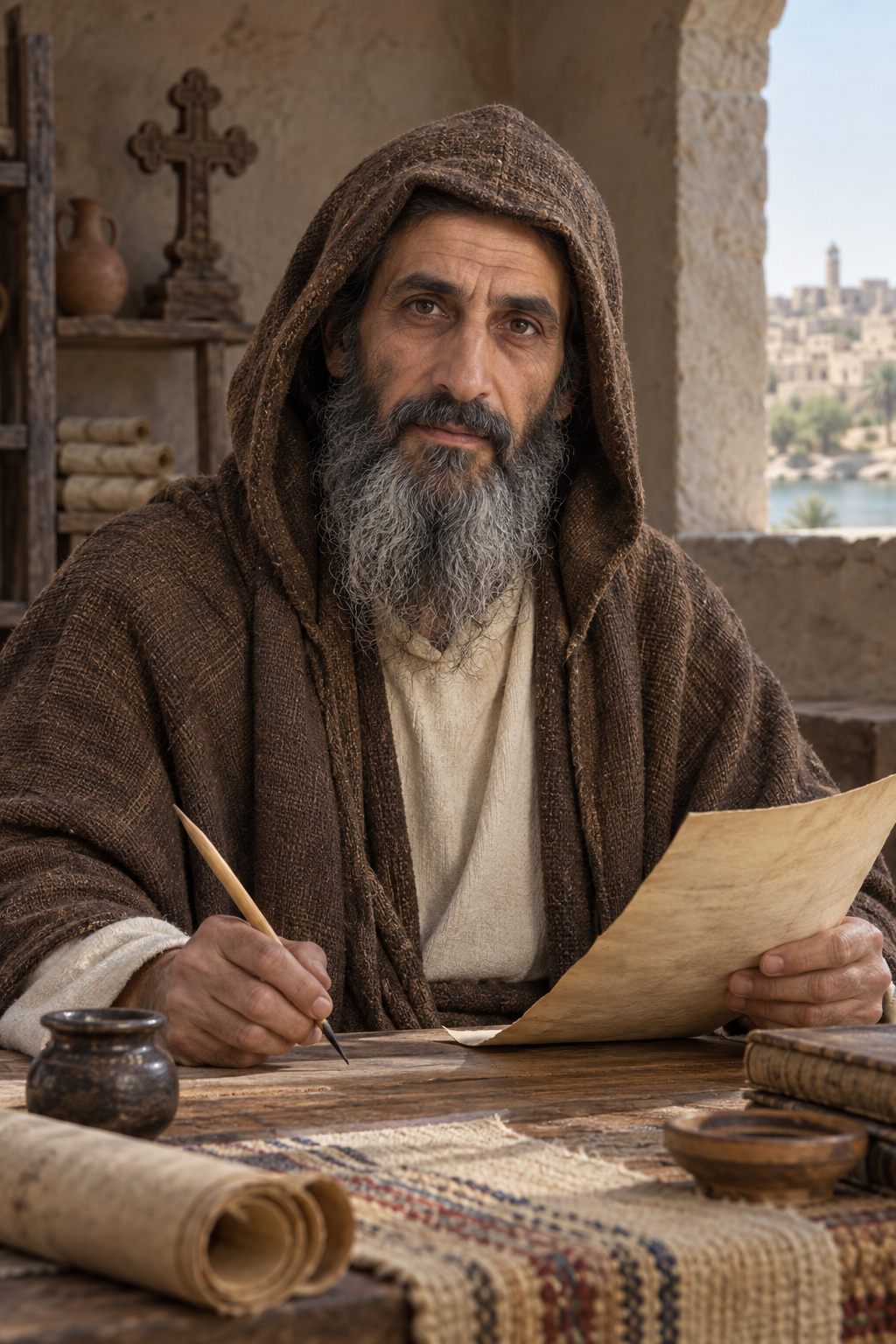
About Ephrem the Syrian
Ephrem was a Syriac-speaking Christian writer whose work joined preaching, poetry and worship. He was born around 306 into a Christian family in Nisibis and grew up in the community of its bishop James. He served as a deacon. When Nisibis passed into Persian hands in 363, he moved to Edessa and continued preaching there. His life thus crossed a change of imperial rule as well as a change of home. He died in Edessa in 373, leaving writings that include biblical commentary, prose, verse homilies and hymns.
His ascetic commitment belonged to a distinct Syriac setting. Joseph Amar locates it among the Sons of the Covenant, a form of chaste Christian service, rather than simply identifying him with the Greek monastic ideal of later biographies. Amar contrasts those accounts with Jacob of Serugh's homily, which remembers Ephrem's moderation, simplicity and work among the Daughters of the Covenant. Women were part of this remembered ministry, not merely distractions from it. Stories of an encounter with Basil and journeys to Egyptian monasteries belong to a later fictional portrait, not to an established itinerary of Ephrem's travels.
The poems themselves show how he taught. In the first hymn of The Pearl, the speaker turns a pearl in his hand and finds its brightness unchanged from different sides. Its purity and undivided shape become ways of contemplating Christ. The small object does not solve every question; it trains attention toward what can be received without pretending to master what remains hidden. By the seventh hymn, that teaching becomes a criticism of church life. Ephrem attacks competition for clerical rank, including ambition pursued through bribery and deceit. He closes by asking for peace between clergy and rulers. Beauty and rebuke belong to the same collection: delight in a pearl does not keep him from confronting the desire for power.
His Homily on Our Lord uses another sustained contrast: overwhelming power and a humble voice. Interpreting Paul's conversion, Ephrem distinguishes the dazzling light from Christ's lowly way of addressing the persecutor. The light overcomes the eyes; the voice reaches a person who needs help. For Ephrem, Christ's humility is not a failure of divine strength but the means by which pride is checked. He develops the point through repeated comparisons rather than a brief definition. The same discussion turns to the woman received by Jesus in a Pharisee's house. Ephrem casts Christ as a physician and challenges the host's refusal to understand a wounded person's approach for healing. These are his theological readings of scriptural episodes, not accounts of incidents he witnessed. They show a preacher arguing that gentleness can reach someone whom force or spectacle has not persuaded.
A later account by Sozomen remembers his service during a famine in Edessa. In that narrative, Ephrem confronts wealthy people who allow their neighbors to suffer. They say they cannot find a trustworthy distributor for their gifts, so he offers to undertake the work himself. He uses the money to arrange beds in public porticoes and to care for people from both the city and the surrounding country, including strangers. Sozomen places his death shortly afterward. This is a received story of practical mercy, not a contemporary medical record; it does not establish that he died of plague contracted while nursing patients.
Jerome supplies an earlier witness to his reputation as a writer. In On Illustrious Men he identifies Ephrem as a deacon of Edessa who composed numerous works in Syriac. He reports that some churches read these writings publicly after the scriptural readings. Jerome also describes reading a Greek translation of Ephrem's work on the Holy Spirit and finding its intellectual force still evident across the language barrier. His notice does not require a personal meeting between the two men. It records a reader's encounter with a translated book and a reputation that already extended beyond Ephrem's own language.
Much later, Benedict XV gave that reputation a particular Catholic recognition. On October 5, 1920, he proclaimed Ephrem a Doctor of the Church after petitions from Eastern church leaders and other clergy. The decree recalls earlier Roman efforts to collect and publish his writings, as well as a proper Mass and office approved in 1909 for a Benedictine priory in Jerusalem. It also expresses a wish to protect Eastern liturgical customs. The title belongs to Catholic recognition of his teaching; it should not be treated as a decree binding every church that venerates him.
The current Roman calendar keeps an optional memorial on June 9.
The Orthodox Church in America commemorates him on January 28 under the title Venerable.
In the same church's Lenten practice, a prayer traditionally bearing his name asks worshippers to attend to their own faults instead of condemning a neighbor. That liturgical use is documented; this modern witness does not establish Ephrem's personal authorship of the prayer.
Wondering how to weigh the stories and sources? Learn how to read a saint biography.
Explore similar vocations
Prayers for Ephrem the Syrian
Ephrem: Lenten prayer excerpt
Grant me to see my own transgressions and not to judge my brother