Biography
Arnold Janssen
About Arnold Janssen
Arnold Janssen was born on November 5, 1837, at Goch, a small city in the Lower Rhineland of Germany. The says he was the second of ten children and learned deep religious practice from his father. That family setting should be presented simply, without turning it into a full childhood psychology.
Janssen was ordained a priest on August 15, 1861, for the Diocese of Munster. He was assigned to teach natural sciences and mathematics at a secondary school in Bocholt. The official profile says he gained a reputation as a demanding but fair teacher, a useful detail for showing discipline before his later missionary organization.
His devotion to the Sacred Heart led to appointment as diocesan director of the Apostleship of Prayer. Through that apostolate, the profile says, he sought openness toward Christians of other confessions and gradually became concerned for spiritual needs beyond his own diocese. The profile can keep this as a development of pastoral vision.
Janssen decided to dedicate his life to awakening missionary responsibility in the German Church. In 1873 he left teaching and soon founded a monthly mission magazine, The Little Messenger of the Heart of Jesus. The source says it carried mission news and encouraged German-speaking Catholics to support missionary work.
The magazine is important because Janssen began with communication before he had a large institution. The source shows him using printed reports to connect local Catholics with needs beyond their own region. That makes the publication work a pastoral tool, not a side business or merely a fundraising device.
The timing was difficult. The official profile places his efforts during the Kulturkampf, when anti-Catholic laws affected priests, religious, and bishops in Germany. Janssen suggested that some displaced priests might serve in mission or help form missionaries, but he came to see himself as called to the difficult task.
The Kulturkampf context should be handled carefully. It explains why a German mission house was difficult to imagine at that moment, but the profile should avoid turning Janssen into a political polemicist. The reliable claim is that a period of church pressure sharpened his missionary imagination.
With support from several bishops, Janssen opened a mission house at Steyl in the Netherlands on September 8, 1875. This beginning became the Society of the Divine Word. On March 2, 1879, the first two missionaries departed for China; one of them was Joseph Freinademetz.
Steyl also provided a practical location outside the immediate German conflict. The profile can name the Netherlands setting without implying that political exile was the whole point. The mission house gathered formation, publications, prayer, and eventual departures into one concrete place.
Publications were part of the foundation from the beginning. The source says Janssen opened his own printing shop only four months after the mission house began, because publications attracted vocations and raised support. Lay helpers distributed the Steyl magazines through German-speaking regions.
The new congregation developed as a community of priests and brothers. That detail matters because the work was not simply Janssen's private project or a magazine office. It became a missionary community with clerical and lay-religious forms of service, organized around evangelization and formation.
Women also served the Steyl mission house from the beginning. The official profile says their desire to serve the mission as religious, together with years of faithful service and Janssen's awareness of women's importance in mission, led him to found the Missionary Sisters Servants of the Holy Spirit on December 8, 1889.
The first sisters left for Argentina in 1895. In 1896 Janssen selected some sisters to form a cloistered congregation, the Servants of the Holy Spirit of Perpetual Adoration. Their mission service was prayer before the Blessed Sacrament for the Church and especially for the other two missionary congregations.
That cloistered foundation should not be treated as a withdrawal from mission. The official profile presents adoration as mission service by prayer, while the missionary sisters served through direct apostolic work. Janssen's project therefore held together proclamation, publishing, community life, women's service, and contemplative prayer.
Janssen died on January 15, 1909. The official profile describes his life as a continuing search for God's will, trust in divine providence, and hard work. It also records his beatification by Paul VI on October 19, 1975, and canonization by John Paul II on October 5, 2003.
The profile should not use the official page's present institutional numbers as current facts, because such statistics can age. Instead, it can show historical growth through the foundations, the early missionaries to China, the printing work, and the two women's congregations.
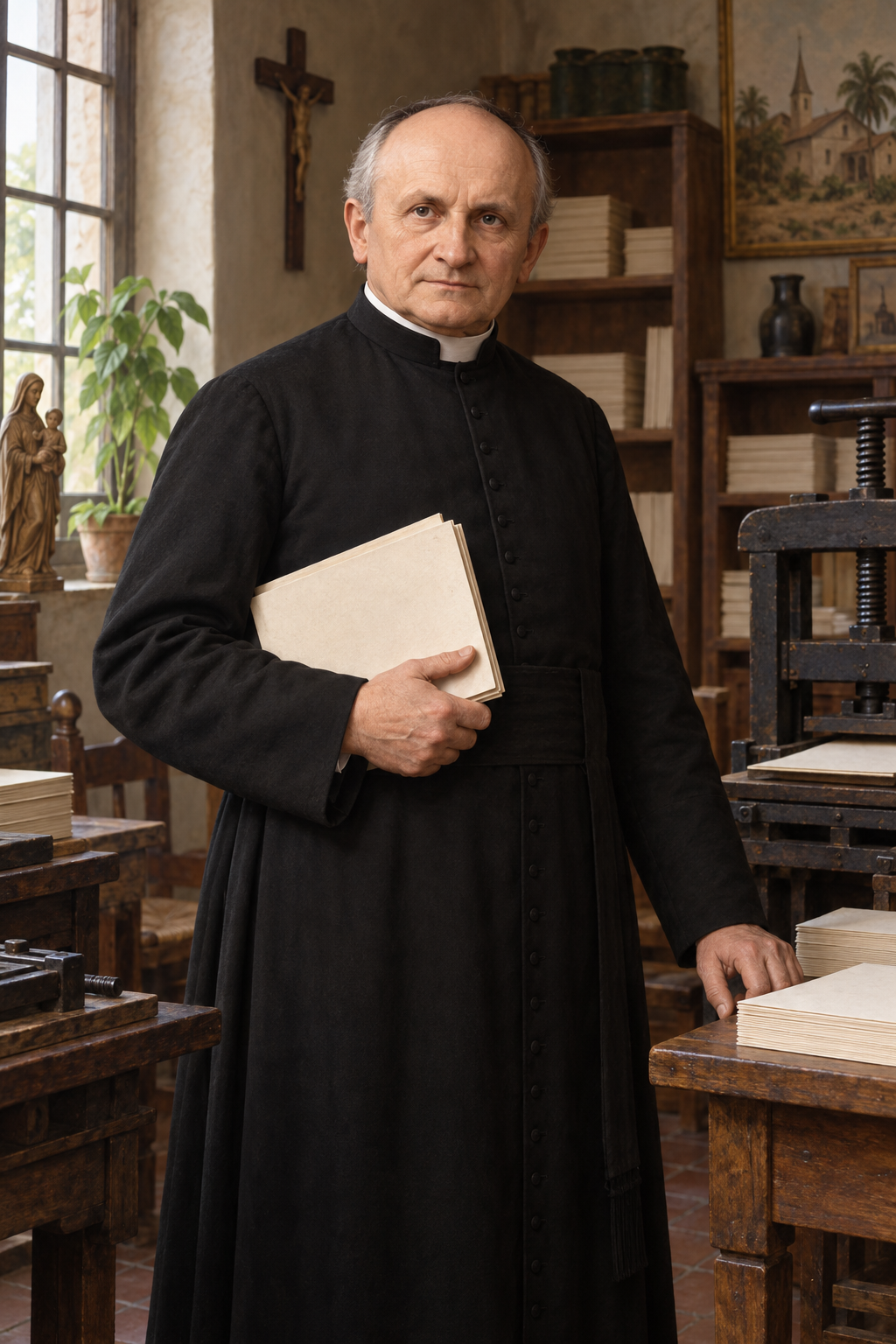
Artwork should show a German priest and missionary founder in a black cassock in a mission-house study or printing room. Books, blank papers, or a small press may appear as attributes. Avoid readable text, maps, modern objects, globe cliches, crowd scenes, and any claim to historical portrait likeness.
Wondering how to weigh the stories and sources? Learn how to read a saint biography.