Biography
Paul
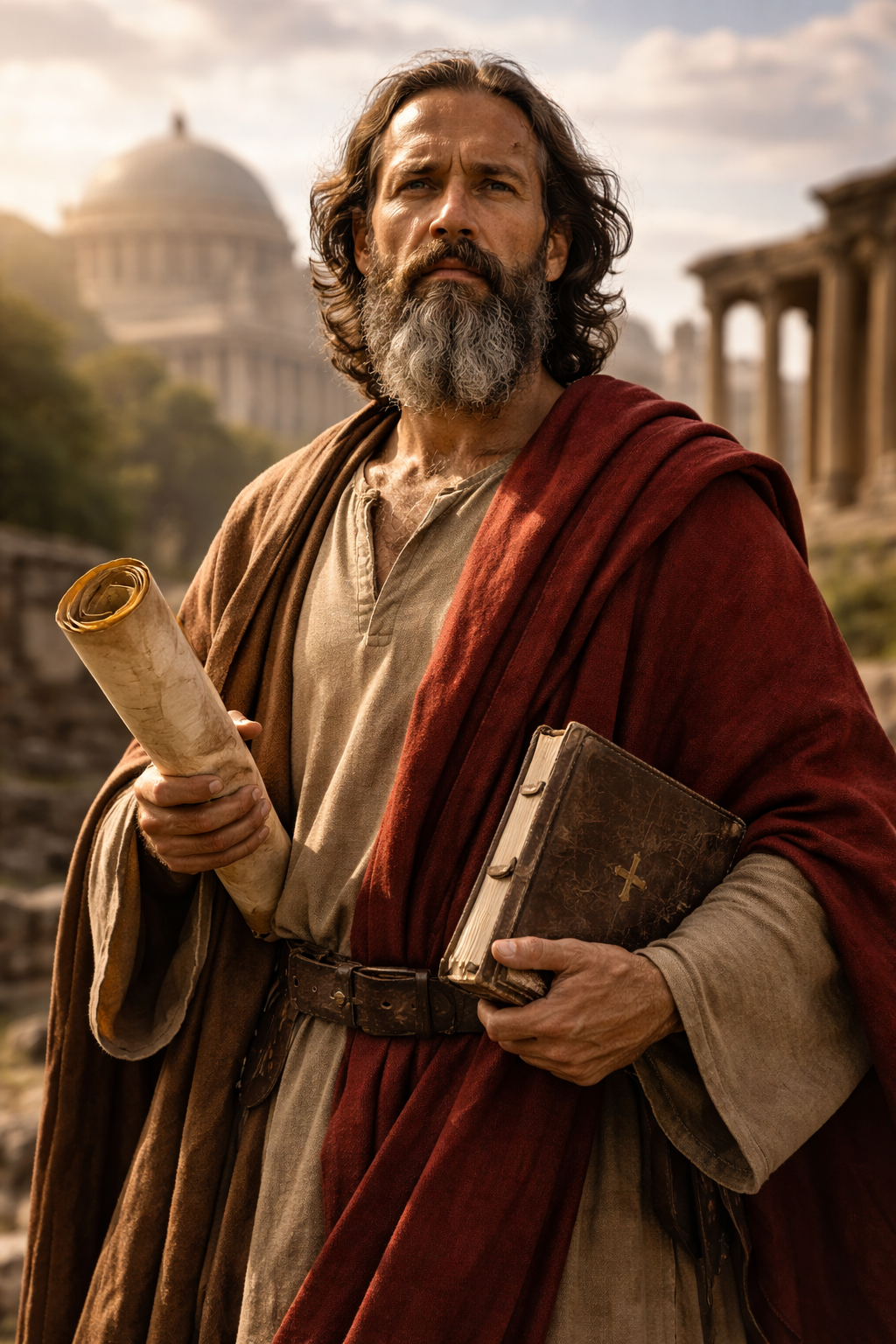
About Paul
Paul was a Jewish missionary whose work brought the message of Jesus to communities beyond Judaea. In his letter to the Galatians, he describes a calling to announce Christ among the Gentiles, people outside the Jewish people. His account begins not with an unbroken religious career, but with an acknowledgment that he had persecuted the church he later served.
Acts identifies his birthplace as Tarsus in Cilicia and describes his upbringing in Jerusalem under the teacher Gamaliel. It also reports his claim to Roman citizenship by birth. These details belong to the speeches and encounters preserved in Acts; they are not an autobiography written by Paul. They place the story within both Jewish religious life and the wider Roman world.
Acts describes a decisive encounter near Damascus: a light surrounds Saul, and he hears Jesus addressing him. Unable to see, he is led into the city, where Ananias visits him. The account connects his recovery of sight with baptism and his subsequent preaching about Jesus. The vision and healing are presented here as the testimony of Acts, not as independently verified observations.
In his own account, Paul emphasizes God's revelation of the Son and his calling to preach among the Gentiles. He says that he went to Arabia, returned to Damascus, and visited Peter in Jerusalem after three years. During that visit he also saw James, the Lord's brother. His telling gives particular attention to the origin of his mission and to his contact with other leaders.
The change in his work should not be confused with a change of name at his conversion. Acts later identifies Saul as also known as Paul. In its account of the church at Antioch, Barnabas and Saul are sent out together after prayer and fasting. They travel through Seleucia to Cyprus, where their preaching takes them from Salamis to Paphos.
Mission also required difficult discussions about belonging. Paul recalls going to Jerusalem with Barnabas and Titus and receiving recognition for his work among the Gentiles. He says that Titus was not compelled to be circumcised and that the leaders asked him to remember people in poverty. The account connects agreement about mission with a continuing responsibility toward others.
Agreement did not remove every disagreement. Paul describes challenging Peter at Antioch after Peter withdrew from eating with Gentile believers. For Paul, the conduct of a shared meal raised a question about whether these believers were being treated as full members of the community. His letter preserves the dispute rather than smoothing the relationship into an image of uninterrupted harmony.
Acts places Paul and his companions at Philippi after a journey through Troas and Neapolis. There Lydia listens to their teaching and offers hospitality after her household is baptized. The narrative later describes Paul and Silas imprisoned, and Paul calling out to prevent the jailer from harming himself. Before leaving the city, the missionaries return to Lydia's house and encourage the believers gathered there.
In Corinth, according to Acts, Paul stays and works with Priscilla and Aquila because they share the trade of tentmaking. The account describes an extended period of teaching, followed by an accusation brought before the proconsul Gallio. Work, hospitality, preaching, and opposition appear together in this part of the story. His mission is sustained through relationships as well as public speech.
Paul's letters also address the daily conduct of communities. Writing to the Corinthians, he insists that impressive speech, knowledge, and generosity cannot take the place of love. He describes love through patient and kindly behavior rather than through status or achievement. The passage challenges rivalry by giving ordinary relations between people priority over displays of religious distinction.
In Romans, Paul explains his plans to carry assistance to believers in poverty at Jerusalem. He names Macedonia and Achaia as the communities making the contribution and understands their material help as a response to shared spiritual gifts. He also hopes to travel through Rome toward Spain. The letter records that intention; it does not establish that the Spanish journey took place.
Imprisonment did not end his concern for others. In Philippians, Paul writes of his confinement while thanking the community and praying for its growth in love and discernment. He reports that his situation has encouraged others to speak with greater confidence. His attention moves between his own uncertain future and the life of the people to whom he is writing.
Acts follows Paul as a prisoner on a sea voyage toward Italy. During a prolonged storm, the narrative shows him urging those aboard to take food and courage. The ship is lost, but everyone reaches land. The next chapter describes the islanders' hospitality, a stay of three months, and a further journey through Syracuse, Rhegium, and Puteoli toward Rome.
At Rome, Acts depicts Paul living under guard and receiving visitors. Its closing scene leaves him teaching for two years in rented accommodation. His death is not narrated there. Later Christian tradition places his martyrdom in Rome under Nero, commonly within the years 64–68; the precise date remains uncertain. His surviving letters preserve the work of a missionary concerned with shared meals, practical generosity, and the patient care of Christian communities.
Wondering how to weigh the stories and sources? Learn how to read a saint biography.
Explore similar vocations
Prayers for Paul
Prayer for growth in love — Philippians 1:9
that your love may increase ever more and more in knowledge and every kind of perception