Biography
Thomas
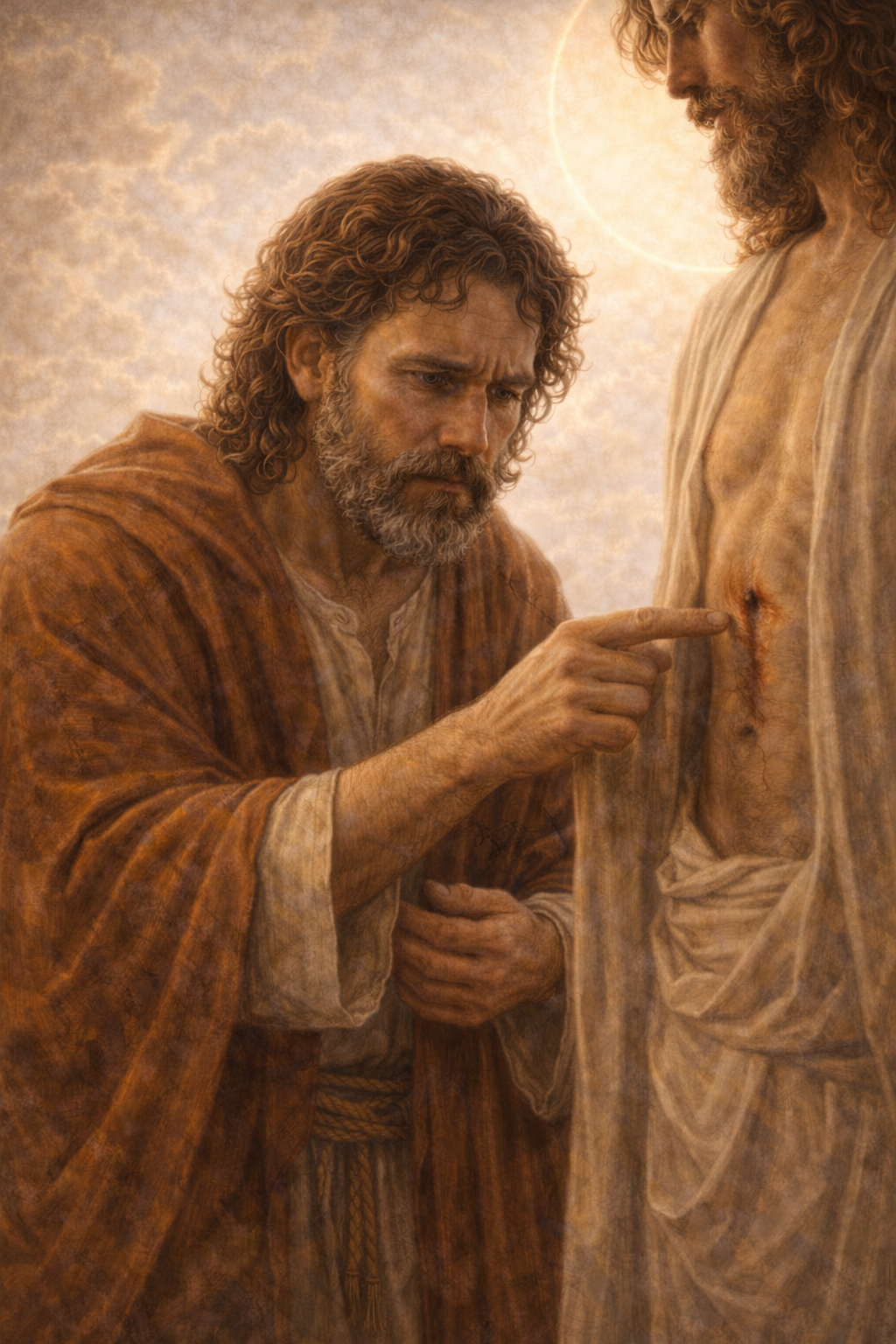
About Thomas
Thomas was one of the twelve apostles named in the New Testament. Matthew, Mark, and Luke place him in their apostolic lists, while John's Gospel calls him Didymus and makes him a speaking participant in four scenes. Both Thomas and Didymus mean ‘twin,’ although the texts do not identify his twin. Scripture gives no birthplace, family history, occupation, birth date, or death date for him. Those fields therefore remain unset. The most reliable account begins with John's portrait and then clearly separates the ancient missionary traditions that grew around Thomas from what the New Testament records.
Thomas first speaks when Jesus decides to return to Judea after Lazarus has died. The disciples remember that opponents there recently tried to stone Jesus. Thomas does not minimize the danger. He tells the others, ‘Let us also go to die with him.’ John may allow irony in the line, because the disciples do not yet understand what Jesus will do, but the action is still one of solidarity. Thomas recognizes risk and remains with the group. This scene complicates the later nickname ‘doubting Thomas’: before the Passion, John presents him as candid about death and willing to accompany Jesus toward it.
At the Last Supper, Jesus speaks of departure, dwelling places, and a way the disciples know. Thomas answers without pretending to understand: ‘Master, we do not know where you are going; how can we know the way?’ His question prompts Jesus's statement, ‘I am the way and the truth and the life.’ The exchange does not make Thomas a systematic theologian or prove motives the text never supplies. It does show a disciple willing to expose confusion in the company of others. Benedict XVI later emphasized this frank request for explanation as one of Thomas's characteristic Gospel moments.
John's best-known Thomas scene occurs after Jesus's death. Thomas is absent when Jesus first appears to the gathered disciples. The Gospel does not explain why. When they report what they saw, Thomas asks to see the nail marks and place his hand in Jesus's side before believing. The other disciples had already received a visual encounter, so the episode should not be reduced to ridicule of one unusually defective follower. Thomas demands continuity between the crucified Jesus and the one his companions say is alive. His words are severe, but they remain within a community whose testimony he has not yet accepted.
A week later Thomas is with the disciples when Jesus appears again. Jesus invites him to inspect the wounds and calls him to belief. John does not say whether Thomas actually touches them. Thomas answers, ‘My Lord and my God!’—a direct confession placed near the Gospel's conclusion. Jesus then blesses those who believe without seeing. The sequence moves from an unmet demand for evidence to recognition, but it does not erase the question that preceded it. Thomas remains present long enough to receive an answer, and the community keeps a place for him during the interval.
John names Thomas once more among seven disciples by the Sea of Tiberias. They fish through the night, recognize Jesus from the shore after an abundant catch, and share bread and fish. The narrative gives Thomas no separate speech, yet his presence matters: the disciple associated with the difficult resurrection encounter remains among the witnesses. Acts also lists Thomas in the Jerusalem upper room after the Ascension, where the apostles, women, Mary the mother of Jesus, and Jesus's brothers devote themselves together to prayer. These are the final New Testament notices attached securely to his name.
Later Christian memory carries Thomas far beyond the places named in Scripture. Benedict XVI summarized an ancient tradition that he evangelized Syria and Persia and then traveled to western and southern India; the same audience identifies the Acts of Thomas and Gospel of Thomas as apocryphal works important for studying Christian origins, not additional New Testament biography. Indian churches have long received Thomas as an apostolic founder. That living inheritance deserves respect, but an exact arrival in AD 52, a seven-church itinerary, and modern route lines cannot be treated as documented merely because they are familiar.
The Orthodox Church in America preserves a fuller account: Thomas founds churches across several regions and is eventually imprisoned, tortured, and pierced with spears at Meliapur in India. This is explicitly introduced as Church Tradition. It supplies the basis for his title as martyr in that tradition, not a contemporary death record. Competing later accounts and relic histories further caution against assigning a precise year or mapping a single established journey. The packet therefore records India only as a broad traditional mission region and Meliapur as the traditional martyrdom setting, with no coordinates.
Thomas is commemorated on July 3 in the Roman Catholic calendar represented by the USCCB readings, on October 6 by the Orthodox Church in America, and with the Twelve on June 30; the OCA also connects him with the Sunday after Pascha. These observances document reception rather than prove disputed biographical details. Thomas's enduring significance rests first in the Gospel record: courage in danger, honest inquiry, insistence that resurrection not be detached from the wounded Jesus, a concise confession of faith, and continued life within a praying community. Later Indian traditions extend that memory into a major apostolic identity while remaining historically distinct from John's testimony.
Wondering how to weigh the stories and sources? Learn how to read a saint biography.