Saint profile
Benedict Menni
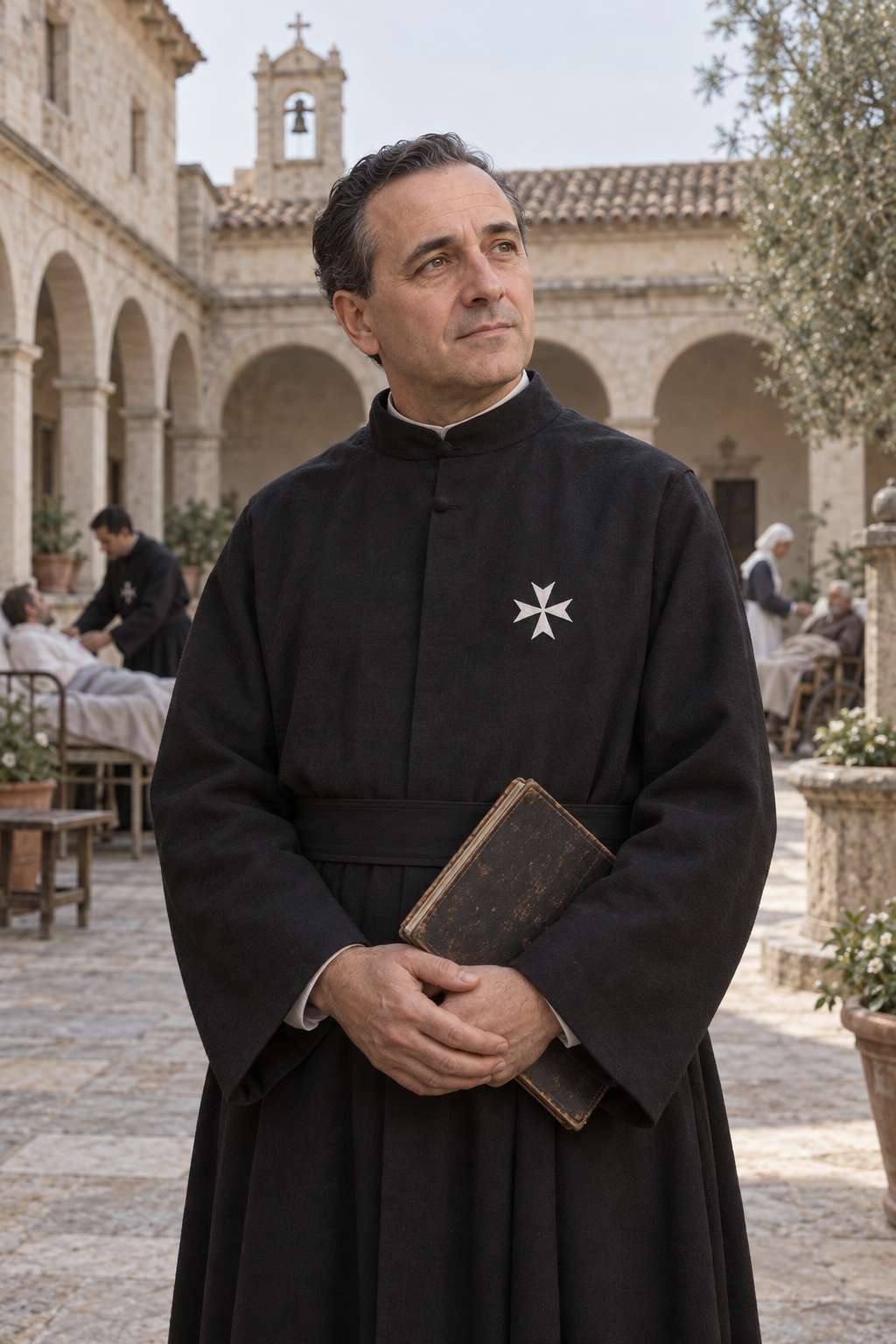
About Benedict Menni
Benedict Menni was born Angelo Ercole Menni in Milan on 11 March 1841. He was the fifth of fifteen children of Luigi Menni and Luisa Figini. The official biographies give only a brief view of his childhood, so the account begins with the work that shaped his vocation. As a young man, Menni worked in a bank. In 1859, after the Battle of Magenta, he volunteered to help wounded soldiers at Milan's railway station, where he encountered the Brothers of Saint John of God caring for the injured.Menni entered the Order's novitiate at the Santa Maria d'Aracoeli hospital in Milan on 1 May 1860 and took the religious name Benedict. The Order records that he made profession in 1864; Menni was ordained a priest in 1866. Menni's nursing and priestly formation prepared him for a ministry that joined religious life with care for sick people. He did not begin his work as a hospital administrator: the Order first sent him abroad as a young religious to help rebuild a community whose institutions had been weakened by political opposition to religious orders in Spain.In 1867 Menni arrived in Spain with the mission of restoring the Hospitaller Order of Saint John of God. The Vatican account describes a country in political conflict where religious communities met open hostility and the Brothers' work had nearly disappeared. The General Curia records that he reached Barcelona during Holy Week and opened a home for children with polio in December. Over the following decades, he rebuilt the Order's presence in Spain and helped extend its work to Portugal and Mexico. The Vatican biography says the restoration continued for 36 years. The Order's accounts describe his leadership as a renewal of its Hospitaller mission. They do not establish a single definitive total for institutions attributed to him, so this biography does not give a number. His work combined religious formation, hospitals, and service to people who were sick or otherwise in need.Menni also helped establish a new women's religious congregation. In Granada he met María Josefa Recio and María Angustias Giménez, who joined him in founding the Congregation of the Hospitaller Sisters of the Sacred Heart of Jesus. The Sisters' official history dates the foundation to 31 May 1881 and describes its early ministry as care for women with mental illness. The congregation's own account names the three founders, making clear that the work was shared. The Vatican biography reports that the Holy See approved the congregation in 1901 and that it later expanded through Europe and Latin America, then Africa and Asia. Menni offered spiritual guidance and formation to the community for more than thirty years. Its mission carried the Hospitaller tradition into a new institution and placed care for people with mental illness within the congregation's stated work.Menni later held senior responsibilities in the Order. He was appointed apostolic visitor in 1909, and in 1911 Pope Pius X appointed him Prior General. The Order's official biography says he resigned the following year amid misunderstandings and ill health. Because the institutional accounts do not provide a detailed independent reconstruction of the disputes, this biography does not assign motives or blame. The same sources indicate that his health worsened. His leadership years therefore ended with a resignation and a move away from the communities he had guided, rather than with a claim of an uncomplicated institutional success.Menni died at Dinan, France, on 24 April 1914. His remains were later transferred to Ciempozuelos, where they are venerated in the chapel of the Sisters he founded. The diocesan cause opened in Madrid in 1945–1947, and the Church recognized his virtues as heroic in 1982. After accepting a healing attributed to his intercession, John Paul II beatified him in 1985 and canonized him on 21 November 1999. The Hospitaller Order lists his liturgical feast on 24 April. These dates mark the Church's formal recognition of Menni; reports associated with the cause are not presented here as independent historical evidence. Pope John Paul II's address to pilgrims after the canonization recalled Menni's service to sick people, especially children and people with mental illness.Menni's lasting significance is closely tied to the organizations he helped rebuild and establish. The Brothers Hospitallers remember him for restoring their work in Spain, while the Sisters Hospitaller preserve the shared foundation of their congregation with Recio and Giménez. Their histories emphasize care for sick people and for women living with mental illness. The surviving official biographies are commemorative and concise; they give little detail about patients, staff, financing, or clinical methods. For that reason, Menni is described here as a religious leader and founder whose institutions served people in need, rather than as a modern medical reformer. The documented work still shows how he expanded the Order's charitable mission and helped create a lasting community devoted to healthcare.
Wondering how to weigh the stories and sources? Learn how to read a saint biography.