Biography
Benedict of Nursia
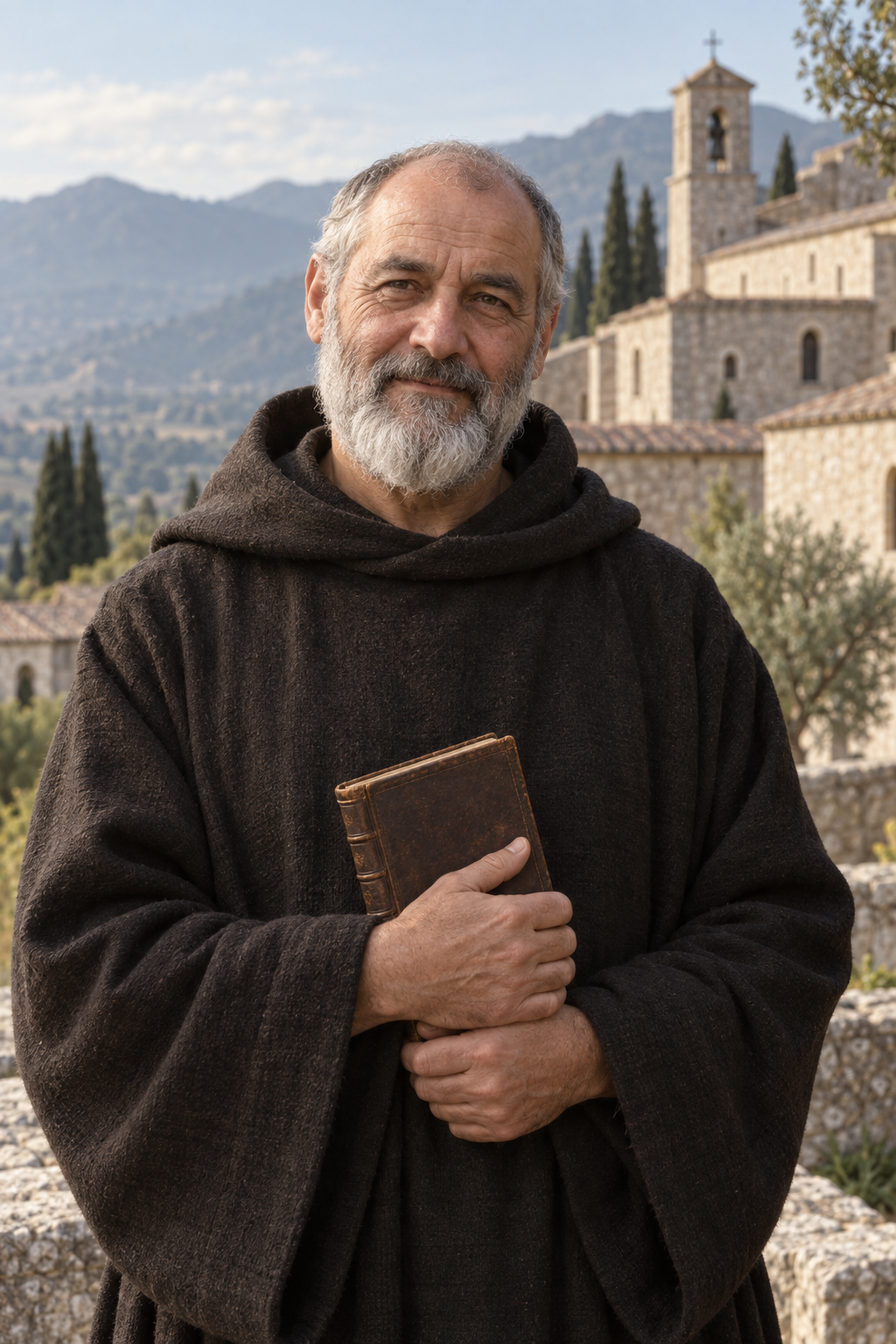
About Benedict of Nursia
Benedict of Nursia gave communities of monks a practical pattern for sharing their lives. His Rule brought prayer, reading, work, and responsibility for other people into the same daily order. It belongs to a much older monastic tradition, rather than marking the beginning of Christian monastic life. The Benedictine account of the text identifies earlier rules, especially the anonymous Rule of the Master, among its sources. Benedict's achievement lay in shaping that inheritance into guidance for a community and its leader.
The received chronology places his birth around 480 at Nursia, in Italy. Benedict XVI's account describes his departure from studies in Rome and his retreat to Subiaco before the establishment of a community at Monte Cassino. It places the move to Monte Cassino in 529. These broad stages give the outline of the life, but the narrative depends heavily on a religious biography written after Benedict's lifetime.
Gregory the Great devoted the second book of his Dialogues to Benedict. He names four disciples as informants and acknowledges that he could not learn every part of the life. According to this account, the monk Romanus supplied Benedict with food during his hidden life in a cave.
Gregory also tells of Benedict's sister Scholastica, who visited him for religious conversation. In one episode, a storm follows her prayer and prevents her brother from leaving when he wishes. Gregory uses the story to make a point about love and prayer. The storm's miraculous cause is part of the hagiographic narrative, not an independently established weather event.
The Rule provides a different kind of evidence: a surviving text of instructions, rather than a collection of remembered episodes. Its prologue and seventy-three chapters address both spiritual formation and ordinary household arrangements. Benedict wrote in Latin, although his own manuscript has not survived. The text's transmission through later copies and translations is therefore part of its history.
Leadership begins with listening in chapter 3. For important business, the abbot is to gather the community and hear its advice before deciding. Younger members are included because insight need not belong only to senior monks. The final decision remains the abbot's, and the community is expected to accept it. This is consultation within a demanding hierarchy, with the leader also accountable for his decisions. Benedict's instruction gives concrete shape to humility: the person with authority must make room for someone else's judgment before exercising his own.
Care for illness receives equally specific attention. Chapter 36 requires a room and an attentive caregiver for sick members of the community. Food and bathing restrictions can be relaxed to support recovery. Responsibility for preventing neglect rests with the superior, even when another person carries out the care. The same Rule contains severe disciplinary measures, including corporal punishment in chapter 30. Its provisions for tenderness and its harsh punishments both belong to the text; a description of its moderation should not conceal that difficulty.
Work and reading are organized through an actual timetable in chapter 48. The distribution of hours changes with the season, and harvest work may be necessary when a community is poor. Benedict treats that labor as compatible with monastic life, while also requiring moderation. The provision for rest includes consideration for others: a person who chooses to read should do so quietly. These details make the daily order more than an attractive slogan about prayer and work. They describe competing needs that have to be accommodated within a household.
Hospitality likewise requires arrangements, not only a generous intention. Chapter 53 instructs the community to welcome arriving guests as Christ. Prayer, a greeting, food, and the washing of feet form part of the reception it describes. Poor visitors and pilgrims receive particular attention, because the wealthy can already attract honor through their position. The practical instructions include a separate kitchen for the abbot and guests, so that arrivals need not disrupt the community's arrangements. Care for visitors and care for residents are responsibilities to be held together.
Near its end, the Rule returns to relationships within the community. Chapter 72 asks members to bear one another's bodily weaknesses and difficult traits with patience. It directs them toward another person's benefit rather than their own advantage. Chapter 73 then describes the Rule as a beginning and directs readers to Scripture and earlier monastic teachers for further formation. Benedict's concluding instructions therefore place his own book within a continuing course of learning. The community is given a framework for growth, rather than a claim that reading one handbook completes its work.
The traditional death date is 21 March 547. Gregory portrays Benedict dying in prayer with disciples supporting him; the circumstances remain part of that later account.
In 1964, Paul VI proclaimed him patron of Europe. The recognition points to the later influence of a life whose most durable expression is a text attentive to prayer and the practical needs of a community.
Wondering how to weigh the stories and sources? Learn how to read a saint biography.
Explore similar vocations
Prayers for Benedict of Nursia
St. Benedict Medal Prayer
Crux sacra sit mihi lux. Non draco sit mihi dux.
Vade retro Satana. Nunquam suade mihi vana. Sunt mala quae libas. Ipse venena bibas.
May the holy Cross be my light. May the dragon never be my guide. Begone, Satan. Never tempt me with vanities. What you offer is evil. Drink your own poison.