Biography
Benildus Romançon
About Benildus Romançon
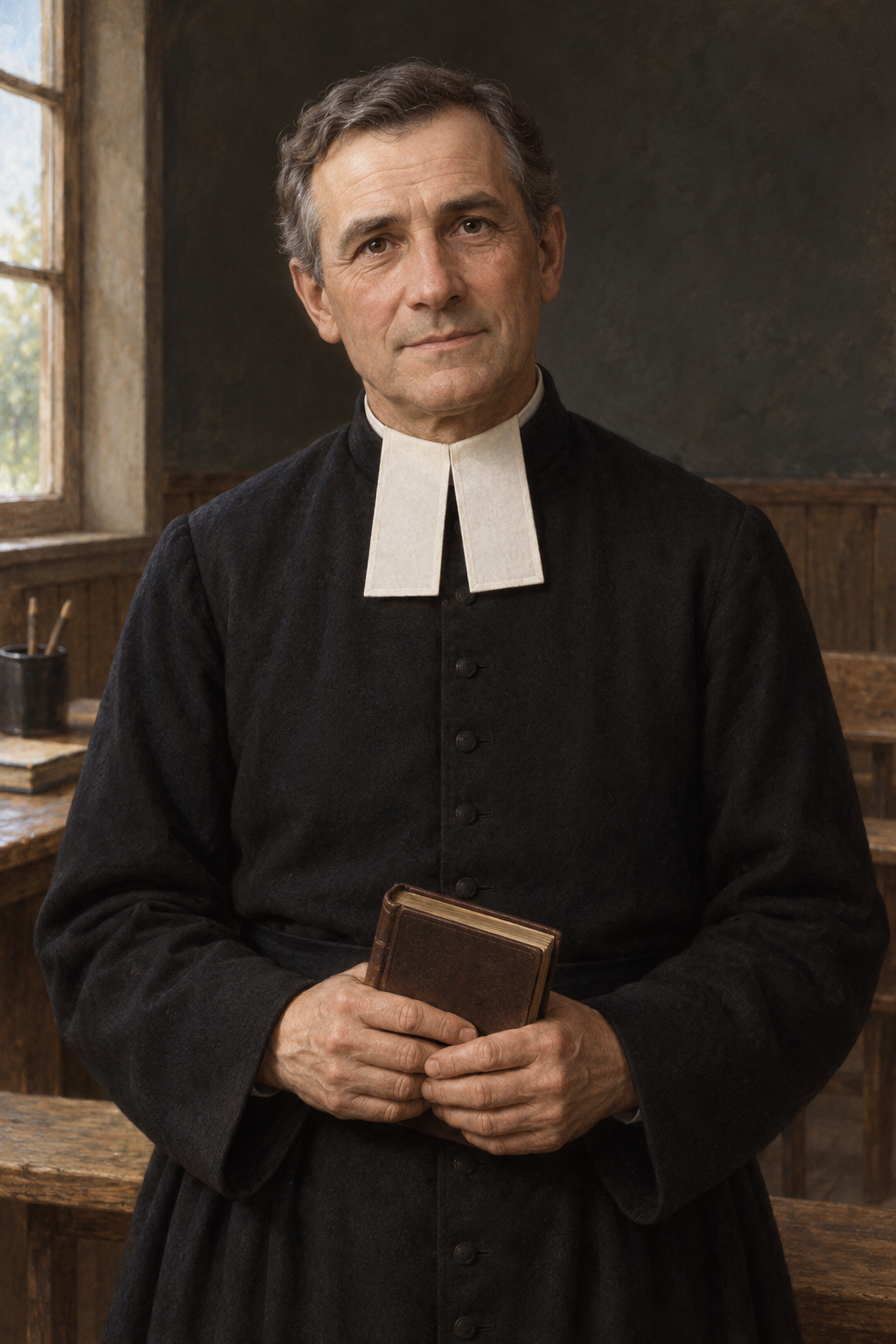
Benildus Romançon was born as Pierre Romançon at Thuret, France, on 14 June 1805. His path into the Brothers of the Christian Schools began while he was still young. The institute remembers his early ability as a pupil and his work as a substitute teacher before he entered the novitiate. He taught in the Brothers’ elementary schools from 1821 to 1841, then became director of the school at Saugues. There he taught village boys and pupils from neighbouring farms, including older beginners. Evening classes offered adults an opportunity to learn, while extra help supported pupils who struggled.
The canonization letter also acknowledges severe school punishments, defending them through the standards of his time and his intention to correct pupils. This qualification belongs beside the accounts of kindness; the letter’s defence does not make those methods suitable for imitation today.
His work at Saugues continued until his death on 13 August 1862. The school formed the lasting setting of his ministry, rather than a brief assignment followed by a more prominent office.
When Pius XII addressed the pilgrims gathered for his beatification in April 1948, he urged them to study the inner purpose of a saint’s life. A life without striking episodes could be overlooked just as easily as a dramatic one could leave its readers dazzled. For the pope, Benildus offered an example that could be imitated through steady attention to ordinary duties. Teaching placed that example in public view: pupils, families and local authorities encountered the brother through the repeated demands of his work. The address treated patience and perseverance as part of a demanding vocation, not as evidence that everyday life was easy.
Pius XII distinguished imitation from copying a saint’s outward actions. His address asked listeners to understand the purpose beneath the practices described in a biography. It also challenged the assumption that a quiet religious life meant comfort or freedom from effort. In his reading, repeated obligations could demand sustained generosity without producing memorable public events. That interpretation matters for a teacher whose reputation rested on returning to the same work with successive pupils.
Paul VI returned to that understanding at the canonization in 1967. His homily described holiness as a life directed towards God and explored how personal freedom could work together with religious discipline. Benildus’s vocation as an elementary teacher was central to the address. The pope honoured education as work requiring wisdom, self-giving and love, and encouraged the Brothers to give themselves fully to their schools. This was a recognition of the spiritual significance of an ordinary classroom and the responsibility carried by the person who teaches there.
The homily’s discussion of freedom gives that praise a more specific meaning. Paul VI placed personal initiative and moral effort beside the external rule of a religious community. He saw their agreement as a kind of harmony in the person, and read Benildus’s fidelity through that framework. His argument honours a chosen vocation whose discipline shaped daily action. It does not supply a separate record of classroom events or establish that every remembered practice should be repeated.
The canonization letter records an unusual detail of the ceremony. Paul VI was prevented by illness from attending, and Cardinal Arcadio Maria Larraona pronounced the canonization formula in his name and with his authority. The pope’s written address was read by Giovanni Benelli. The letter confirmed Benildus’s inclusion among the saints and provided for his annual remembrance on 13 August. It places the public recognition of his life within the Church’s formal process, while the teaching that filled his days remains the clearest thread connecting his vocation and his remembrance.
The same letter distinguishes successive stages in the cause: diocesan inquiries, examination of virtues, beatification and renewed proceedings towards canonization. It records the Church’s judgments about healings as part of that process. Those judgments are religious findings reported by the document, rather than independent medical conclusions offered here.
Saugues preserves his memory through a diorama as well as through worship. The town’s account credits Brother Phelippeau with conceiving the presentation and Lucien Gires with making it. Other members of the Gires family contributed the scenery, metalwork and costumes. The display was inaugurated in 1962, before the canonization. Its sequence of animated scenes and recorded narration sets Benildus’s story among familiar landscapes and the lives of local people. This is a later artistic interpretation, rather than a surviving view of his classroom.
The building gives that remembrance a connection with the place where he taught. According to the municipality, it served as the communal school during his years at Saugues, later became a gendarmerie and then returned to educational use. The diorama moved there in 1973 with help from Brother Jean-Pierre Sabadel. The town describes its subsequent use for welcoming pilgrims. These changing uses help explain how an ordinary school building became a setting for telling a local teacher’s life.
Wondering how to weigh the stories and sources? Learn how to read a saint biography.