Biography
Bernward of Hildesheim
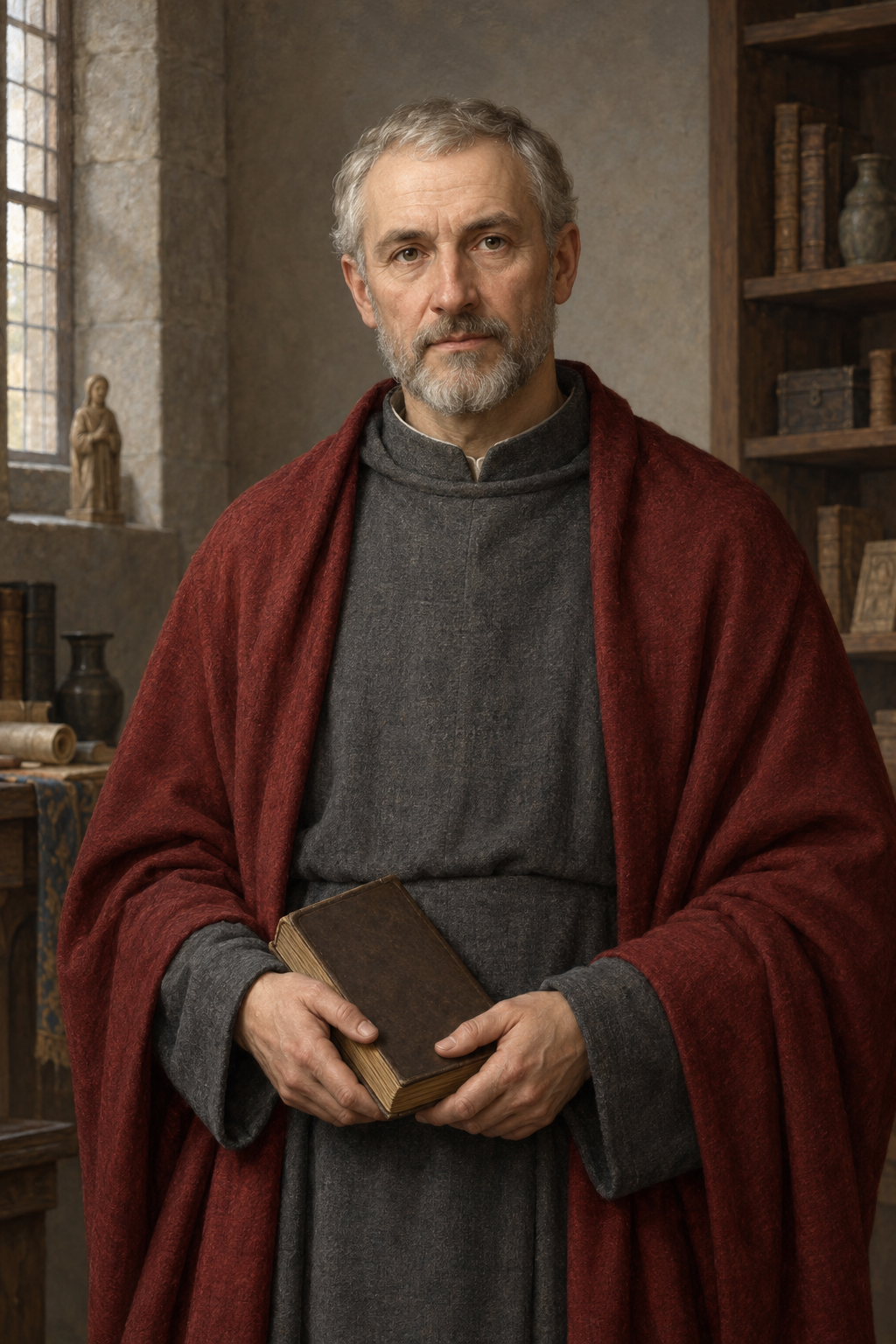
About Bernward of Hildesheim
Bernward of Hildesheim was a bishop whose responsibilities joined teaching, government and the care of a diocese. Educated at Hildesheim’s cathedral school, he served at the royal court and became a tutor to Otto III before his appointment as bishop in 993. His work included church discipline, synods and support for monastic life. He died at Hildesheim on 20 November 1022.
His office also involved armed power and jurisdiction. Wilhelm Berges’s account describes his fortification of Hildesheim, participation in royal campaigns around Rome and Tivoli and later in Flanders, and defence of his claims against Mainz over Gandersheim. Service at court did not mean agreement with every royal policy. Berges links his growing reserve toward Otto III’s plans and hesitation over Henry II’s accession to a Saxon political outlook. These responsibilities belong beside his pastoral and artistic work in an account of his episcopate.
St. Michael’s gives a substantial form to his monastic patronage. UNESCO’s architectural account identifies a church arranged around opposing eastern and western ends, each with a choir and projecting transept. Towers mark the crossings, while smaller round turrets articulate the transept ends. Inside the nave, columns alternate with square pillars. The account emphasizes the balance of the plan and the influence of this arrangement on later medieval building. These features describe the church associated with Bernward’s foundation, without requiring the claim that every design decision was personally his.
Its survival also has a history. The World Heritage assessment records severe wartime destruction and substantial restoration, while distinguishing the preservation of major design features from untouched medieval fabric. Furnishings were taken to safety, and later reconstruction sought the medieval appearance through research. The church seen today therefore carries evidence both of Bernward’s foundation and of the work of later custodians. It should not be treated as a completely unaltered setting from his lifetime. The cathedral and St. Michael’s entered the World Heritage List together in 1985.
His memory is also carried by works of art. The cathedral’s account of the bronze doors describes a sequence of sixteen biblical scenes, setting events from the Old and New Testaments opposite one another. The doors turn an entrance into a place for reflecting on the Christian story of salvation. The cathedral identifies Bernward as their commissioner; that role should be distinguished from claiming that he personally performed every part of their manufacture.
The bronze Christ column gives that story a different form. Its scenes rise in a spiral through the public life of Jesus. The cathedral’s account places its origin in Bernward’s foundation at St. Michael and describes later changes to its setting and upper parts. The present capital is a nineteenth-century replacement. These changes belong to the history of the object: what survives today combines a medieval commission with centuries of preservation and alteration.
Christine Wulf’s study examines inscriptions as evidence for the way Bernward understood his work. She relates his gifts and the buildings he supported to the desire for lasting remembrance and prayer. These texts have a different history from the surviving Life. Wulf also considers the language of the tomb inscription and disputes a reading that makes Bernward simply a person who rejected the world. Her interpretation holds together humility, human limitation and confidence in the gifts he believed he had received. This remains a scholarly reading of the evidence, including objects whose dating and interpretation have been debated.
The Life itself needs the same attention to transmission. The Geschichtsquellen repertory distinguishes material concerned with the dispute over Gandersheim from the biography prepared for Bernward’s recognition as a saint. It records later revisions that gave greater prominence to miracles and devotion, as well as shorter forms of the work. The surviving text is therefore not one unchanged account written at a single moment. Its development connects the memory of a bishop with the interests of the communities that preserved and used it. That distinction helps explain why a detailed biography can retain valuable early material while also expressing later purposes.
The repertory describes a beginning during Bernward’s lifetime, followed by completion after his death, as one scholarly reconstruction of the earliest work. It separates that stage from the version prepared for the canonization proceedings of 1192 and a substantially revised text dedicated to a later bishop, Siegfried II. Some shorter versions subsequently circulated with copies of the Golden Legend. That record of revision makes the date and purpose of a particular version important when assessing its testimony.
Recognition of Bernward’s cult developed in stages. Wulf distinguishes the decision at Rome in December 1192, its documentation in January 1193 and the elevation of the relics in August 1194. These stages help explain the different dates attached to his recognition. In the Diocese of Hildesheim’s liturgical directory, 20 November remains his feast. His remembrance continues through the observance and the buildings and objects associated with his work.
Wondering how to weigh the stories and sources? Learn how to read a saint biography.