Saint profile
Cuthbert of Lindisfarne
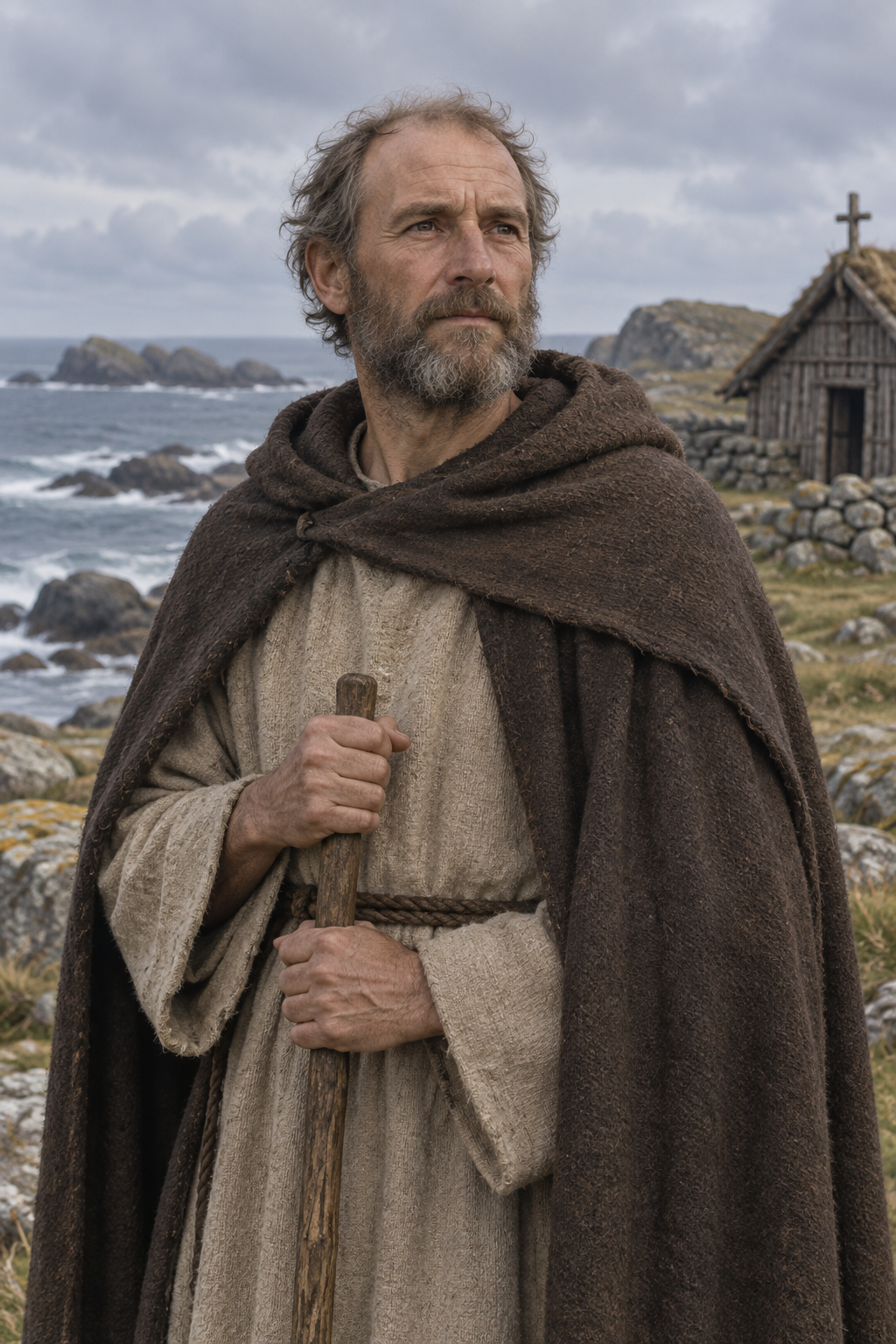
About Cuthbert of Lindisfarne
Cuthbert lived in seventh-century Northumbria, where monasteries served as places of worship, learning, hospitality, and mission. The earliest dedicated account of him was written by an anonymous Lindisfarne monk between 699 and 705, little more than a decade after his death. Bede later produced verse and prose Lives. These witnesses are unusually early, but they were written to present a saint and include miracles as part of that purpose. The anonymous Life also records miracles, death, translation, and early cult.
The two dedicated prose Lives must also be compared rather than stacked as if they were independent biographies. Sally Shockro shows that Bede retained much of the anonymous Life's information and sequence while reshaping its portrait. Scholars have read his changes as serving both Lindisfarne's community and a broader ideal of the monk-bishop. This dependence makes repeated stories useful evidence for reception, but repetition alone does not verify their miraculous content.
The early Lives place Cuthbert at Melrose as a young man. Bede says that a vision on the night of Aidan's death moved him toward monastic life. The monastic entry is credible within the early career; the vision is a traditional interpretation. Bede then describes pastoral journeys from Melrose and a period at Ripon before Cuthbert returned to Melrose.
Eata later brought Cuthbert to Lindisfarne. There he acted as prior and worked to establish a shared discipline despite resistance within the community. Bede's portrait emphasizes patience rather than a single dramatic victory. English Heritage places this work within Lindisfarne's mixed monastic and episcopal history and notes the community's movement toward Roman practices.
Cuthbert eventually withdrew first near Lindisfarne and then to the more isolated Farne Island. The prose Life describes his cell and adds stories of spiritual combat, providential materials, birds, and healings. Those episodes are early traditions, not independent observations of supernatural events. The hermitage itself is consistently rooted in the early record.
Bede's Ecclesiastical History reports that Cuthbert was chosen for episcopal office and consecrated in 685. Although initially connected with Hexham, he exchanged sees with Eata and became bishop of Lindisfarne. The history remembers him continuing pastoral travel while keeping an ascetic manner of life. After about two years he returned to Farne, where he died on March 20, 687. His body was taken to Lindisfarne and buried in the church.
The concentration of writing soon after Cuthbert's death is itself historical evidence for an organized cult. A modern scholarly history notes that the anonymous Life and Bede's three treatments were all available to Cuthbert's community by about 730. Those texts did more than preserve memories: they helped the community interpret its origins, claims, and identity. Reading them in that institutional setting explains both their value and their limits.
The community opened Cuthbert's grave eleven years later and reported his body undecayed. That claim, already present in the early cult, helped transform his burial into a major shrine. English Heritage documents the later movement of the community and relics to Chester-le-Street and then Durham. These translations belong to the history of Cuthbert's cult after his death; they are not episodes from his lifetime.
Objects from the tomb supply a different kind of witness. Durham Cathedral dates the surviving carved oak coffin to 698, when the community raised Cuthbert's remains. Its fragments bear Christian figures and inscriptions in Roman letters and runes. The coffin confirms the scale and artistry of the early commemoration, but it cannot prove the Life's report that the body was incorrupt. Nor can every object later found in the tomb be assumed to have belonged to Cuthbert while he lived.
The small Gospel of John associated with the tomb is an early eighth-century manuscript with its original binding. The British Library catalogue carefully distinguishes the object from the later records: a thirteenth-century note and Durham accounts connect it with the coffin's opening in 1104. The book therefore illuminates the material history of the shrine, while its placement with Cuthbert cannot be narrated as an event he personally directed.
Durham Cathedral remains the site of Cuthbert's shrine. Its own history labels the stopped cart, dream of Dun Holm, and guiding milkmaid as legend. Those details come from later Durham memory and should not be folded into Bede's seventh-century account. The stable core is narrower: Cuthbert was formed in Northumbrian monastic life, served Lindisfarne, sought solitude on Farne, briefly held episcopal office, and died there in 687. His March 20 commemoration preserves the death date reported by the early sources.
The Church of England calendar calls Cuthbert Bishop of Lindisfarne and Missionary and observes him on March 20. It permits September 4 as an alternative, the date on which Durham now marks the Translation of his relics. Keeping those observances distinct preserves the difference between the anniversary of his death and the later history of his shrine.