Biography
Damien of Molokai
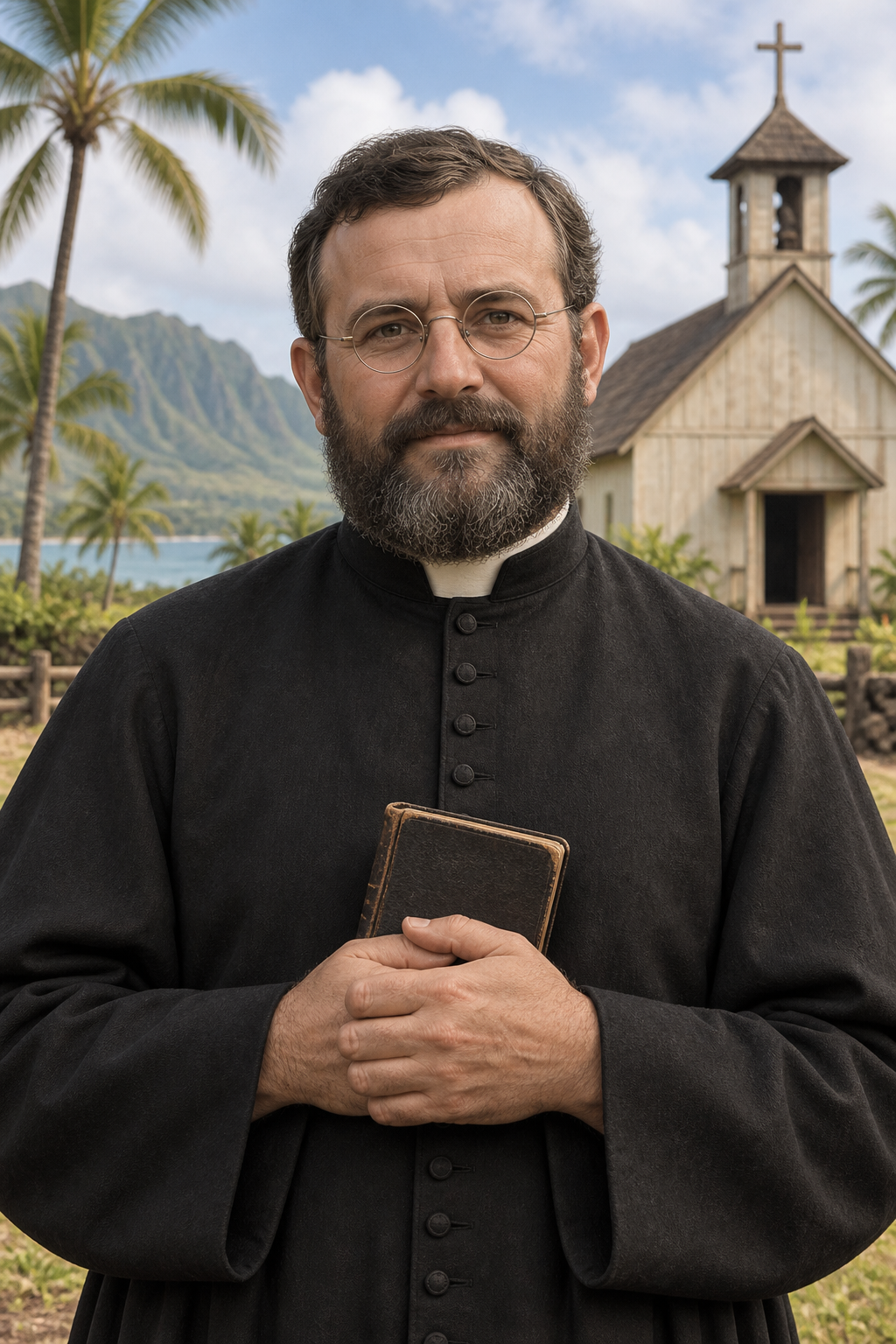
About Damien of Molokai
Damien of Molokai began life as Joseph De Veuster, a Belgian who entered the Congregation of the Sacred Hearts as a young man. His journey to Hawaii was followed by a period of learning Hawaiian before his ordination in Honolulu in 1864. He then spent nearly nine years ministering in Puna, Kohala and Hamakua on the island of Hawaii. There he encountered the suffering caused when people with leprosy were separated from their families, before making the move that would define his public memory.
The opportunity came in 1873, when Bishop Louis Maigret sought priests willing to serve the isolated settlement on Molokai. The bishop would not simply order a priest to accept such a dangerous posting. Four volunteered, and Damien was the first to go. What began as a shared undertaking became a lasting commitment when he asked to remain with the people entrusted to his care.
The settlement existed because the Hawaiian government had adopted compulsory isolation for people with the disease. The first group was sent there in 1866, to a peninsula separated from the rest of Molokai by steep cliffs and the sea. Officials expected patients to support themselves in conditions that made this difficult. Kalawao, on the windward side, was distinct from the later settlement of Kalaupapa. These were communities shaped by an exclusionary policy, not merely a remote destination chosen by a missionary.
Damien did not enter a place without affection, faith or capable helpers. Hawaiian relatives and friends had already accompanied patients as kokua, providing practical assistance and sustaining relationships across forced separation. They carried water and supplies, gathered fuel and tended livestock. Religious workers of several traditions also served the community. Among them was Jonathan Napela, a Mormon who accompanied his wife Kitty. Remembering these people changes the story from a solitary rescue into a history of cooperation under severe constraints.
Damien's work joined religious ministry to the ordinary requirements of a livable community. With assistance from patients, he developed housing and a water system, planted trees and helped establish schools, bands and choirs. He cared for living people and buried those who died, while enlarging the church of Saint Philomena. He also pressed government and church authorities for resources. His service therefore included both direct care and persistent requests to institutions that could improve conditions.
His priestly responsibilities remained central to this practical work. The Capitol biography recalls daily Mass and the hearing of confessions alongside dressing wounds, making coffins and digging graves. It also records the construction of six chapels by 1875. These activities belonged to the same ministry: worship did not remove the need for shelter and burial, and building work did not replace the religious duties for which he had originally come.
Joseph Dutton, who joined the settlement in 1886, later described improvements as a gradual process rather than an achievement completed at once. His account traces the boys' home from older cabins to larger buildings and formal government recognition. The home cared for orphaned boys and men unable to care for themselves, giving its residents a place within the settlement where their daily needs could be met. As a participant, Dutton offers an important perspective on the labor and cooperation behind that development. His description also leaves room for changing conditions and additional workers, instead of attributing every improvement to a single person.
Damien welcomed assistance across religious differences. The Vatican biography names Lutheran, Anglican, Buddhist and freethinking friends among those with whom he worked. His commitment to Catholic ministry did not prevent him from accepting help offered through other convictions.
He eventually developed the disease himself, but continued his work until shortly before his death. The center's account preserves his understanding of the illness as a cross accepted within his vocation, not a reason to abandon those beside him.
Damien died at Kalawao on 15 April 1889, aged forty-nine. He was buried beside Saint Philomena. His remains were later returned to Belgium, while a relic of his hand was brought back to Molokai.
His reputation was contested even after his death. Robert Louis Stevenson answered a hostile account in an open letter, drawing on conversations and observations from a visit made after Damien had died. Stevenson acknowledged that he had never known him personally. He did not describe an invariably agreeable man: the testimony he collected included friction, stubbornness and the ability to accept correction. The defense is powerful partly because it distinguishes difficult personal qualities from a sustained willingness to serve, rather than requiring a faultless hero.
When Benedict XVI canonized Damien in 2009, he emphasized the choice to approach suffering despite fear and repugnance. Benedict called for charity expressed through personal presence as well as generosity. It identifies what made Damien's own contribution enduring: remaining close to people whom public policy had placed at a distance, and allowing that closeness to shape the rest of his life.
Wondering how to weigh the stories and sources? Learn how to read a saint biography.
Explore similar vocations
Prayers for Damien of Molokai
Damien of Molokai: sourced prayer excerpt
Teach us to give our lives with joy like yours,