Biography
Didacus of Alcalá
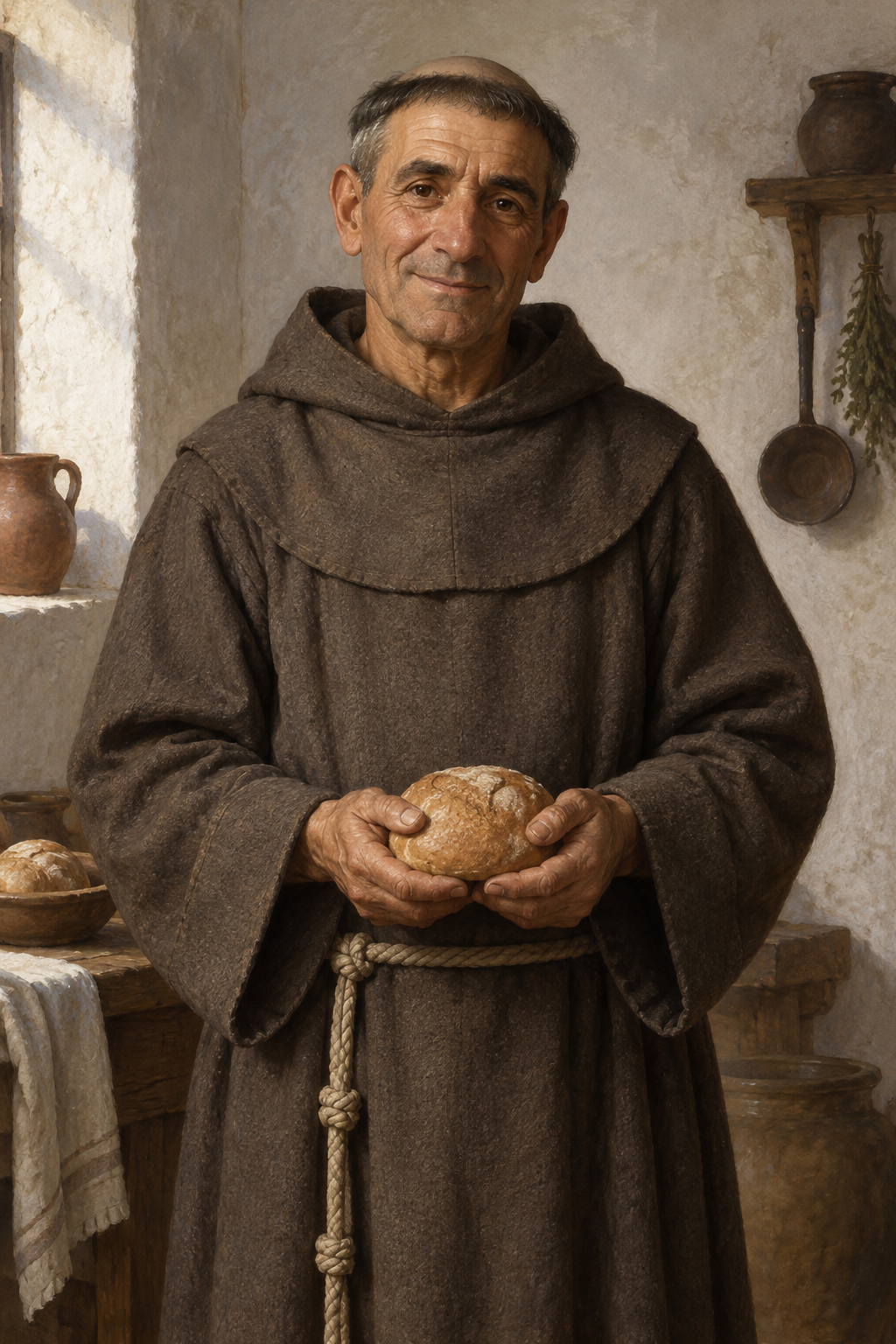
About Didacus of Alcalá
Didacus of Alcalá, better known in Spanish as Diego, was a Franciscan lay brother remembered for caring for sick people and sharing food with the poor. His vocation took him from southern Spain to the Canary Islands and Rome before his final years at Alcalá de Henares. He was not a priest. The Catholic Encyclopedia describes him as a brother whose practical care for others accompanied a life of prayer.
He came from San Nicolás del Puerto, near Seville. Accounts of his early years describe a period under the direction of a hermit before he entered the Franciscan community at Arruzafa, near Córdoba. The date of his birth is uncertain. These beginnings place him among the brothers who entered religious life through penitence, manual work and service rather than through a clerical career.
The Franciscan writer Tomás Gálvez describes gardening and making small household objects as part of his early livelihood. After joining the Observant friars, Diego worked in ordinary community roles, including tending gardens and receiving people at the door. The account presents these duties as a means of sharing what he had with those who needed help.
He was sent to the Canary Islands and became guardian of the community on Fuerteventura. Appointment as a superior was unusual for a lay brother, and the Catholic Encyclopedia emphasizes the trust his fellow religious placed in his judgment. His responsibilities extended beyond his own daily work to the care of the community entrusted to him.
Gálvez’s account places his island ministry within the tensions of Spanish conquest and describes him defending Indigenous people against the greed of colonists. It also recounts his return to Spain and journey to Rome in 1450 for the jubilee and the canonization of Bernardino of Siena. When illness spread among the assembled friars, he stayed to care for the sick at Aracoeli.
His final home was the newly founded convent of Santa María de Jesús in Alcalá. Historian Ramón González Navarro records the opening of its church in 1456 and Diego’s arrival with the community. He died there on November 12, 1463. Veneration of his remains followed soon after his death, and the convent became the centre of a devotion that would eventually attract royal attention.
The most influential royal association concerned Philip II’s son Carlos. González Navarro describes the prince’s grave illness in 1562, the bringing of Diego’s remains to his room, and the recovery attributed to the friar’s intercession. That religious interpretation helped advance the cause for canonization. The process opened in 1563 with support from the king and several institutions of Alcalá.
Sixtus V canonized Diego in 1588. The opening of the canonization bull, Rex regum, explained the choice in terms of Christian humility: someone without learning, wealth or worldly rank could become an example of holiness. It praised his freely chosen poverty and life as a lay brother. Its language belongs to the Church’s theological judgment of his life and the miracles attributed to him.
The bull also placed his example within a wider reading of Christian history, recalling the apostles and martyrs as people through whom God worked without ordinary worldly advantages. In that setting, Diego’s modest position was central to the argument for honouring him. The document praised the influence of his example on others, rather than presenting academic achievement or social standing as the measure of his life.
Artists made his generosity visible through stories about food. Zurbarán’s painting in the Museo Lázaro Galdiano shows roses gathered in the front of his habit, recalling the tradition that bread intended for the poor became flowers. The museum notes that similar stories were told of other charitable saints. The image expresses a devotional tradition; it is not evidence that the episode was independently witnessed.
Murillo chose a different scene: Diego distributing food from a pot that, in the story, does not run empty. The Royal Academy of San Fernando’s catalogue describes the women, children and older people surrounding him. Painted around 1646 for the Franciscan convent in Seville, the work made care for hungry neighbours the central action of his remembered life.
His memory also crossed the Atlantic. Mission San Diego’s account traces the California place-name to Sebastián Vizcaíno’s arrival in 1602. The later mission bore the same dedication. When the Diocese of San Diego was established in 1936, it adopted him as its principal patron. Its November 7 observance differs from the November 13 celebration at Alcalá.
At Alcalá, the annual remembrance still connects prayer with practical charitable help. The diocese’s 2025 report describes veneration at the cathedral and a parish Cáritas collection of food, hygiene supplies and donations for people in need. Small loaves associated with his feast are also distributed. These practices keep his reputation for feeding and welcoming others within the life of the local church.
Wondering how to weigh the stories and sources? Learn how to read a saint biography.