Biography
Domingo Ibáñez de Erquicia
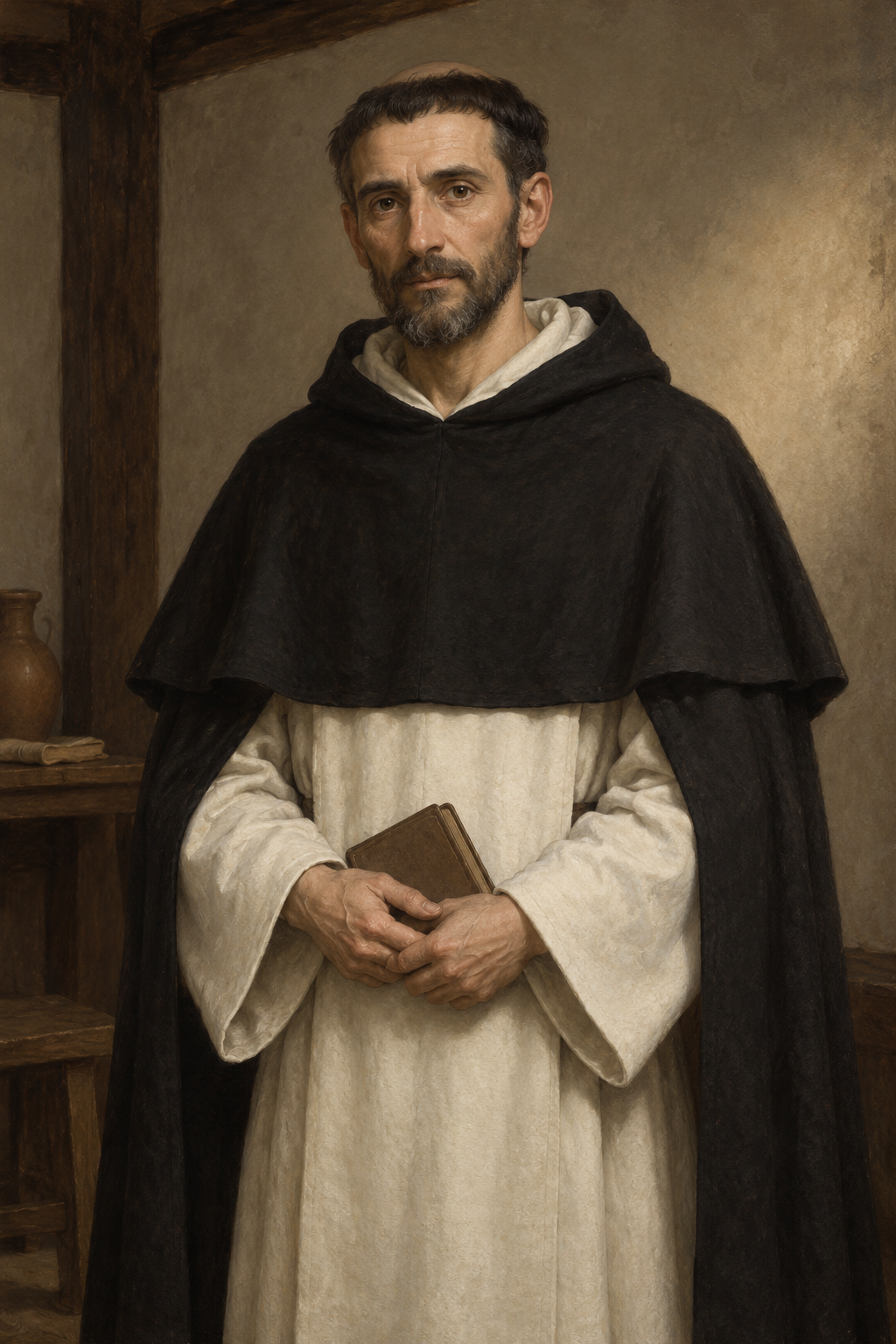
About Domingo Ibáñez de Erquicia
Domingo Ibáñez de Erquicia was a Dominican priest who taught and ministered in the Philippines before spending a decade with persecuted Christians in Japan. The Vatican’s canonization account identifies him as provincial vicar of the mission and remembers both his pastoral leadership and his surviving correspondence. His ministry depended on cooperation with Japanese Christians, including the catechist Francisco Shoyemon.
He was born in 1589 at Régil in Gipuzkoa. A diocesan account names his parents as Martín Ibáñez de Erquicia, a notary, and María Pérez de Lete, and records his baptism at the parish of San Martín on February 8. That is a baptismal date, rather than a securely stated day of birth. He entered the Dominican convent of San Telmo in San Sebastián as a teenager.
The same account dates his taking the habit to June 1604 and his profession to June 1605. He left for the missions in 1610, travelling through Mexico on the long journey to the Philippines. His first assignments were in Pangasinán, followed by service in Manila. The diocesan history also associates him with care at a hospital and work among the Chinese community there.
Jesús González Vallés places his priestly ordination in Manila in 1612 and includes teaching at the college of Santo Tomás among his duties. By the early 1620s the Dominican mission in Japan had lost many of its members, and his superiors sought reinforcements. Domingo was among those sent in 1623. The mission required serving communities whose public practice of Christianity had become dangerous.
The accounts differ on the precise date of his arrival, but agree that his Japanese ministry began in 1623 and soon required concealment. González Vallés describes flight, night journeys and makeshift hiding places while Domingo administered the sacraments and helped Christians who wished to return to their faith. These duties took place without the security of an established public parish.
His own letters make that insecurity concrete. In extracts addressed to his provincial, Miguel Ruiz, in 1624, he describes learning Japanese while the need to hear confessions was already urgent. He and his companions moved between houses after dark, visited the sick and gathered believers for confession and Mass. The people who sheltered them restricted visitors because their own households were at risk.
The journeys could involve winter rain, snow, mud and painful walking over stones. Yet he also wrote that the devotion of the Christians gave him unusual contentment. His request to the provincial was practical: continue sending help, since the missionaries already present might soon be killed.
A letter to his father in October 1630 shows another side of that vocation. Unable to comfort him in person, Domingo promised remembrance in prayer and at Mass. He asked his sister to pray for him and sent greetings to relatives and friends, fearing this might be his final letter.
The Dominican archive preserves evidence of the correspondence’s later transmission. Its catalogue describes copies made by Justo Cuervo in 1915–1916, including letters and reports dated in 1624, 1625 and 1630. These are later copies, not manuscripts freshly written by Domingo at the moment they entered that collection. The catalogue helps trace the documentary record without replacing the letters themselves.
Domingo was eventually arrested and died at Nagasaki on August 14, 1633. John Paul II’s canonization decree identifies the method of execution as suspension over a pit and names Francisco Shoyemon as his catechist and companion. The decree places their deaths within the suppression of Christianity under Tokugawa Iemitsu. It recognizes their endurance as martyrdom for the faith.
The same decree records early investigations at Manila and Macao in 1636–1637. Recovery of the records in the twentieth century helped reopen the cause. Domingo and fifteen companions were beatified in Manila on February 18, 1981, and canonized on October 18, 1987. They belonged to several countries and had died in different years; their shared canonization did not make them one travelling party.
At the canonization, John Paul II emphasized the contribution of lay catechists alongside ordained missionaries. He presented the group’s witness as a call to Christian service and holiness, and closed by associating evangelization with love and peace. The Dominican calendar remembers Domingo and his companions on September 28.
Wondering how to weigh the stories and sources? Learn how to read a saint biography.