Biography
Edith Stein
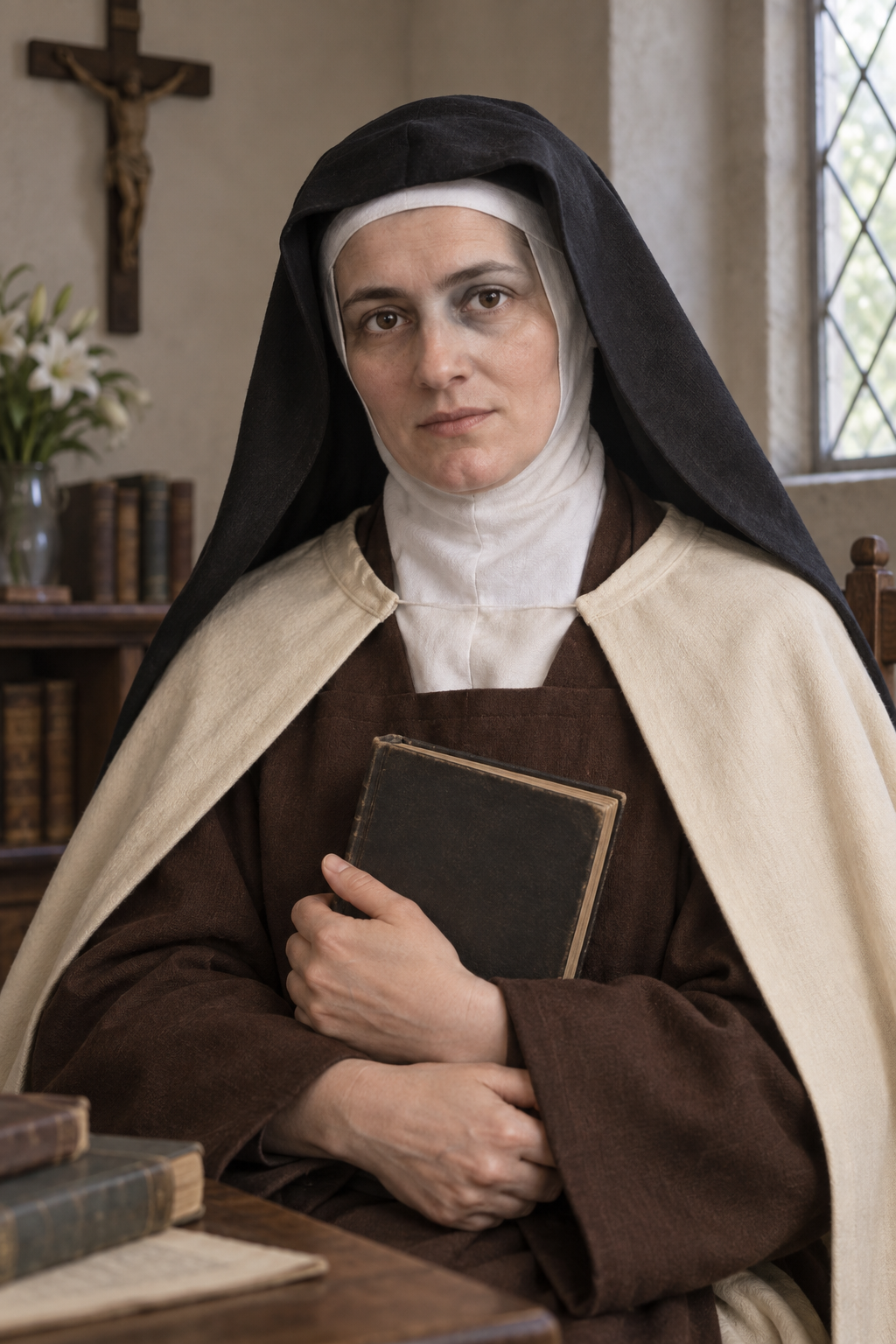
About Edith Stein
Edith Stein was born into a Jewish family in Breslau, then in Prussia and now Wrocław in Poland. Her studies led her to Göttingen and the philosophical circle around Edmund Husserl. She completed her doctorate in 1916 and subsequently worked as Husserl's assistant, helping prepare manuscripts for publication. This was demanding scholarly work, although the relationship did not give her the intellectual exchange she wanted.
Empathy became an important subject of her philosophical research. She examined how another person's experience can become intelligible without becoming one's own experience. Understanding another person did not mean dissolving the difference between two people. Her attention to embodied persons gives this work a reach beyond an abstract account of minds, while preserving the limits of what anyone can know from another's standpoint.
Her student years also included service away from the university. In 1915 she served from April to September in a German Red Cross hospital at Mährisch Weißkirchen, taking up hospital work away from her philosophical studies. Her duties included work with patients suffering from typhus and assistance in an operating theatre.
Her path toward Catholicism unfolded through encounters and reading rather than a single childhood certainty. She had ceased praying as an adolescent. In 1921 she read Teresa of Avila's autobiography while staying with friends, and the book became decisive in her conversion. Her new religious commitment did not eliminate the difficulty this choice brought to her Jewish family, especially her mother. The story belongs to the history of a particular person's search, not to a judgment against the tradition in which she was raised.
Stein was baptized at Bergzabern on 1 January 1922. She taught at the Dominican school of Saint Magdalena in Speyer, translated theological works and lectured on education and women's participation in professional life. Her later appointment in Münster extended that educational work. Teaching and scholarship were not abandoned when she became Catholic: they remained important forms of service before she entered Carmel. Her interests included the responsibilities and possibilities of women whose lives would not follow a single pattern.
In the spring of 1933, Nazi pressure made her teaching position untenable. She also wrote to Pope Pius XI about the persecution of Jews. The surviving letter is undated; its editor places it probably in April. She had considered traveling to Rome, but abandoned that plan when a private papal audience seemed unlikely.
Stein described the loss of livelihoods, civil standing and security, and the despair produced by attacks on Jewish people. She asked the Church to speak against violence and the misuse of Christ's name. Her appeal also challenged the elevation of race and state power into objects of reverence. The letter shows her addressing the danger directly, as a Catholic who identified herself with the Jewish people, rather than treating persecution as someone else's concern.
She entered the Cologne Carmel in October 1933 and received the religious name Teresa Benedicta of the Cross the following year. Her final profession followed in 1938. At the end of that year she moved to the Carmel at Echt in the Netherlands. The move changed her place of residence but could not ultimately protect her from the reach of Nazi persecution.
Within religious life she continued writing. Her work included philosophical inquiry and a study of John of the Cross. She also recorded memories of her Jewish family, preserving a personal account against the hostile stereotypes being directed at Jews.
On 2 August 1942 she was arrested at Echt with her sister Rosa. After detention at Amersfoort and Westerbork, they were deported to Auschwitz. The museum's account places the transport's arrival on 8 August. Both sisters were murdered in the gas chambers at Birkenau. Accounts commonly give 9 August as Edith's death date, although the Vatican biography qualifies that day as probable. Her death must be remembered within the Nazi murder of Jews, not detached from the people among whom she was targeted.
Her manuscripts survived through the efforts of others. The Cologne archive describes the recovery of manuscripts from Herkenbosch and Echt and their transfer to Leuven, where editorial work made her writings available. That survival matters because it preserves a thinker and author whose work can still be read, rather than leaving only the circumstances of her death. Lucy Gelber reviewed and edited the material, while Sister Amata Neyer later helped bring it back to Cologne for preservation and further study.
When John Paul II named her a co-patroness of Europe in 1999, he emphasized both her Jewish roots and her Christian commitment. His account presented her memory as a summons to religious respect rather than an excuse to erase either part of her history. Her life joins intellectual inquiry, teaching, religious vocation and a direct appeal against persecution. Each deserves attention alongside the catastrophe that ended it.
Wondering how to weigh the stories and sources? Learn how to read a saint biography.
Explore similar vocations
Prayers for Edith Stein
Edith Stein: sourced prayer excerpt
St Teresa Benedicta of the Cross, pray for us! Amen.